One of these is our 2026 Ballpark of the Year
by Joe Mock
Special to USA TODAY Sports
This year’s five new ballparks are special. They offer environments for fans and players that represent the best that Minor League Baseball has to offer.
Part of this was forced on the operators of Minor League teams. When Major League Baseball took over the governance of the Minors in 2021, new facility standards were announced that required expanded and upgraded areas for players.
These new specifications applied to all 119 parks in the Minors. For most cities, this meant costly renovations – with some simply throwing in the towel and electing to allow their team to move elsewhere, always to a park that complied with the new standards.
These requirements greatly impacted the creation of the new ballparks described below. In all instances, player spaces were greatly enhanced. But this also meant upgrades for the fan experience.
Here is our summary of this year’s new parks, in alphabetical order by city. Thanks to David Kronheim of Number Tamer, the guru of sports-attendance analysis, for providing the comparison of crowd sizes.
At the end of the summaries, we’re announcing the winner of the highly coveted 2026 BaseballParks.com/USA TODAY Ballpark of the Year.
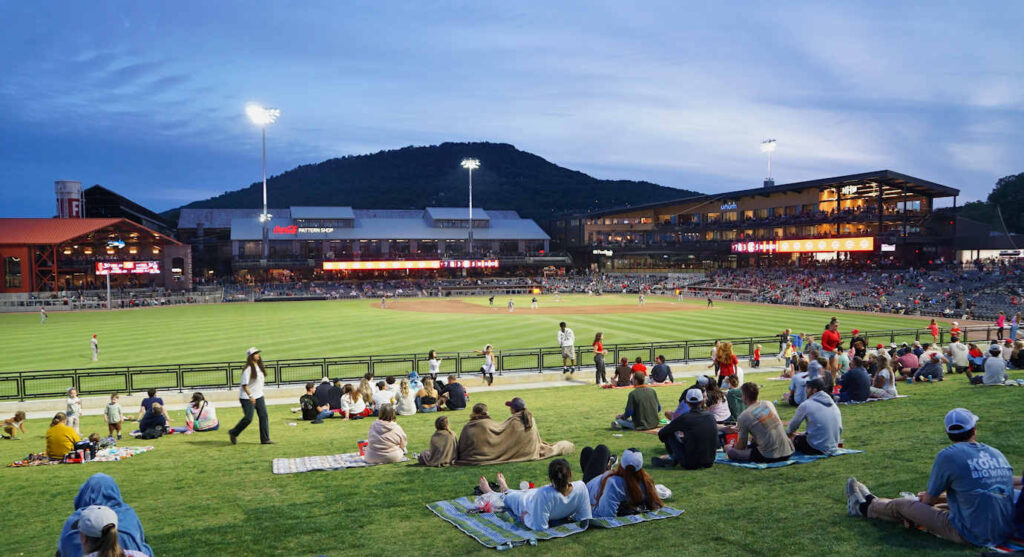
CHATTANOOGA, TENNESSEE
Erlanger Park, home of the Chattanooga Lookouts of the Southern League
Cost to build: $115 million 2026 attendance versus 2025: +52.9%
Our in-depth review: Erlanger Park
The Lookouts franchise can trace its roots back to 1885 in the original Southern League. The team went by several names – Blues, Chatts and Warriors — during its first 15 years, but since 1901, they’ve been known as the Lookouts.
Erlanger Park is only the third new ballpark for the team in the past 96 years. In the preceding 95, fans attending games couldn’t actually see the landmark the team was named for: Lookout Mountain, just to the south of the city’s core.
Also on the south side of Chattanooga was a rusting, abandoned factory, the former home of U.S. Pipe and Wheland Foundry. In building a baseball stadium in the very heart of the site, the Lookouts addressed two issues: how to allow fans to see the famous mountain while attending a game; what to do with the vacant industrial buildings.
Before Jason Freier of Hardball Capital acquired the Lookouts in 2015, he spoke to the owners of the land with the abandoned factory buildings. He wanted to see if it might be viable to build a new ballpark there, as well as a mixed-use development around it.
He moved forward with the acquisition of the team knowing that “there was a place where we thought we could make a real difference. And, you know, that’s what gets a ballpark built, not our needing one.”
Erlanger Park is now the home of the Lookouts. Numerous buildings from the industrial site have been repurposed as lounges and seating areas for fans, creating an environment unique in the sport.
Fans agree, as attendance records are being smashed.
Following the cue from the development work around Freier’s ballpark in Columbia, SC, much more than baseball is planned on the property surrounding Chattanooga’s new stadium. Soon apartments, condos, a hotel and retail establishments will ring the park.
And residents and visitors will enjoy the view of Lookout Mountain.
HILLSBORO, OREGON
Hops Ballpark, home of the Hillsboro Hops of the Northwest League
Cost to build: $120 million 2026 attendance versus 2025: +0.1%
Our in-depth review: Hops Ballpark
When the Portland suburb of Hillsboro successfully attracted a franchise in the Northwest League to move there in 2013, a hastily built ballpark was constructed for the bargain-basement price of $14.3 million. It served the purposes of a team in the short-season league.
When MLB took over the governance of the Minors in 2021, the Northwest League was elevated to full-season High-A status. With the new facility requirements, Hillsboro’s park was found to be sorely lacking. Not only that, it was going to cost more to make it compliant than to build a completely new stadium.
So Hops Ballpark was constructed across the parking lot from the old park, which is still hosting games, now by the Athletes Unlimited Softball League.
The new park has facilities that were never possible in the old place, including a state-of-the-art commercial kitchen, which cranks out arguably the best concession items in Minor League Baseball.
Don’t feel badly for the team because the attendance versus the old park is fairly flat. Hops president K.L. Wombacher puts it like this: “We had to build all the new spaces to meet MLB standards, but because we were going to have to pay for a lot of it, we needed to have additional revenue streams to be able to support the debt.”
The new park has numerous revenue-producing features, so much so that “we’re blowing any numbers out of the water that we’ve ever done as a franchise,” he explains.
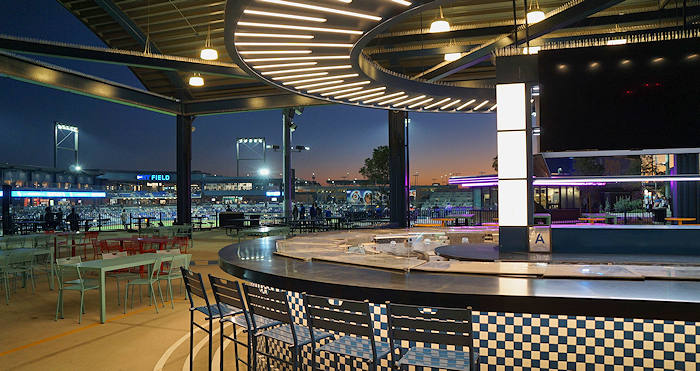
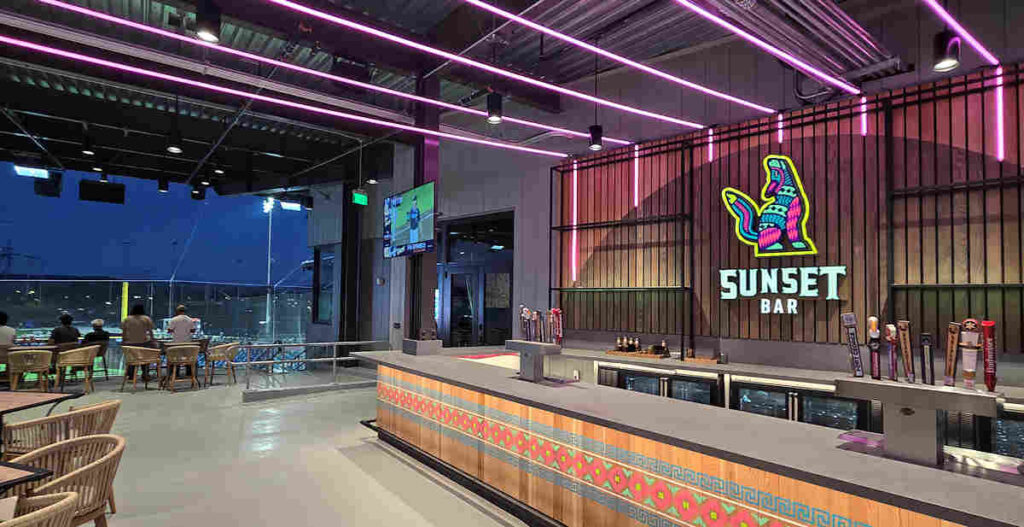
ONTARIO, CALIFORNIA
ONT Field, home of the Ontario Tower Buzzers of the California League
Cost to build: $135 million 2026 attendance versus 2025: +206.1%
Our in-depth review: ONT Field
If this seems like a gargantuan leap in attendance from one year to the next, it is. Note, though, that the comparison is with a lame-duck season in the Cal League in Modesto.
This requires some explanation.
Those pesky MLB standards caused the city of Modesto to admit defeat after seeing what it would cost to make their park compliant. The Seattle Mariners then sold the franchise to Diamond Baseball Holdings, which then played a fascinating game of musical chairs.
DBH moved the Modesto franchise to San Bernadino, while the team there and its affiliation with the Angels were moved to Rancho Cucamonga. The team in Rancho was then transferred to Ontario into a brand-new ballpark. And very importantly, the affiliation with the Dodgers followed the team to its new home.
All of this was made possible because DBH owns all three franchises involved.
The team now in Ontario is called the Tower Buzzers, as the entire ballpark has an aviation theme. Knowing the high bar that residents of Southern California expect when it comes to entertainment, the team and architects at Populous built in an amazing array of special features into the park – including a mechanical dog that barks in Morse code.
“We had a lot of fun taking things to almost a Disney level,” notes Allan Benavides, the team’s general manager. “We want our fans to experience the ballpark in different ways every time they come to a game.”
The food court in center field is fashioned after a baggage-claim pavilion, while the concourse between left field and center is a runway. A large model of a P-38 fighter plane (used heavily during World War II at Ontario’s nearby airport) hovers above the runway, with special effects when the team hits a home run.
And you’re never far from a “Top Gun” reference, like a mascot named Maverick.
The special touches in the park are too numerous to count – and to see in a single visit. “The city just wanted this to be the best ballpark,” adds Benavides. “Other cities or owners would’ve cut things like these out, but Ontario wanted everything kept in.”
Like the Disney-esque animatronic dog.
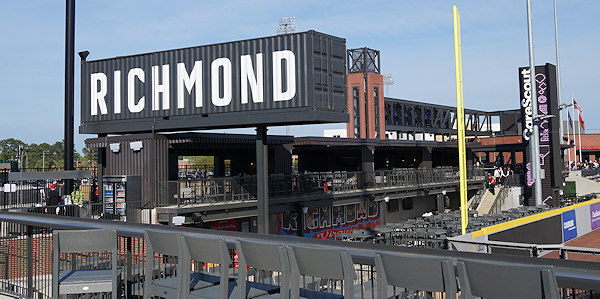
RICHMOND, VIRGINIA
CarMax Park, home of the Richmond Flying Squirrels of the Eastern League
Cost to build: $135 million 2026 attendance versus 2025: +3.7%
Our in-depth review: CarMax Park
Attracting fans was never a problem in Richmond. In fact, the team’s average attendance at The Diamond in 2025 was 59% higher than the Eastern League average. The issue was a stadium that couldn’t be renovated or made compliant with the new standards.
The Richmond Braves started play in 1966. When they threatened to leave, the city tore down Parker Field and hurriedly replaced it with The Diamond in 1985 to keep the team around. Within a decade, the Braves were making noise about the inadequacies of the facility. You see, its concrete-and-steel construction made the prospects of major renovations simply not feasible.
The Braves left after the 2008 season. The Eastern League moved in a year later, on the premise a new ballpark was forthcoming. It took 17 years, but CarMax Park replaced The Diamond for the 2026 season. It had everything The Diamond lacked: intimacy; spacious player spaces and loads of upscale group areas.
“Honestly, for me, the road to CarMax Park and getting it done is a story of perseverance and belief,” observes Anthony Opperman, the team’s general manager. “Our ownership group, led by Lou DiBella, the managing partner, always believed in Richmond. There was the hope that if you got a new venue in Richmond, that it could really be a special market.”
Actually, it was already a market with very supportive fans. CarMax Park finally gave them the special park they deserved.
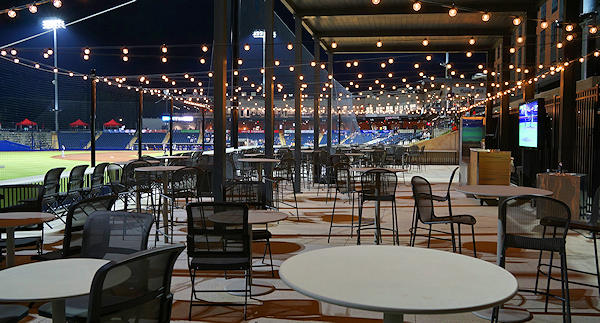
WILSON, NORTH CAROLINA
Wilson Ballpark, home of the Wilson Warbirds of the Carolina League
Cost to build: $64 million 2026 attendance versus 2025: -9.5%
Our in-depth review: Wilson Ballpark
The challenge of making Five County Stadium in Zebulon, North Carolina compliant created an opportunity for the city of Wilson, 24 miles away.
Wilson County had been incredibly successful in attracting major employers, but those big companies wanted their personnel to have affordable entertainment without having to drive to Raleigh or Durham. Minor League Baseball was the perfect solution.
The city leaders enticed the owners of the Carolina Mudcats – which included the Milwaukee Brewers – to leave the non-compliant ballpark in Zebulon. They hired Pendulum, long known for designing cost-efficient, innovative ballparks, to be the architect for a new stadium near the city’s center.
And, oh, the city needed a nice hotel downtown, so a Home2 Suites by Hilton was designed into the third-base side of the stadium. Yes, guests can watch a game from the window of their room. Think Toronto, but for a tremendously lower room rate.
Of the five new parks in 2026, Wilson Ballpark has the fewest seats, was the least-expensive to build and its market has the lowest population.
But don’t call the ballpark small. A better adjective is “intimate.” Its sense of intimacy is not only endearing, you feel incredibly close to the action on the field.
Whether you’re in the grandstands or your hotel room.
And the winner is …
Each year, the winner of the BaseballParks.com/USA TODAY Ballpark of the Year is selected by a committee of ballpark experts. This year’s choice was made much more difficult because of the quality of the new parks, four of which cost well above $100 million to construct. There’s no denying that these are among the very top facilities in all of the Minors.
Due to its unique aviation theme and the City of Ontario’s insistence that everything in its new park be “best in class” in all of pro baseball, ONT Field is this year’s winner.
Upon learning of the award, Pat Battle and Peter Freund, Executive Chairman and CEO of Diamond Baseball Holdings, respectively, released the following statement:
“ONT Field captures the essence of what a Minor League ballpark should be, offering both fans and players a best-in-class experience and serving as a true community gathering place. The Tower Buzzers’ unique aviation theme is meticulously brought to life in a way that is authentic to the region, and we’re incredibly proud to see USA TODAY and BaseballParks.com recognize it as the Ballpark of the Year.”
Check out our press release describing why ONT Field won the award here.
This article first appeared in the September 2, 2026 issue of USA TODAY Sports Weekly. Used by permission.