Article and photos by Joe Mock, BaseballParks.com
All rights reserved
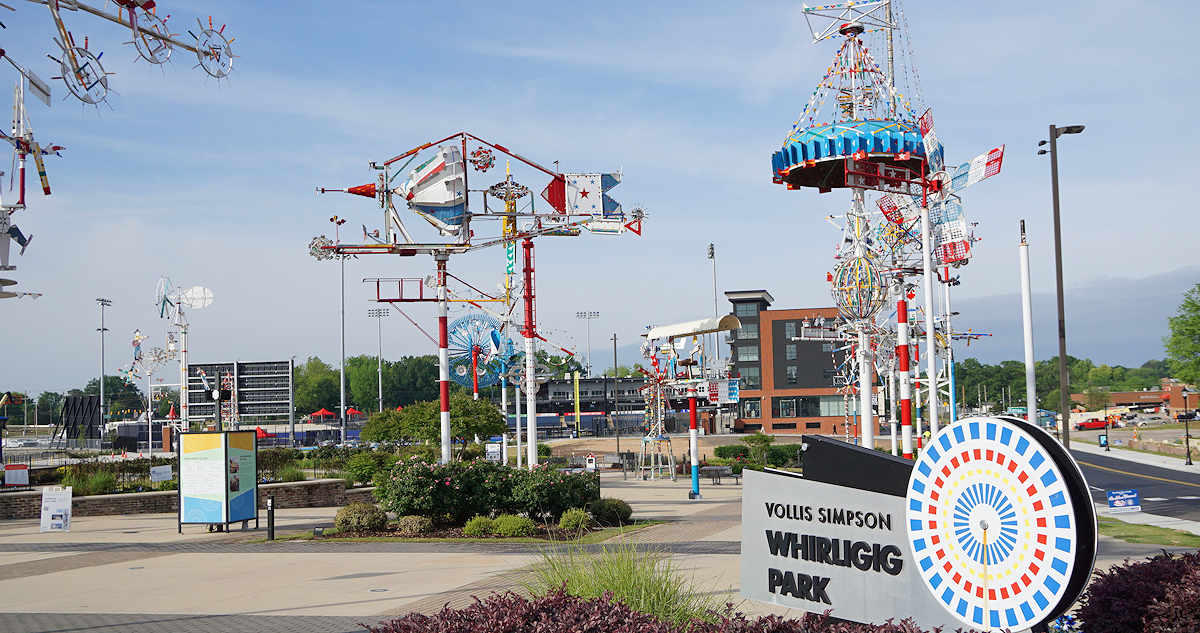
Wilson, North Carolina What exactly is a whirligig? And in the photo above, why is the ballpark in the background, beyond all these whirligig things?
| Ballpark Stats |
 |
| Team: Wilson Warbirds of the Single-A Carolina League |
| First game: April 14, 2026, a 7-5 win over the Hill City Howlers |
| Capacity: 5,000, with 3,300 fixed seats |
| Dimensions: LF – 328′; CF – 400′; RF – 325′ |
| Architect: Pendulum |
| Construction: Barton Malow |
| Price: $64 million, which doesn’t include the hotel |
| Home dugout: 1B side |
| Field points: East |
| Playing surface: natural (a blend of Bermuda and Bluegrass) |
| Naming rights: none as of the park’s opening |
| Ticket info: Warbirds website |
| Betcha didn’t know: the most recent business on the ballpark’s site was a soul-food bakery called Treat Yo’ Self |
To answer this question, you need to understand who Vollis Simpson was, and why in the world he created these bizarre, colorful, mesmerizing sculptures.
Simpson served in the U.S. Army Air Corps during World War II. He was the eighth of 12 children in a family in rural Wilson County, North Carolina. Because he had repaired the equipment used on the family farm, he became very familiar with the intricacies of pumps, tractors, hay-balers and threshers. He also assisted his father in moving houses from one location to another — something that happened with some regularity a century ago.
This knowledge of fulcrums, levers and rollers, added to his experience repairing motors and threshers, came in handy in Saipan, where he was stationed in WWII. Using parts from a wrecked B-29 bomber, he assembled a crude — but useful — wind-powered washing machine, much to the delight of his fellow service personnel at this remote outpost in the Pacific.
Back in Wilson County after the war, he built his own farming equipment while working at a local shop that repaired machinery. He became adept at welding and repairing all manor of machines. One can only imagine the alarm felt by his neighbors as he accumulated a vast array of parts and pieces of junked cars, tractors, balers, abandoned highway signs, fans and mismatched equipment from factories.
It is said that he hated to waste anything — including scraps of metal and parts from obsolete vehicles. As he retired from his farming and machinist jobs in the 1980s, he started building sculptures (in his yard, no less) from all of those pieces of metal. But these weren’t sculptures like you see in front of museums. Simpson creatively assembled structures that the wind could cause to move. He used materials that reflected light in artistic ways as the parts were blown.
This type of art — technically known as kinetic sculptures — reflected what he had experienced in his life. He made structures that resembled farm animals, fighter planes, farm equipment and more. All of it assembled to catch the wind and create sounds and reflect light.
Simpson didn’t call them whirligigs. He referred to his sculptures as windmills. As more and more people made a point of driving by his farm to see these mesmerizing pieces, folks started referring to them as “whirligigs.” After all, that is a term with a lot of history, dating back to the 15th century, according to etymonline.com. “Gig” referred to children’s toys like tops, while “whirl” of course means to move in a circle or spin.
The sculptures in Simpson’s yard were no toys, though. Some weighed thousands of pounds and were over 50 feet tall. As more tourists beat a path to his farm, his work gained regional and eventually national notoriety. As the artist neared his 90th birthday, his ability to maintain all of his windmills waned. After all, kinetic structures out in the elements are going to rust.
| Stately Fleming |
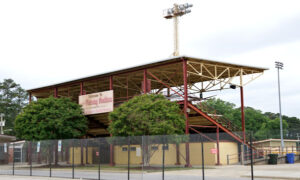 |
| Fleming Stadium was the city’s home for baseball prior to the opening of Wilson Ballpark. It dates back to 1939, and was where the Tobs (both the pro and amateur varieties) played until 2025. |
In 2010, the county seat of Wilson County, a town called simply Wilson, fully realized that the area’s main tourist attraction was out in the country. They also knew they had a central business district that was suffering from the same malady as just about every small town in America. “When I got here in 2007, the vacancy rate (of downtown buildings) was very, very high.” said Rodger Lentz, who was recruited from Charlotte to become the city’s new planning director. He’s the city manager now. “Downtown had only one restaurant.”
He added, “We knew there was this guy doing this folk art on his farm, and we found out that people all up and down I-95 were going there to see it. We realized this was like a treasure.
“We thought that maybe we could talk to his family and build a sculpture park to honor him and honor his art.”
The clever city leaders struck a deal with Simpson to buy, move and restore 30 of his largest sculptures to a newly created park on the edge of the business district. Simpson even acted as a consultant on the project until he passed away in 2013 at the age of 94. Upon his death, his whirligigs were proclaimed to be the official folk art of North Carolina by the state’s legislature.
The Vollis Simpson Whirligig Park officially opened in November 2017. An annual festival is held here, as art lovers from far and wide come to experience the sweeping, creaking and chiming of the pieces as the wind blows through the colorful flaps and covers.
“This park became the front lawn of our downtown and the (entire) community,” said Lentz. The city’s investment in the park “kicked off a tremendous amount of new private development.”
But the city wasn’t done with its revitalization efforts, as the tobacco warehouses and markets that once were the bustling core of the area’s economy were now abandoned and closing in on being condemned. Wilson had been quite successful in attracting non-tobacco businesses, ones that moved processing centers for banking and pharmaceuticals to town. These include Johnson & Johnson, Truist Bank and Bridgestone Tires. But those employers wanted activities for the families of the workers, and Wilson had an idea — one that tied directly into their new whirligig tourist attraction.
“First and foremost, Wilson is a baseball town,” stated Lentz. Indeed, Minor League Baseball here dates back to the Wilson Tobacconists, who finished in first place in the Eastern Carolina League in 1908. That league folded in 1910. Then came the Wilson Bugs, who finished last in the Virginia League in 1920. That franchise continued (playing the 1923 season as the Tobacconists) until the league folded in 1928.
It was the nickname “Tobacconists” — later shortened to Tobs — most associated with this town’s teams. They played in the Coastal Plain League (a pro Minor League back then, unlike today) and the Bi-State League in the ’30s and ’40s, and starting in 1956 as a farm team of the Phillies in the Carolina League. The Tobs continued in that league through 1968, with the Orioles, Pirates and Senators/Twins as their parent.
Starting in 1939, the Tobs had one of the very best parks in whatever league they played in. That was the year that stately Fleming Stadium opened in the middle of a neighborhood a mile and a half west of Wilson’s business district. The 3,000-seat gem still exists today. It’s worth a visit.
| Five counties built Five County |
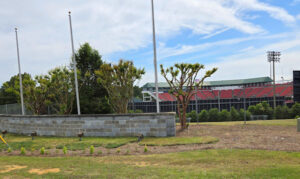 |
| This was the Warbirds’ home in Zebulon when they were the Mudcats. Until 2026, a sign saying FIVE COUNTY STADIUM was on the short stone wall. Yes, five counties cooperated to build this in 1991. |
Starting in 1997, Fleming was the home of a new version of the Tobs in a new version of the Coastal Plain League. This circuit is a summer wood-bat league for college players. The Tobs’ highly successful run there ended in 2025 because a new pro team (yes, the Warbirds) were about to arrive.
A fascinating and almost-ironic bit of history about Fleming Stadium happened in 1991. The Columbus (Georgia) Mudcats of the Double-A Southern League left the Peach State following the 1990 season to move to a brand-new ballpark in Zebulon, North Carolina. They kept the Mudcats name but changed the geographic designation to “Carolina.” The only problem was that Five County Stadium in Zebulon wasn’t finished by the start of the 1991 season. The franchise played the first couple of months that year at, you guessed it, Fleming Stadium.
The most ironic part of this is that the Mudcats, which were bumped down from Double-A to High-A in 2012 and to Low-A in 2021, is the franchise that today is back in Wilson, now under the name “Warbirds.”
Zebulon, you see, is a tiny town of about 7,000 residents, about 22 miles east of Raleigh. How did it attract a Double-A team from Georgia to move there? Well, the story goes, when the Durham Bulls became the best-known Minor League team in America after the 1988 blockbuster film Bull Durham, any team contemplating a move to the greater Raleigh-Durham area did not want a legal battle over territorial rights with the Bulls. So the Mudcats figured out that Zebulon was as close a ballpark could be built to Raleigh without actually encroaching on the Bulls territory, even though Durham was west of Raleigh and Zebulon was east.
So five counties cooperated to build Five County Stadium at a crossroads (with no town in sight) in Zebulon. It just wasn’t completed in time for the Mudcats to move into on Opening Day of 1991. Wilson County is one of the five, along with Wake (where the stadium was actually located), Franklin, Nash and Johnston.
But after a successful 34-year run in Wake County, why did the Mudcats move?
It’s all about Major League Baseball’s usurping the governance of Minor League Baseball in 2021, and the imposition of stricter facility requirements in the Minors.
Remember those clever city leaders in Wilson who built a tourist attraction full of whirligigs, and who had a dual problem of (a) large employers demanding more family-friendly activities and (b) decaying tobacco warehouses?
“We knew that they were going to have to spend a lot of money in Zebulon to bring (the park) up to the new standards,” explained Lentz. An introduction was made with the Milwaukee Brewers, primary owners of the Mudcats. They sent representatives to Wilson.
“We showed them where the ballpark would be built, and pointed out that it is probably the most valuable piece of real estate (in the city) because of its connection to Whirligig Park. And the ballpark is just Phase One.”
The Brewers’ reaction? “They just fell in love with it,” reported Lentz. And they loved that the park would be built to meet all of MLB’s new standards.
Wilson’s leaders were fully committed to the revitalization projects, including the ballpark. The city issued bonds to pay for the construction, and a variety of sources are paying down that debt, including revenue from a special taxing district within Wilson, Wilson County, the Healthcare Foundation of Wilson and the Brewers. “Not only did (the Brewers) buy a couple million dollars worth of equipment that went into the stadium, they also contributed another $250,000 to upgrade the kitchens,” Lentz said.
Both the Brewers and the city leaders knew that the entire proposition would collapse under its own weight if the to-be-built ballpark ended up being too big and too expensive. In other words, overbuilding the stadium would be its downfall. That’s why finding the perfect architect for this “right-sized” project would be crucial.
Let’s look more deeply at Wilson as a market for pro baseball (isn’t it too small?), and what else is close to the new stadium. Then we’ll look at its exceptional architecture.
And if there was going to be a rebranding of the team upon the move to Wilson, why didn’t they go with a whirligig theme? Ahh, we’ll look into that, too.
The Setting
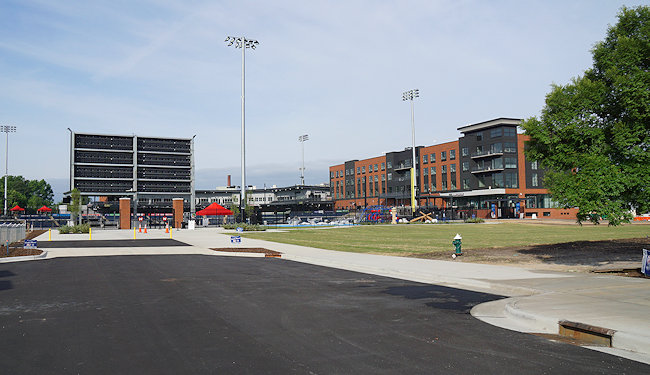
The move from Zebulon to the business district of Wilson is only 24 miles. And without a doubt, Wilson is tremendously larger than Zebulon — but it was never about how many people lived near Five County Stadium. It was about getting fans from the larger population centers — notably Raleigh, which hasn’t had its own Minor League team since 1971. And now the team plays 24 miles farther away from Raleigh.
Wilson’s population of about 48,000 makes it the 24th biggest municipality in North Carolina, and with only nine affiliated Minor Leagues franchises in the state, how did Wilson land one of these prized teams?
I asked David Kronheim, the foremost expert on attendance figures in pro baseball (NumberTamer), about Wilson as a market. He noted that it’s unlikely that fans would flock here from major population centers like Raleigh and Durham when they can see the Triple-A Bulls. However, two cities with Minor League history are within easy driving distance of Wilson: Greenville (population of 95,000, 11th biggest city in the state) and Rocky Mount (54,000, 20th).
And he adds, “There have been smaller cities like Reading, PA that have had very good attendance.” And the Double-A Fightin Phils in Reading are one of the most successful franchises in the Minors.
Lentz agrees that there are plenty of population centers nearby that the Warbirds can draw from. “Thirty-five minutes away is Greenville, which also has one of the largest public universities in the state (East Carolina University). Twenty-five minutes to the north is Rocky Mount. You’ve got a military base in Goldsboro, 30 minutes to the south. And then you’ve got all those people who used to go to the Mudcats.
“And the fact of the matter is that Wilson has more people who commute in to work than commute out.”
Lentz believes the city government has also created an environment where major employers want to operate, creating an ever-growing population of ballpark-goers. “This city council has always been bold in the infrastructure investments. We were the first city in North Carolina to own a broadband network so we could connect every single address. That was … done for economic development, to attract Johnson & Johnson and Reckitt and to keep Bridgestone and to keep Truist.”
Joe Ricciutti is the president of the Warbirds, and he pointed out that the way the team is approaching group sales will be the key to their success in the long run. “A lot of how the audience is built has to do with how the team approaches ticket sales. If you approach it as a reactive model, then you’re looking at a very small geographic footprint. Our model is very groups-based, which means we’re proactive. We’re reaching out to every little league, Boy Scout, Girl Scout, church group, civic group (and) business group in a 50-mile radius. Because it is a very group-centric model, we get to push out the geographic boundaries as well.”
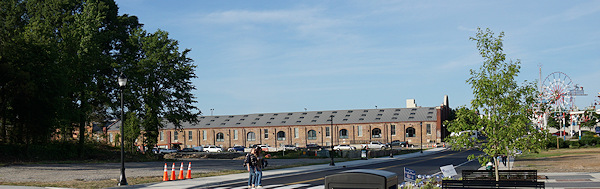
So what about the location of the new ballpark in Wilson? Keep in mind that this was a major hub in the tobacco industry, so the ballpark site was the home of a number of tobacco warehouses and markets. Most of those buildings have been demolished, but one you can see beyond the park’s left-field entry is a long, low structure that has been re-imagined as loft apartments — and it’s beautiful now (above). The side of the building closest to Goldsboro Street is now a visitors center and adorable museum shop that accompanies the Whirligig Park across the street.
In a long-ago-demolished structure where the ballpark’s grandstand is now was a soul-food shop called Treat Yo’ Self. Across Goldsboro Street from the park are more sites where tobacco warehouses used to be. Those cleared lots are now used for baseball parking (which is free, by the way).
And on lots beyond the outfield will be apartments, once the current commercial buildings are demolished.
 This is all part of Wilson’s master plan.
A solid decision by the city as the site plan for the Whirligig Park and ballpark was being developed was to extend Douglas Street next to the sculptures all the way to the center-field gates of the ballpark (see the photo at the top of this section). This acts as a perfect pedestrian walkway from the business district, past the Whirligig Park, right into the baseball stadium. I’m told this dead-end street was used as a plaza to welcome fans on the ballpark’s opening day, with bands, contests and other attractions.
This is all about three blocks from the central corridor of the town, which is on Nash Street, which is perpendicular to Goldsboro Street. Here you’ll find an arts center, a children’s museum with technology and local-history exhibits and lots more than the one restaurant that existed when Lentz arrived in 2007.
The one thing this part of town now lacks? A nice hotel … and as we’ll see in the next section, that issue is well on its way to being addressed.
The Exterior
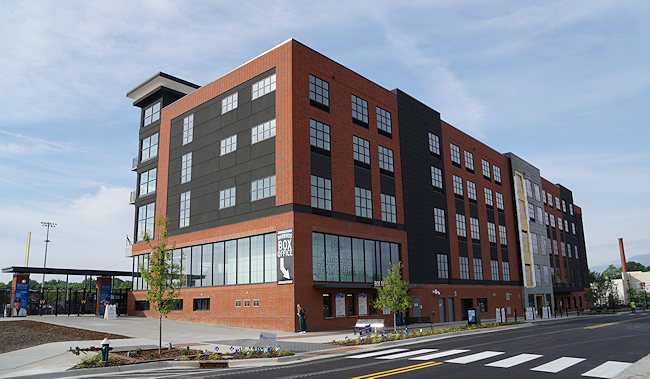
The photo above is of a hotel that’s under construction. It’s not a shot of the ballpark.
Or is it?
What you’re looking at here is a nearly finished Home2 Suites by Hilton. Around the time of the All Star Break during the 2026 season, it will begin hosting guests. And those staying on the eastern side of the building will look down on the seating bowl and playing field of Wilson Ballpark. In fact, the Warbirds’ team store is on the first floor, and the park’s main ticket windows are below it on the ground (street) level.
This gives this ballpark one of the most unusual exteriors in sports. The only other arrangement that I have ever seen that is even remotely like this is the Toronto Marriott City Centre Hotel which is built into the outfield of Rogers Centre, the home of the Blue Jays. Here for $570 a night (I don’t know whether that’s US Dollars or Canadian — but does it really matter?), your room will look down at the Blue Jays playing baseball.
About 700 miles due south, you’ll be able to watch the Wilson Warbirds take on a Carolina League rival from your hotel room for, I hope, considerably less money.
The hotel is by far the most noticeable feature of Wilson Ballpark’s exterior. For that matter, it is the most noticeable feature of the interior of the park. It’s hard to ignore no matter your vantage point.
This is by no means a bad thing, as the masonry of the hotel is beautiful and is wonderfully compatible with both the inside and the outside of the rest of the stadium. Making sure this is the case is Pendulum Studios of Kansas City, the architects for the park. Jonathan Cole is the firm’s principal, and he’s built a tremendous reputation designing ballpark’s of this general size: Dunkin Park in Hartford; CaroMont Health Park in Gastonia, NC; CoolToday Park, the spring-training home of the Atlanta Braves in North Port, FL; Meritus Park in Hagerstown, MD and Jimmy John’s Field in Utica, MI.
| The designers |
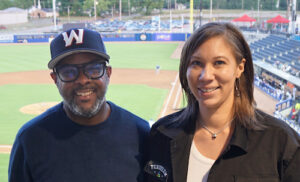 |
| Jonathan Cole, principal at Pendulum, is the lead designer of Wilson Ballpark. Assisting in this effort is local architect Janae Wilson, who runs Pendulum’s office in Rocky Mount. |
All of these were designed using a scale that was perfect for its market. A lot of designers want to create a Major League ballpark, then simply shrink it so it has fewer seats than a big-league ballpark. Cole feels that is absolutely not the way to do it.
He authored a white paper called WiSE Park and the Case for Right-Sized Ballparks in 2026 (WiSE was the working name of the stadium before the city settled on “Wilson Ballpark” — at least until a corporate-sponsorship name is negotiated). In the paper, Cole makes this observation:
…WiSE Park distinguishes itself not by excess, but by discipline and, ultimately, by impact. Where other (new ballparks) have leaned into scale, spectacle or ancillary real estate plays, WiSE Park’s argument is rooted in proportion: a ballpark calibrated to its market, its fan base and its civic purpose … The result is a facility concept that reads less like a speculative development anchor and more like a durable piece of community infrastructure, one that prioritizes the everyday fan experience while still meeting the evolving standards of player development and league expectations.
An extremely important component of all of this is cost. Of the five new Minor League parks in 2026, Wilson’s cost the least to build. By a lot. Cole likes to say that Wilson Ballpark is “the most compelling ‘pound for pound’ value in this year’s class” of baseball stadiums. He adds, “It is not simply a question of dollars spent, but of outcomes delivered.”
He refers to this as “right-sizing” a ballpark.
Again, when you consider the size of the city of Wilson (and no doubt the size of its city budget), a shiny new ballpark that cost over $100 million to build might have been nice to look at, but it would have left Wilson’s finances in the hole for many years to come. Instead, not counting the hotel, the cost to build the park was about $64 million.
In the next section we’ll talk about Cole’s initial reaction to this project, but for now, let’s concentrate on the look of the park’s exterior. As Cole emphasizes, “Everything in this ballpark revolves around clear lines of sight to Whirligig Park. The Park was already a civic asset, so that was our driving factor. That’s the city’s landmark tourist attraction, so its important to the community.”
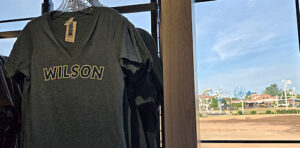 Indeed, other than the kids playground, there is nothing beyond left field to mar the view of the whirling and spinning sculptures a block away. Note that even the windows in the team store have a clear view to the whirligigs!
And Cole understands that there is more development coming, and the baseball stadium has to fit well into the master site plan. He likens Wilson to Dayton, which he visited when Day Air Ballpark was first being discussed. “All that was there was a battery plant. No one was thinking that this was going to develop into this great thing. Now you look at it, and everything has developed around it — condos, apartments, restaurants, everything. And (the Dayton Dragons) now hold the record for most consecutive sellouts in sports.”
He sees exactly the same potential in Wilson. And it was his job to design the park with the unshakable link to Whirligig Park, and build in expansion possibilities for growth both within the stadium and beyond its walls.
And, like Richmond, those walls wrap all the way around the main grandstand, with no major entry gates behind home plate. Most fans enter next to the hotel in left field, the main gates in centerfield, and a smaller gate near the right-field foul pole.
There are doors on ground level almost directly behind home plate, but that is a VIP entrance for suite-holders. Otherwise, there are two stories of beautiful masonry. Cole says the inspiration for the style and color of the brick comes from the tobacco warehouses that used to cover this part of town.
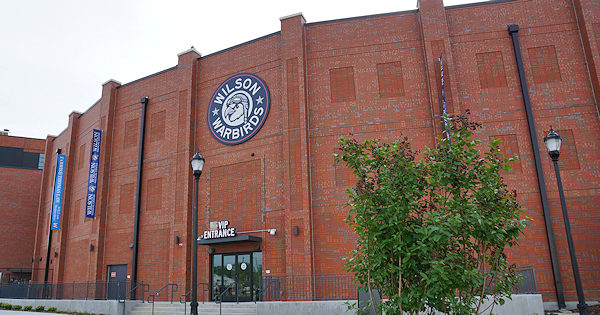
My only complaint about what you see of the park from outside is the back of the video board in left field. It looks very unfinished, and since that is the part of the park most visible from within the Whirligig Park, it should do a better job promoting the Warbirds (see the photo at the top of The Setting section above).
Now let’s move to the park’s impressive interior. Was anything omitted to keep the stadium’s price down?