Article and photos by Joe Mock, BaseballParks.com
All rights reserved
Ontario, California Almost everyone has played the game Musical Chairs. Even if you haven’t, you no doubt know the rules. Typically it involves a group of children circling a set of chairs as music plays. When the song stops, everyone scrambles to sit in one of the chairs. The only problem is that there is always one fewer chair than contestants, so in each round, one player is eliminated when they can’t claim a seat.
| Ballpark Stats |
 |
| Team: Ontario Tower Buzzers of the single-A California League |
| Award: 2026 BaseballParks.com Ballpark of the Year (see the press release for details) |
| First game: April 2, 2026, a 7-5 loss to the Lake Elsinore Storm |
| Capacity: 7,000, with 4,453 fixed seats |
| Dimensions: LF – 327′; CF – 401′; RF – 327′ |
| Architect: Populous (Project team: Jason Michael Ford, Geoff Kornegay, Casey Hagen, Joanna Grant, Sarah Edmonds, Andrew Harvey, Henry Lau, Brian Smith, Corey Mintz, Justin Cox) |
| Construction: Tilden-Coil |
| Price: $135 million, funded by the city |
| Home dugout: 3B side |
| Field points: North by northeast |
| Playing surface: Latitude 36 Bermuda overseeded with rye grass |
| Naming rights: Ontario International Airport |
| Ticket info: Tower Buzzers website |
| Betcha didn’t know: Prior to being a ballpark, this land was a dairy farm |
You now understand the premise of how the rapidly growing city of Ontario, California obtained an affiliated Minor League franchise to play in its shiny new ballpark.
Spoiler alert: the city of Modesto is the child without a chair to sit in.
As you may know, Major League Baseball now is in charge of the governance of the Minor Leagues. When this happened in 2020 and 2021, a new set of minimum standards were imposed on all stadiums hosting a Minor League team. This included rules about the size of clubhouses, facilities for teams’ trainers, weight rooms, batting tunnels and so forth. These standards are included in the Player Development License, or PDL.
Some Minor League facilities didn’t have a problem with this, because they had future-proofed their player spaces by building them larger than the minimum standards at the time. For most parks, though, there was a lot of hand-wringing because the new standards required far more robust facilities than could easily be implemented.
For instance, when the fairly new Northwest League park in Hillsboro, Oregon examined what it would take to bring Hillsboro Ballpark up to the new standards, the city decided to throw in the towel and build a completely new ballpark that met all of the minimums. The old ballpark is now used for professional softball.
Modesto, long a proud member of the California League, came to the conclusion that they simply couldn’t afford to construct a new, compliant stadium … nor could they afford the $32 million to bring quaint Modern Woodmen Field, built in 1955, up to the new standards.
This prompted a fascinating series of events. With the handwriting on the wall that the Modesto Nuts, affiliate of the Seattle Mariners, would have to move elsewhere, Diamond Baseball Holdings (DBH) purchased the franchise from the Mariners following the 2024 season. They immediately announced that 2025 would be the team’s final season in Modesto.
As fate would have it, the city of Ontario, California had huge plans for a recreation complex that would be anchored by a significant Minor League stadium. But they needed a team to play in it.
As Ontario City Manager Scott Ochoa explained, their first inquiry was to the closest team, in Rancho Cucamonga, just to ask what’s involved in acquiring a franchise. Bobby Brett, executive of Brett Sports, owners of the Rancho Cucamonga Quakes at the time, explained the challenges of finding a team willing to move. “So we thanked them for letting us waste their time, and got up to leave,” said Ochoa. Just then Brett said to wait a minute. He was curious why Ontario wanted to know. “He told us there’s this thing called the PDL, and it is just hammering some teams, especially at the Class A level. We told them that we’d bought 200 acres and we’re going to do a sports complex. They wanted to know if we were going to meet the PDL standards. We said of course.
“They said, well, let’s continue talking.”
The plight of the Modesto Nuts was coming to light around that time … but if you are thinking that the Nuts franchise could simply move to Ontario, you’d be wrong. Nothing in baseball is that straightforward.
| Musical Chairs in the Cal League |
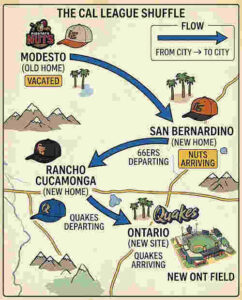 |
| It’s confusing trying to follow the movement of the franchises in the California League for 2026. So I asked Google Gemini to create an image that illustrates the changes. Hope it helps! |
Instead, the Nuts and their Mariners affiliation moved to San Bernadino in Southern California ahead of the 2026 season, and kept the team nickname already in place there: the Inland Empire 66ers. And, oh by the way, DBH had just purchased the Inland Empire franchise. To make way for the incoming Nuts, the 66ers franchise — and their affiliation with the LA Angels — was shifted to another existing Cal League market a short 18 miles away in Rancho Cucamonga. That transplanted franchise adopted the team nickname of the old team in Rancho, the Quakes.
So where did the pre-2026 Quakes go? You guessed it: the former Rancho Cucamonga franchise is now the Ontario Tower Buzzers, playing in brand-new (and drop-dead gorgeous) ONT Field, just opened for the 2026 season.
And not incidentally, the Quakes’ affiliation with the LA Dodgers came with the franchise to Ontario, as did a fair amount of the front-office staff.
So if your head isn’t spinning enough over all of this, add these two facts to the mix: DBH not only bought the Modesto franchise that they moved to San Bernadino, and also bought the original 66ers team that moved to Rancho, they *also* bought the original Quakes franchise that moved to Ontario; as the crow flies, the ballpark in Rancho Cucamonga is only seven miles from ONT Field. So all three Cal League teams are now owned by the same entity.
Yes, really.
Perhaps this is going through your mind right now: “I thought there were rules prohibiting an entity from owning multiple teams in the same league, and not only that, I thought you couldn’t have teams so close together.” If you’re thinking this, you need to get with the way things work nowadays.
Because of the close relationship between DBH and MLB, they are allowed to own up to 50 affiliated Minor League franchises (there are 120 total teams following the contraction of three entire leagues in 2021). MLB stopped worrying about entities owning multiple teams in the same Minor League years ago.
| Predecessors |
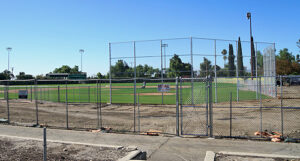 |
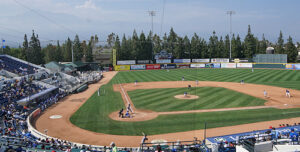
| Ontario’s Jay Littleton Ball Park was the home of one Minor League season, but a number of movies, TV shows and commercials. It’s sad that it burned down in 2024. This picture shows its current state. Below is the ballpark left behind when the Quakes moved from Rancho Cucamonga to Ontario … yet it is still in use in the California League, still by a team called the Quakes. |
 |
And, yes, usually there are territorial rights that a franchise possesses based on 75 miles or contiguous counties, but in this case, DBH is the owner of the teams in San Bernadino, Rancho and Ontario, and they aren’t going to complain about their own franchises encroaching on each others’ territories.
And besides, one reason that MLB took over the governance of the Minors was to streamline things like travel for the players. When the 66ers are playing the Quakes or Tower Buzzers, they don’t bother to put their players up in a hotel. They just bus back and forth from their home park, and the players sleep in their own beds. In other words, this unusual arrangement of having three teams so close together is viewed by DBH as an advantage, not something to complain about.
Ontario is not without baseball history, but not a lot of it involves the Minors. In fact, prior to the Tower Buzzers, only one affiliated (sort of) Minor League team played here: the Ontario Orioles. That franchise lasted one year in the Class C Sunset League (yes, back then, the classes went all the way down to D), during the league’s inaugural season in 1947. The league included teams as close as El Centro and Riverside, and as far away as Las Vegas and Reno.
Three of the six teams in that league had Major League parents, while the other three operated as independent or co-op squads. The Orioles fell into the latter category. And before folding at the end of the ’47 season, the team finished in fifth place.
But it was the home ballpark of the Orioles that gave Ontario such an interesting baseball history. Jay Littleton Ball Park’s wooden grandstands were constructed in 1936 as a Works Progress Administration (WPA) project during the Great Depression. It was the home of lots of amateur and semi-pro teams, in addition to that one season with the Sunset League franchise. But there is a bigger reason why this ballpark was so beloved: movies. It looked the part of a facility from the 1910s, which is why part of “Eight Men Out” (the story of the 1919 Black Sox scandal) was filmed here. It was also perfect for a movie set in the 1940s, which is why some games in “A League of Their Own” were shot here.
Unfortunately, the lovely grandstand of Jay Littleton Ball Park burned down in August of 2024. According to press reports, homeless people inhabiting the ballpark likely started the blaze. This was just as construction of ONT Field was about to start. Littleton’s playing field remains today, but where the stands once existed is nothing but dirt and gravel. I asked Jennifer Hiramoto, the executive director of Economic Development for the city, if there is any chance the beautiful wooden ballpark would be rebuilt. She said that the city council is very interested in honoring the history of Jay Littleton Ball Park, but city staff is still developing a plan as they wait for insurance proceeds and solicit community feedback.
| Flying the friendly skies |
 |
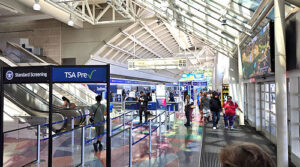
| It’s unusual for an airport to be the inspiration for a ballpark, but ” … the airport is really a source of pride for us,” says Scott Ochoa, Ontario’s city manager. |
 |
Here’s hoping Littleton is rebuilt. It was a treasure.
The history of baseball in the area is featured in a gallery of pictures in ONT Field’s upper-level lounge, but it isn’t really something the Tower Buzzers celebrate throughout the park. They feel that they are a new franchise, and the history of the Quakes is something that was left behind in Rancho. Instead, they celebrate the history of the Dodgers, since (a) the majority of locals are Dodger fans and (b) they are a Dodgers farm team. As we will see, there is much about ONT Field that pays homage to the team that plays in Chavez Ravine.
Jay Littleton Ball Park, by the way, was just to the northwest of Ontario’s airport — and it’s this airport that influences so much of ONT Field’s features, including its name.
There’s an interesting history to this transportation hub. In 1929, the city of Ontario bought 30 acres around an existing landing strip to establish Ontario Municipal Airport. A dozen years later, the city acquired 470 acres surrounding that airfield, and with the help of the aforementioned WPA, constructed two massive runways. With the outbreak of World War II, these runways became crucial for operations for P-51 Mustang fighter planes and for training for P-38 Lightning bombers. It’s the P-38 model that we will encounter again when we talk about the most impressive features of ONT Field.
Following WWII, the facility was renamed Ontario International Airport, as first cargo flights, then passenger planes, began making treks across the Pacific. About the time that passenger flights started roundtrip service to cities in the American West in 1960 (although these were airplanes, not yet jets), operations were taken over by the Los Angeles Regional Airports System, with LAX being the primary airport in the network.
The longer runways in Ontario accommodated jets very nicely, and by the 1970s, non-stop jet service to places like Dallas and Chicago were added to the daily schedule. In 1985, the city of Los Angeles bought Ontario’s airport outright, but that didn’t stop the expansion of runways, terminals and passenger service in Ontario. The latter peaked right before the 2008 economic crisis. What followed was a drop of flights in Ontario and an uptick of flights into LAX. All the while, cargo flights using Ontario skyrocketed, which is why you now see warehouse after warehouse in the square miles surrounding ONT. In fact, today it is the eighth busiest cargo airport in the U.S., used heavily by FedEx, UPS and Amazon.
| Representing the city |
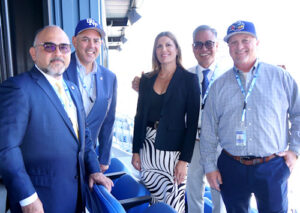 |
| Sometimes municipalities don’t have a lot to do with a new sports facility. Other times they have everything to do with it. In Ontario, it’s the latter. Shown here are: Scott Ochoa, City Manager; Dan Bell, Communications & Community Relations; Jennifer Hiramoto, Economic Development; Tito Haes, Public Works; Dan Beers, Project Manager. |
With LAX in control, “it didn’t take a genius to figure out that they were going to enrich themselves at the expense of our airport,” noted Ochoa. By adding new routes for LAX, they retained the landing fees, so during a period when air travel was expanding rapidly, new flights weren’t being added at Ontario. The solution? “We effectively bought the airport back from LAX.” That was in 2016. Airlines — particularly Southwest — added more routes to Ontario, while the cargo traffic remained strong. “We are a logistics and goods market and the airport is really a source of pride for us. So the idea that we would have the (ballpark) and the team incorporating the airport was almost a foregone conclusion.”
Added Hiramoto, “It actually seemed like it was the easiest part of all of this deal (on the ballpark) to negotiate. It was a no-brainer. We were able to very easily come up with what we thought the concept would be for the title sponsorship.” That’s why the stadium is called ONT Field, honoring the International Air Transport Association three-character code for Ontario’s beloved airport. In exchange for the naming rights, the Tower Buzzers team receives $200,000 a year from the airport authority, while the city receives $1 million. “That really is helping us ensure that this operation pays for itself,” added Ochoa. “So for us, we didn’t need to make money off of baseball. We just needed for it to pay for itself.”
The team nickname was inspired by the antics of Tom Cruise’s character in the movie “Top Gun.” His character was named Maverick, so of course the bee mascot of the Tower Buzzers is named Maverick as well.
As we will see, the airport name isn’t just plastered on the outside of the stadium. It is a theme that is employed throughout the ballpark — with many hilarious touches and Easter eggs scattered about.
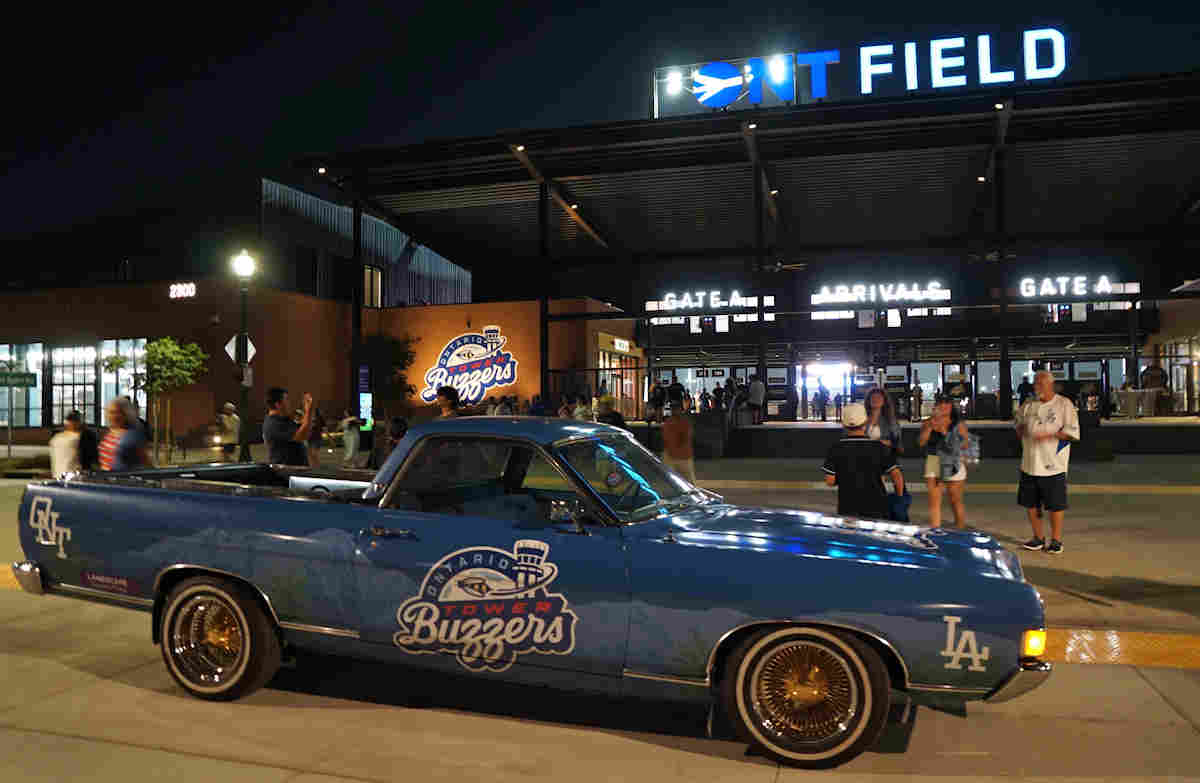
So the game of Musical Chairs has ended, with Ontario gaining a team and Modesto losing one. Let’s now take a look at what makes ONT Field — and I might as well go ahead and admit that it’s on a very short list of the very best Minor League parks in existence — just so special. And why is there a vintage 1969 Ford Ranchero parked outside its main gate?
Read on.
The Setting
Other than having a fast-growing airport, what do we know about Ontario, California?
It’s a city surrounded by a lot of other Southern California cities in the sprawling eastern region of the Los Angeles basin — which makes it a great spot for an airport! Its population of 189,000 represents a robust growth of 35.5% since 2000. The 50-square-mile municipality lies just east of Pomona and Chino, just west of Fontana, and its neighbor just to the north is, of course, Rancho Cucamonga, where the Tower Buzzers played until this year.
If you’ve driven from Los Angeles toward Palm Springs and Indio, you likely traversed Ontario and might not have even realized it, as Interstate 10 cuts right across the city just north of the airport.
Although it’s not an official designation like an area within city limits or a county line, this part of California is referred to as the Inland Empire — hence the team name of Inland Empire 66ers in San Bernadino. Ochoa refers to Ontario as being the “capital of the Inland Empire” — again, not an official title.
But there is a psychological aspect of this. “For a long time, Inland Empire, the 909 (area code), was seen as (a) less-than sub-region of LA. It was like the butt of a joke,” explained Ochoa. “(Now) LA is in many ways unworkable and unaffordable, so where do you think people in LA are going? LA is moving east, and Orange County is moving north. And here we are on the west side of San Bernadino County ready to receive it all.”
And that more-affordable housing in Ontario will cause the city’s population to double in the next two decades, according to some estimates. So this is an excellent market for Minor League Baseball.
But there’s also the way land within the 50 square miles will be utilized. Ochoa points out that within the city limits used to be 400 dairy farms. Now there are 20, and that number is declining because the farmland is worth exponentially more when sold by farmers to developers of subdivisions. I asked if the city’s desire to buy 200 dairy-farm acres for a sports complex was a defensive measure to keep other developers from buying the land for commercial purposes that the city might not be fond of. “No, because it was all zoned residential anyway. It was all going to be subdivisions.
“What we do want to guard against is just being another suburb, the ill-defined sprawl that is Southern California,” Ochoa continued. “We want to make (Ontario) special. We had the funds and the political will to do it with our city council.
 “So we embarked on that journey.”
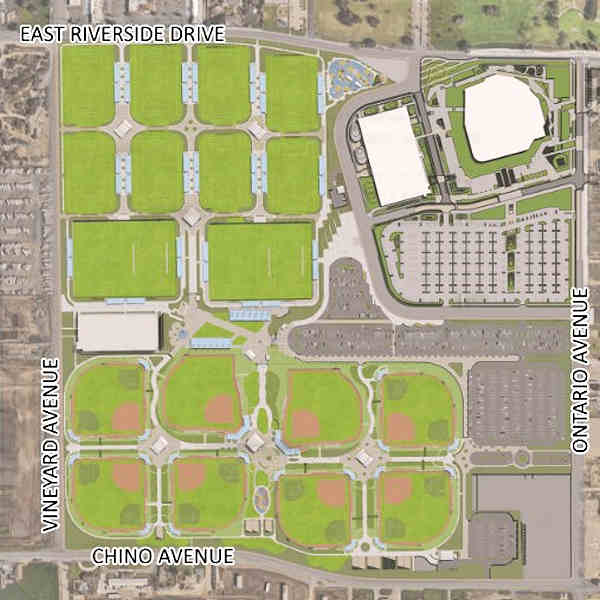
The funds came from a ballot initiative called Measure Q, passed by Ontario voters in November 2022. It raised sales taxes to generate millions of dollars for the public good. One expenditure was to purchase about 200 acres of farmland for roughly $200 million. That has now become the Ontario Sports Empire, which will have dozens of soccer, baseball, softball and football fields — plus a six-level parking garage — once construction is finished (the image shows the layout once Phase One is complete. Courtesy of the City of Ontario). There are plans for a massive indoor volleyball/basketball arena and perhaps a pro soccer stadium, too.
Interest from the around the country is already pouring in to hold tournaments of all kinds here. “We anticipate that this will have about 1.2 million visitors a year, and that’s on the conservative side,” revealed Ochoa.
And those young athletes and their families will need hotel rooms, which is why ground is about to be broken for a two-brand hotel directly across the street from the ballpark’s right field. Just to the south of the hotel will be mixed-use development with eateries and shops. The revenue from the rent on these will supplement the tax dollars from Measure Q to pay for the Empire.
There are more dairy farms just to the south of the complex, and those will undoubtedly turn into dozens more subdivisions. The recreational complex will be ready to accommodate that exploding population growth.
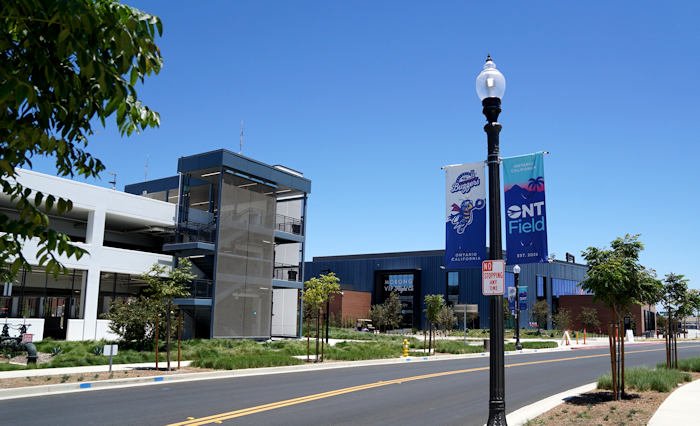
The first structures completed at the “Empire” are ONT Field and the adjacent parking garage, shown in the upper right corner of the County’s site diagram.
The planning and financing of all of this — not to mention the execution of the sports facilities — is nothing short of brilliant. I wouldn’t be surprised if municipalities from around the country come to Ontario to see how this was all accomplished — in much the same way that the owners of sports franchises have traveled to the north side of Atlanta to see how the Braves pulled off the stunning Battery.
So ONT Field is toward the northeast corner of the 200 acres. The major east-west route East Riverside Drive is just beyond the ballpark’s left field, and across that street is the city owned Whispering Lakes Golf Course. Ontario Avenue is beyond right field, separating the ballpark and the to-be-built hotel. Just to the west of the third-base entrance to the ballpark is the three-level parking garage, and across from the main gate on the first-base side are acres and acres of paved surface lots. Some of the latter will one day be developed into more sports facilities or, if there is demand, additional businesses.
And all of this is about two miles south of those great big runways at Ontario International Airport. And about 13 miles beyond the airport are the gorgeous San Gabriel Mountains, which can be seen clearly from inside the ballpark. One of the peaks is even named after the city of Ontario.
Those snooty folks in LA “can joke about the Inland Empire all they want, but they need the Inland Empire,” said Ochoa. Keep in mind that he considers Ontario the capital of the Inland Empire, which is pretty much a mythical title for a mythical place, but I see exactly what he is getting at.
But when you stop and think about it, isn’t it amazing what can be done with dairy farms?
One funny aspect of this occurred when planners and architects first visited the dairy farms along Riverside Drive to see if it would be feasible to build a recreational complex there. The smell of cattle — and what they leave behind after eating their feed — was inescapable. “It stunk. It really stunk,” noted Bobby Brett upon his visit to the dairy farms. When I first got out of my car in the parking garage the morning of my visit to ONT Field, I could definitely detect that there are still dairy cattle not too far away. But it was by no means unbearable.
Now that ONT Field is open for business on the former dairy farm, how did it turn out? Let’s check it out, first on the outside.
The Exterior
In planning for the facility that would one day be called ONT Field, the order of events was fairly atypical. The city of Ontario didn’t need anyone’s help in picking a location for the park. They already knew where their Sports Empire was going to be built. They didn’t need an architect to bring in their favorite contractor. The city already had a longstanding relationship with Tilden-Coil Constructors, whose headquarters were in nearby Riverside. Everyone knew it was the Rancho Cucamonga Quakes — and their affiliation with the Dodgers — that were coming to town. At the time, Brett Sports owned the franchise. All Ontario needed were architects.
Geoff Kornegay, who would become the lead designer of the park, was one of the members of the team that Populous sent to be interviewed by city representatives. That included Ochoa and several members of the city council. Tilden-Coil was also represented there. “They had questions, really good questions, about process and how we would go about it,” recalled Kornegay. “But the bulk of the conversation was about what baseball can be and what baseball can do for a community like theirs. They obviously had a big vision. They’ve got the kind of big-picture thinking to want to deliver something of that scale to the city. And they had the means to do so.”
| Designers |
 |
| Representing Populous in designing ONT Field is Jason Michael Ford, Baseball Market Leader and Geoff Kornegay, Lead Project Designer. They are shown here with Tower Buzzers’ GM Allan Benavides (right). |
He knew it was “going to be a good project because they were going to push the envelope of what a ballpark can be.”
Absent were the typical topics of where in the city the park should go, how it and the parking should be situated at its site, how to get utilities to the facility and what kind of grading the land would need. “It was a unique process,” observed Kornegay.
With no body of water affecting the water table nearby, and no changes in elevation from one side of the site to the other, it was a straightforward decision to excavate about 20 feet into the ground, making the ground floor (i.e., the playing field) one story down from the main concourse, which is pretty much where fans enter.
This has a distinct impact on the park’s exterior, which is oriented to maximize the visibility of the San Gabriel Mountains beyond left field. In fact, Kornegay revealed that the playing field doesn’t “point” (if you drew a line from home plate through second base to center field) northeast, like you might think since the surrounding street grid is pretty much north-south and east-west. “It is rotated about 10 degrees counterclockwise, so it’s open slightly further to the mountains. When you’re standing at home plate and you look toward the left-field power alley, you’re looking right at the mountain range. This is to maximize the view.”
Great choice.
There were a lot of conversations regarding the exterior of the ballpark around the main seating bowl. “There were a lot of opinions across all the various constituencies about what a Southern California ballpark should look like, and how to balance those things out in a way that felt true and honest.” One aspect that kept coming up was about the importance of the nearby airport, so there were a lot of discussions about “the parallels between aviation design and ballpark design. They have a lot, if you squint, of the same elements. You need to have an iconic moment of arrival. You need something that makes it recognizable, that makes it unique. You’re moving a lot of people in and out in an efficient and functional way.”
All of these characteristics influenced the look of ONT Field. Kornegay explained that all of the structures at ground level are simple masonry, while above that is a “big soaring canopy … It just has this big upward motion that is welcoming and feels big.”
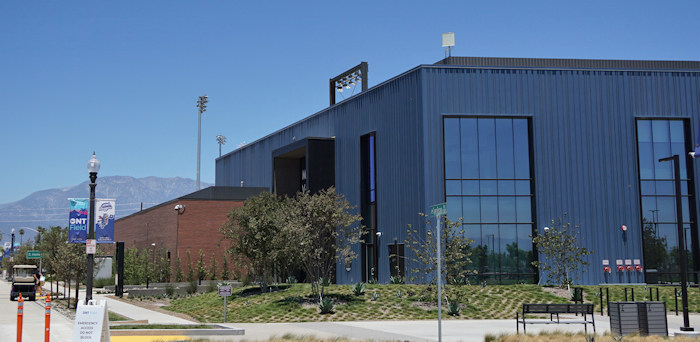
When you stand outside of the ballpark behind home plate, you see the simple brick design that is complemented by a bright blue shell, made of a material called galvalume, which is a corrosion-resistant sheet of steel. Yes, it does have an upward feel.
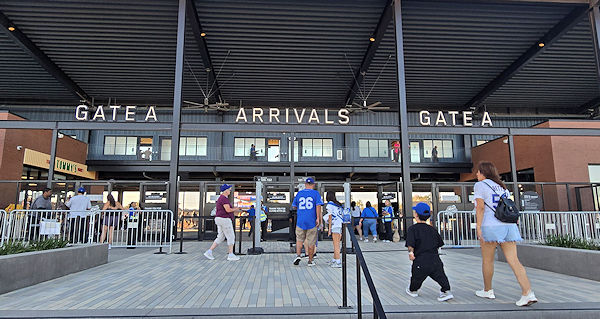
It used to be that a new Minor League park had to have an entrance behind home plate, even if not a lot of fans used it. Think Columbus, Ohio. That’s not true any longer. The new parks of 2026 — Richmond, Wilson, Chattanooga — have their main entryways elsewhere. That’s true here in Ontario, too. The main gate — referred to as the ARRIVALS – GATE A (this is your warning that this is the first in a long line of airport-related terms and puns here at ONT Field) — is behind first base. Fans coming from the surface lots, as well as the restaurants one day, will enter here. It is big and impressive (see above).
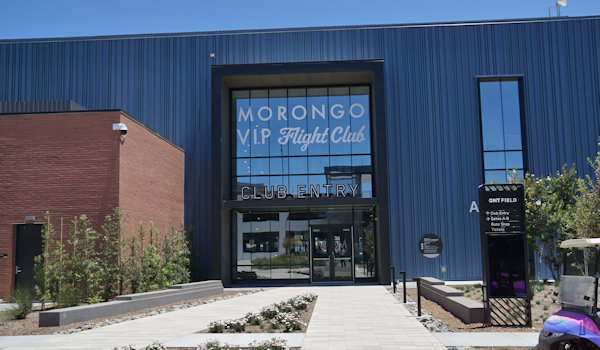
Not quite as large is the Club Entry which is just to the third-base side of home plate. The landscaping around it is very nice, I might add (see below)
While there is an entry gate in right field (here’s another one of those puns: it says BOARDING GATE above the entryway) that probably won’t really be necessary until the hotel and restaurants are built, the most fascinating aspect of the exterior is hands-down the batting cages. Unlike the majority of cages at pro ballparks, these aren’t buried in the basement with no natural light. No, they are on the concourse level (necessitating that players have to climb a flight of stairs from the clubhouses). What makes these two full-size cages truly special is their visibility — both for fans and players.
And the visibility is on both sides of the batting tunnels. On the side of the playing field, fans can enter from the main concourse into a group area to watch the players hit. Even better, there are garage doors with windows separating the outside sidewalk from the cages. Ochoa called this his favorite aspect of the ballpark. “Right before the game, we roll up those windows and you have all these little kids sitting there watching, and you just hear whack whack whack. The guys taking cuts in there and watching those kids watch them is outstanding. It warms the heart.”
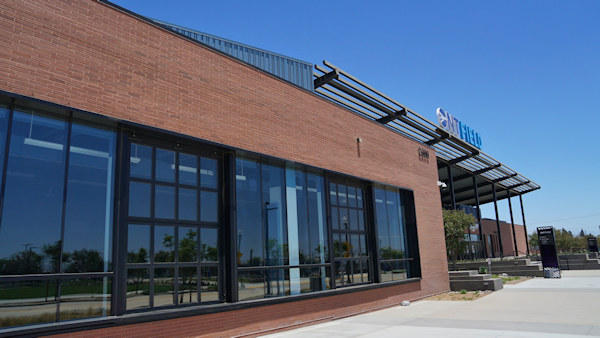
These batting tunnels are shown above, with the sweeping canopy over the Gate A entry beyond. Ochoa said this type of indoor/outdoor batting cage was inspired by one they saw while touring other parks (most likely in Kannapolis, NC). In Ontario, these are located between the Club Entry and Gate A. Make a point of checking this out as you’re entering a Tower Buzzers’ game.
By the way, the service entrance and the spot where players and staff enter is down the third-base line. Apparently, there are new rules that player parking has to be close to their entrance, and this puts it just a few steps from the parking garage.
So ONT features a modern exterior, not unlike an airport … which is the whole point. Well done.
Now let’s venture inside the ballpark so we can discover even more aviation puns! Wait, you don’t think they dress the staff as flight attendants, baggage handlers and pilots, do you??