Article and photos by Joe Mock, BaseballParks.com
All rights reserved
Richmond, Virginia This website is nearly 30 years old. We’ve provided reviews of every new pro park during that period … but the last time a new ballpark opened in Richmond, the World Wide Web was still a dozen years away.
| Ballpark Stats |
 |
| Team: Richmond Flying Squirrels of the Double-A Eastern League |
| First game: April 7, 2026, a 3-2 win over the Altoona Curve |
| Capacity: 9,585, with 6,800 fixed seats |
| Dimensions: LF – 325′; LCF – 350′; CF – 400′; RCF – 373′: RF – 325′ |
| Architects: LaBella Associates and KEi |
| Construction: Gilbane |
| Price: $135 million, with the Richmond Economic Development Authority contributing $120.5 million |
| Home dugout: 1B side |
| Field points: East by Northeast |
| Playing surface: Tahoma 31 Bermuda |
| Naming rights: CarMax, which is headquartered in Richmond |
| Ticket info: Flying Squirrels website |
| Betcha didn’t know: The railcar suites in left field were partially inspired by Richmond’s Triple Railroad Bridge Crossing, the first in the world |
So a good way to start this look at baseball’s newest showplace is to review the rich history of the sport on the city’s northside.
The Commonwealth of Virginia was busy designing and constructing a north-south corridor called the Richmond-Petersburg Turnpike through the heart of Richmond in the late 1950s. As this freeway was materializing, the Eisenhower administration and the U.S. Congress were drafting one of the most ambitious projects in the country’s history: the Interstate Highway System.
The turnpike opened in 1958, and was quickly integrated into the plans for Interstate 95, envisioned to stretch from Maine to Florida. Today it does.
The freeway makes a funny curve around what was the Virginia State Fairgrounds. The city’s pro-baseball teams had called the fairgrounds home since 1954, when the grounds’ outdoor stadium called Parker Field was converted to a baseball venue to house the city’s new Triple-A team. That franchise had just moved from Baltimore when the St. Louis Browns transferred to Maryland to became the Orioles.
The movement of Minor League teams was more common then, and after a decade, the Virginians moved to Toledo to become the Mud Hens. That’s the same franchise that is still playing in northwest Ohio today.
Richmond again benefitted from the shift of a Major League franchise, when the Milwaukee Braves moved to Atlanta in 1966. That bumped the Triple-A team in Atlanta to Virginia to become the Richmond Braves. In order to keep the Braves in town, the city agreed to build a greatly updated stadium. Parker Field was hurriedly demolished after the 1984 season, and a new stadium was constructed for $8 million on the same spot, just off The Boulevard exit of I-95. In 2019, that cross street was renamed Arthur Ashe Boulevard.
Drivers on the interstate couldn’t miss the mammoth new stadium, as its concrete shell surrounding the infield is roughly twice as tall as Parker Field. It was a big venue when it came to seats, too, as it could hold over 12,000 fans. This new facility was given the same name it still has today: The Diamond.
Around the turn of the century, it was obvious that the stadium was reaching obsolescence more quickly than was envisioned when it was constructed in 1985. Its concrete-and-steel construction made the prospects of major renovations simply not feasible. Discussions began about a replacement for The Diamond, but when an agreement failed to materialize, the Braves pulled their top Minor League team out of Richmond and moved it back to Georgia following the 2008 season. That team was initially called the Gwinnett Braves, and is now known as the Gwinnett Stripers.
| Concrete and steel |
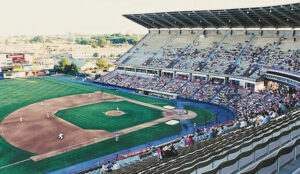 |
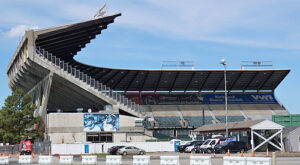
| This was The Diamond during a Richmond Braves contest in 2006. Later when the Flying Squirrels came to town, they covered the upper deck with advertising banners. Below is how The Diamond looked as CarMax Park opened in April 2026. |
 |
One has to wonder if the execs in Atlanta had second thoughts after abandoning Richmond, which was a solid Triple-A market that supported baseball regardless of how nice the home ballpark was. For the nine seasons before the move, Richmond’s average attendance was 402,000. Even in a brand-new stadium in Gwinnett County, in the 16 seasons since the move to Gwinnett (there was no season in 2020), the average has been 238,000. Even in the lame-duck season of 2008, Richmond’s attendance was 289,570. Gwinnett hasn’t cracked 250,000 since 2015.
Maybe that has something to do with the Braves’ decision to sell the Gwinnett franchise to Diamond Baseball Holdings in 2021.
Even with a sub-par facility, it was obvious to the baseball world that Richmond is a tremendously supportive baseball market. The Diamond was only empty for one season after the Braves left, as the Connecticut Defenders of the Double-A Eastern League jumped to Richmond for the 2010 season.
The franchise went through a rebranding as part of the move, becoming the Richmond Flying Squirrels following a name-the-team contest held by the city’s daily newspaper.
While it would have been nice to make significant renovations and add social/group areas to The Diamond for baseball’s return to Virginia’s capital city, the structure of the stadium wouldn’t allow it. Instead, the Defenders’ ownership made modest changes (such as covering the upper deck with ad banners, reducing the capacity to under 10,000) and put their efforts into pursuing a new stadium.
It took 16 seasons, but they got one.
Anthony Oppermann is the current general manager of the Squirrels. He describes himself as a “thrice recycled” member of the front office, as he left and returned twice. “My first day on the job actually was the ‘Baseball’s Back’ press conference in Richmond on September 23rd, 2009. At that time, I … just basically did a little bit of everything. But it was the opportunity to come to Richmond and a AAA market, and be a member of the broadcast team with a good friend of mine, John Lacer, that was so appealing — that and the promise of a new ballpark back in 2009.”
| Thrice recycled |
 |
| Anthony Opperman is in his third stint with the Flying Squirrels. As the team’s current GM, he’s been very involved in getting the new ballpark ready. |
Who could’ve imagined it would take all this time to make it happen.
“Honestly, for me, the road to CarMax Park and getting it done is a story of perseverance and belief. Our ownership group, led by Lou DiBella, the managing partner, always believed in Richmond. There was the hope that if you got a new venue in Richmond, that it could really be a special market.”
To be honest, even before CarMax Park, it was a very impressive baseball city. Now with this showplace ballpark, it is one of the very top markets in Double-A. Truly, it’s a Triple-A city masquerading as a Double-A market.
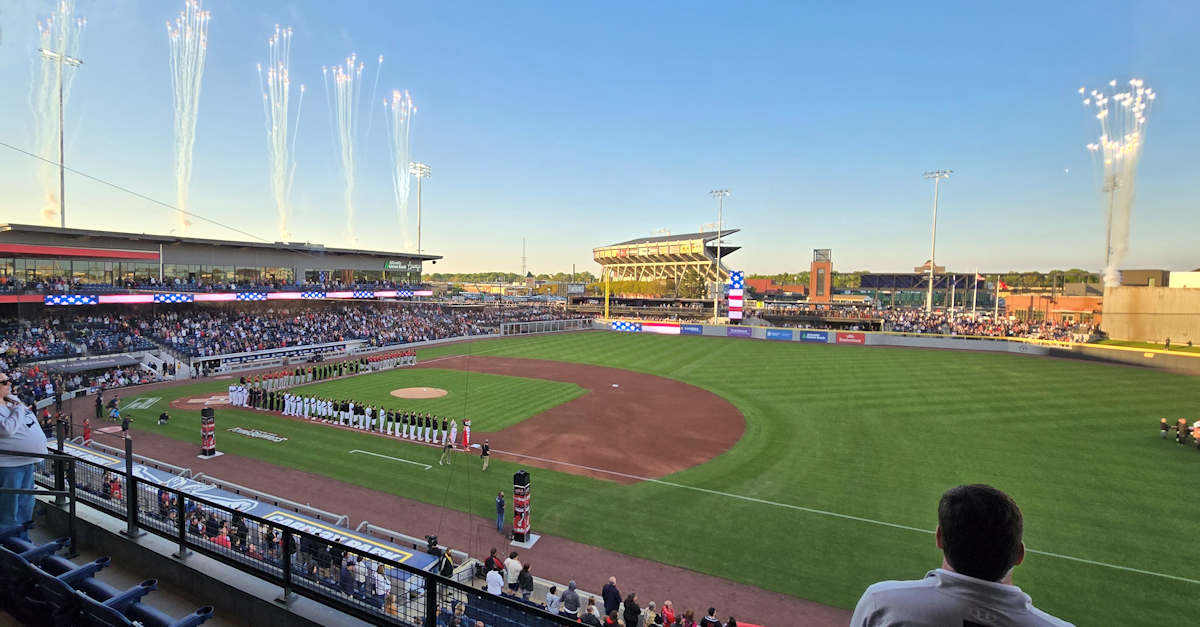
The photo at the top of this section shows the National Anthem at the park’s opening night on April 7, 2026. The immense stadium in the very center of the shot? That’s The Diamond, of course.
Let’s take a closer look at this market and why this site was chosen for CarMax Park. Then we’ll dive into the architecture of the stadium, and what amenities it offers the fans and players.
You know, when a new car includes lots of accessories, the salesman will tell you that it’s “fully loaded.” So is this CarMax also fully loaded? Let’s find out!
The Setting
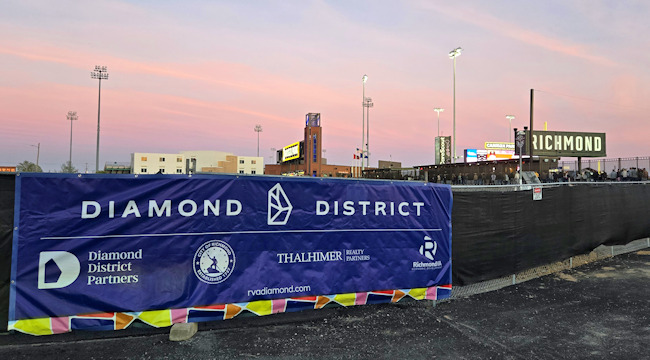
When I lived on the East Coast, I drove through Richmond numerous times. The only times I stopped in the city was to see baseball at The Diamond.
This was very dumb of me, as Richmond’s attractions and history are just begging to be explored.
On the east side of town is Church Hill, where the Civil War’s largest military hospital was located in what today is Richmond National Battlefield Park. Its 150 medical tents have been replaced by a sprawling park with a stunning view of the James River Valley below.
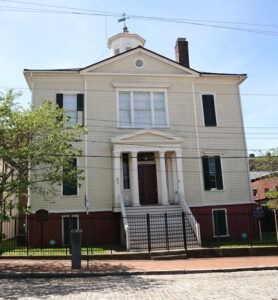 Closer to downtown is Shockoe Bottom, where the history oozes from the cobblestone streets and buildings that date back to the Revolutionary War. It also was home to one of the biggest slave-trading exchanges in the country. Tourists today can walk on a trail that goes by the spots where slaves were unloaded from ships, displayed in slave markets, auctioned off and even where an unknown number are buried. Richmond was the leading center of slave traffic from 1830-1860.
On the edge of this neighborhood is a historic spot that you would absolutely miss if you’re not looking for it. Here on the banks of the James River, three train tracks pass over each other (photo below). Its official name is the Richmond Triple Railroad Bridge Crossing. Its top trestle was completed in 1901, marking the first time such an engineering feat had been accomplished in the world.
Just for good measure, there are two highway overpasses towering over this confluence of train tracks. You’ll quickly notice that Richmond is a city of bridges and overpasses, and in the center of town where the James River flows and trains and automotive traffic intersect, I can’t think of another location in the country with this concentration of bridges.
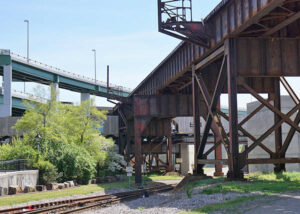 This historic railroad feature and the adjacent neighborhood of Shockoe Bottom are actually part of the story of CarMax Park. We’ll touch on the railroad theme in the park in The Design section of this review. Shockoe Bottom figures in this tale because there was proposal after proposal to build the city’s new ballpark here. The thinking was that there were already tourist sites here, and a ballpark would shine an even brighter light on this historically important area.
Even though this was thought to be the preferred site for several years, eventually Shockoe Bottom was determined to be unworkable. “There were some concerns about that site in terms of its low-lying flood area and also some cultural sensitivity about it,” explains Michael Montgomery. The architect for LaBella Associates was one of the key designers of CarMax Park.
Focus for a new stadium then returned to the area containing The Diamond. This made sense for a variety of reasons, not the least of which was the desire to surround a new ballpark with the oft-used phrase “mixed-use development.” As the city refined what they wanted in an overall development, the name Diamond District was attached to the 67-acre trapezoid that included The Diamond, Virginia Commonwealth University’s soccer and track stadium, some city maintenance buildings and lots of parking lots.
Everyone knew that what happened in the winter of 1984-1985 (when Parker Field was torn down and The Diamond was constructed in its place in one offseason) could never happen today. Therefore, for the time being, The Diamond needed to remain intact while a new ballpark was constructed.
So the city pinpointed a 10-acre parcel on the west side of the to-be-developed Diamond District to house a new ballpark. The maintenance structures that filled this site were (according to the “historical imagery” of Google Earth) demolished in 2015, leaving a nicely leveled grass field. This field remained until excavation for the park began in 2024.
To understand the design of the park — both its footprint and its orientation — you need to know more about this 10 acres. It is bounded on the northwest by Arthur Ashe Boulevard, on the southwest by railroad tracks, on the north side by the parking lots of The Diamond, on the east side by VCU’s soccer stadium and on the southeast by commercial buildings that appear to have been removed in late 2016.
By no means did this result in the perfect square or circle that might be desirable for a sports facility, but at least the designers had something to work with.
Montgomery explained that while they looked at the way the setting sun might be in the players’ eyes, “we were mostly constrained by the agreements that were in place with the master developer. We also had to get (the team) comfortable that their operations were going to need to change because of the site and what was going to come later,” because there was going to be a hotel attached to the ballpark on its west side and a strip of retail shops just beyond left field.
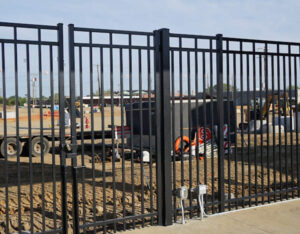 While The Diamond and the soccer stadium are eventually going to be removed to make way for Phase Two and Three development, they were absolutely in the way as CarMax Park was being constructed.
The result of all of this is that the footprint of the ballpark is pretty much backed up against Arthur Ashe behind third base and the railroad tracks behind first base. As we will see, there are no entryways for fans whatsoever — and no parking — other than on the outfield side of the park. That makes this an unusual ballpark indeed.
So the surroundings of CarMax Park as it opens in 2026 are very different than what they will be in future years. Construction has already started on apartments beyond right field (see photo above). A strip of retail shops will be just beyond left field and a hotel behind third base. Construction on those hadn’t started as the park began hosting games.
So for now, what you see beyond the outfield is the soccer stadium (not very tall) and The Diamond (absolutely unmistakable because it’s very tall — much taller than CarMax Park). Those two sports facilities will be demolished in the next two years, making way for stores, more apartments and eateries. I’m sure Richmond’s baseball fans can’t wait!
The Exterior
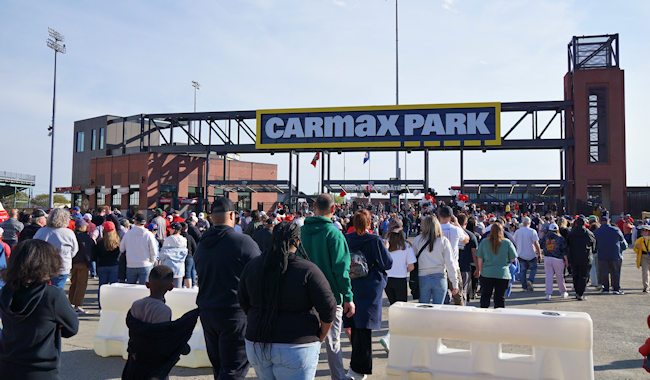
To be blunt, the exterior of CarMax Park isn’t its strongest feature. Far from it.
But it does have a stunning, signature element.
And when the construction of the retail strip and adjoining hotel are complete, things will look quite different than in 2026.
Let’s take a look around the park’s exterior, going counter-clockwise from the main gates beyond center field … but be advised you won’t be able to take this stroll once more of The Diamond District’s businesses are built!
The vast majority of fans will enter through the center-field gates, and until the soccer stadium is demolished, there is a makeshift plaza there (see photo at the top of this section). On the left of this plaza are the ticket windows and an outer entry to the souvenir shop (below). 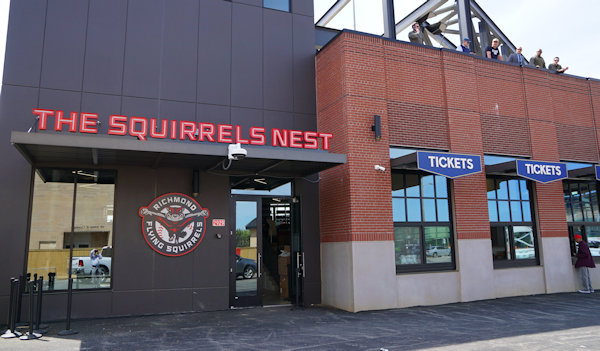
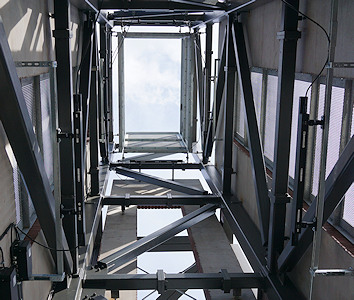
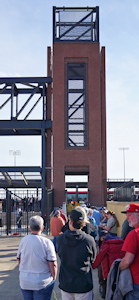
On the right edge of this plaza is — to me — the signature element of CarMax Park: a tower (below). I asked if it is meant to resemble some structure elsewhere in Richmond, and it doesn’t seem to be the case. Regardless, it is beautiful, and it will soon be outfitted with colored lights where the colors will have various meanings. It was also clever to design it to act as the wheelchair entry. If you do enter this way, take a look up as you go through it!
  |
As we go counterclockwise around the exterior, you’ll see what will be the foundation of the strip of retail stores beyond left field. Just to the right of that is the park’s only other entry gate. To the right of that is where a hotel will be built (below). From what I understand, it will connect in some way to the ballpark’s concourse and/or upper hallway.
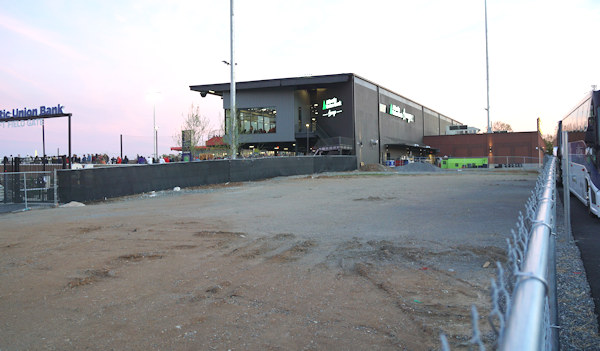
The loading dock you see in the distance in the above photo will serve both the ballpark and the hotel. Once the hotel is built, an access road that currently leads from Arthur Ashe Boulevard to the area behind the ballpark will no longer be open. To access that loading dock, trucks will have to enter the lane from behind the first-base side of the park.
Other than catching a glimpse while traveling over the railroad tracks on Arthur Ashe Boulevard, most folks will never see this “back” side of the ballpark, behind the entirety of foul territory. Basically, it is a continuous brick wall, with nary a door. There is a simple door where visiting players enter, one for the umpires, and a couple for team employees. Otherwise, there is nowhere for a fan to enter the facility.
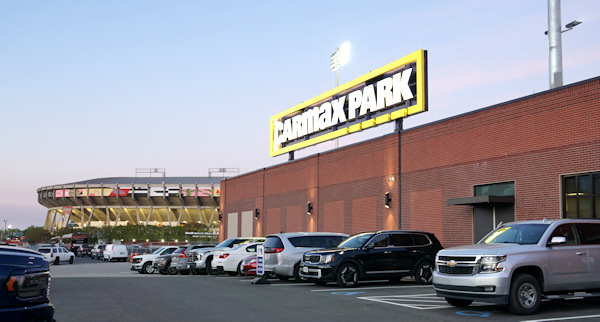
The most noteworthy feature on the exterior behind third base is a large CarMax Park sign (above) that can be seen (barely) from the interstate. The stadium in the distance in this shot is, of course, The Diamond.
Behind first base, part of the structure is two stories tall. While the three clubhouses (one is for VCU, who will move its games to CarMax Park in 2027) and batting cages occupy most of the space behind the main concourse, the top floor in the photo below is where the spacious team offices are located.
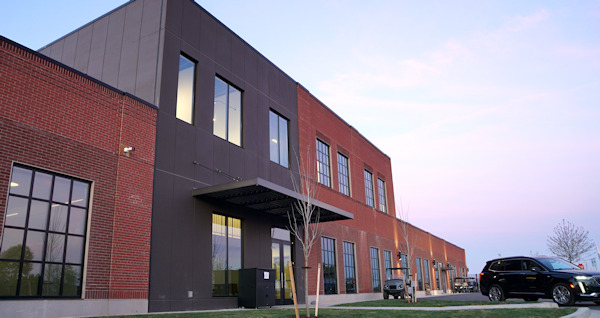
If you continue around the exterior, you reach a point beyond right field that is a construction zone for apartments. The designers of the park provided space for there to be an entryway for fans on this side if there is demand for it once the apartments are finished. If it’s added, that will mean the park’s three entry gates are all in the outfield, certainly not typical of a recently built stadium.
So while the exterior won’t be featured in Architectural Digest magazine, the interior deserves to be. Let’s now venture inside CarMax Park.