Back to page 1
The Design
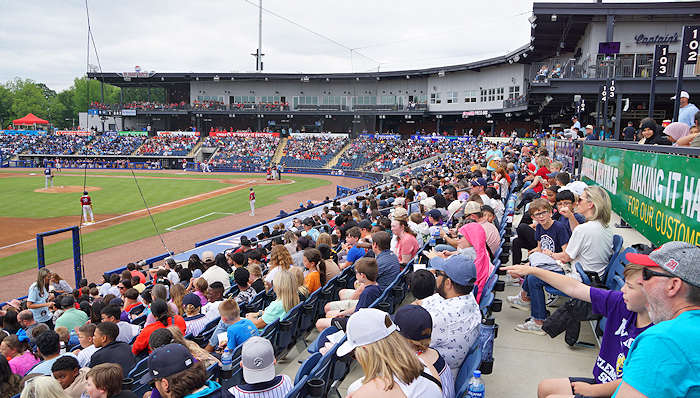
Ever heard of the word “charrette”? The American Heritage Dictionary defines it like this: A collaborative planning or design session, often involving interested third parties such as public officials and environmentalists, in which problems relating to a proposed architectural project are discussed and solutions adopted in a limited time frame.
Pendulum’s Cole said his first dealings with a proposed ballpark for Wilson was when he was invited to a charrette in Wilson. “It was by invitation only, and there were three or four architects with the development group and some other interested parties. It was a day-long workshop on the topic of if we were going to do a ballpark here, what would you do? I think there were folks in there that had preconceived notions about what it should be, but I wanted to really challenge the group to look at things differently.”
Did Cole have reservations that a pro ballpark could work in a city as small as Wilson? “Not at all, because I think our best projects are the ones that are challenged in that way. You’ve got to look ahead 10, 15 or 20 years, and what I saw here was a lot of opportunity for growth. So this didn’t scare me.”
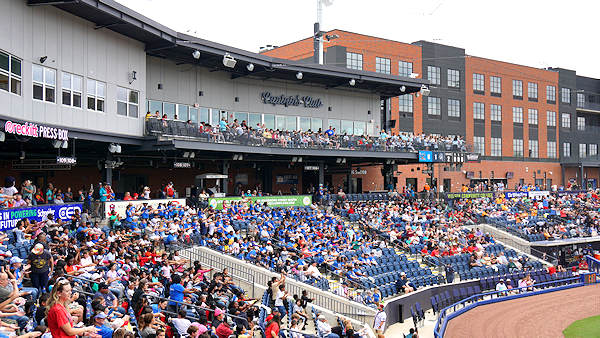
Cole understood that the ballpark would need to be intimate while still having the amenities that modern fans require. In other words, by “right-sizing” the facility, intimacy could be achieved while never making the fans feel like they were in a small, inadequate ballpark. “I tell people all the time that we’re not selling architecture. We’re selling a vibe. When you come to the ballpark, you’re supposed to feel like, wow, this is impressive. This is cool, but you don’t know why.
“We started out with an intentional ‘less is more.’ This (park) is really kind of understated. You want to drive demand. You want people to want something that they can’t have,” because there is a limited number of seats.
“I always want the ballpark to look full. No matter when you’re here, the magic is in feeling like it’s still cool to be here.”
This starts by resisting the urge to overbuild the seating bowl. In most sections, there are only about 13 rows. The open concourse directly behind the last row keeps fans connected to the action on the field.
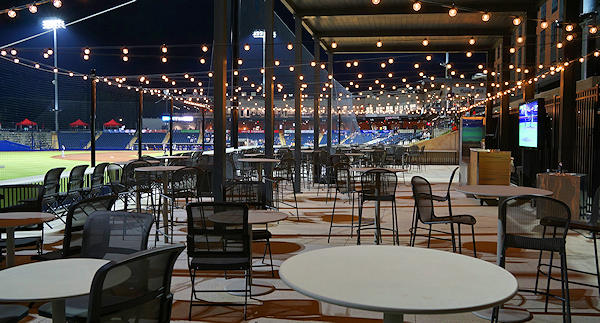
As we’ve established, the key to the franchise’s financial viability is group sales, so the park is designed to accommodate them. Down the third-base line is a partially covered space for groups up to 200 (above). It has a wonderful name chocked full of alliteration: the Poba Party Patio.
In keeping with the aviation theme, the Pepsi Flight Deck is a covered space for up to 50 people on the upper level down the first-base line. The largest space in the ballpark is the Captains Club. At 3,000 square feet, it can hold up to 200 fans. It is completely enclosed and air-conditioned (making it perfect for non-baseball events year-round), with tiered seating along its front (below)
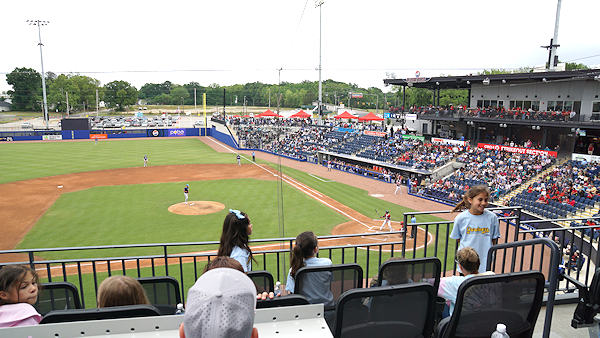
In between the Deck and the Club are suites and the press area. Cole has heard me complain for years about the poor location of pressboxes in new parks in recent seasons, but this one is a dandy, almost directly behind home plate on the upper level.
The team’s GM is David Lawrence. He told me his favorite aspect of the ballpark is “the flexibility of the group spaces. We have spaces for larger corporations and spaces for smaller organizations and families, such as a suite. We have spaces for everybody in the community.”
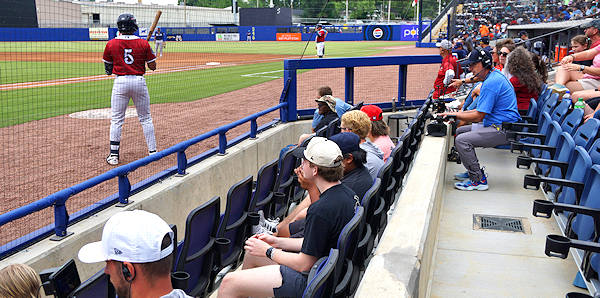
There are no field/dugout suites like there are in Richmond, but the front two rows of seats in the main bowl are separated by a short wall from the rest of the seating sections (below). This area is also accessible to wheelchairs.
Down the first-base line is a set of four-top tables. This section is angled so it faces the infield rather than outfield. Just behind that section on the level of the concourse are round picnic tables with umbrellas. The only berm here is down the third-base line.
Cole’s ballparks always have a 360-degree concourse, and this is no exception. In the outfield, the walkway runs parallel to the end-to-end bullpens in right field. The drink rails there provide a great view of the action — and sunsets (below). “For me, it’s the 360-degree concourse,” said team president Ricciutti when asked for his favorite feature at the park. “What it does is facilitate community, because you’re not stuck in your seat. You can wander the ballpark. You see everybody at the drink rails in the outfield just looking in.”
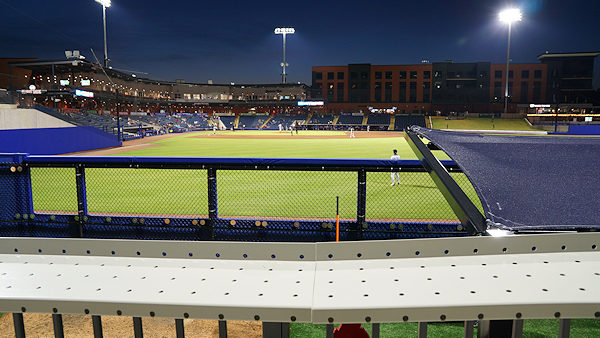
On the left-field side of the batter’s eye is a standing room area with drink rails. This is close to the beautiful kids playground that I am happy to report has netting to protect the area from home-run balls, especially during batting practice.
Again, it is interesting to note how the hotel is integrated into the ballpark. On the ground floor of the hotel are the team offices and other player areas. One level up from that is the team store and concession stands — and everything above that are the hotel’s rooms.
So the architecture of Wilson Ballpark certainly meets the “less is more” mandate — but without feeling that it’s small. Perhaps Paul Durham of the Wilson Times put it best: “The stadium is probably the most spectacular building ever constructed in Wilson County.”
But you probably want to know what it’s like for a fan to attend a game there, right?
The Essentials
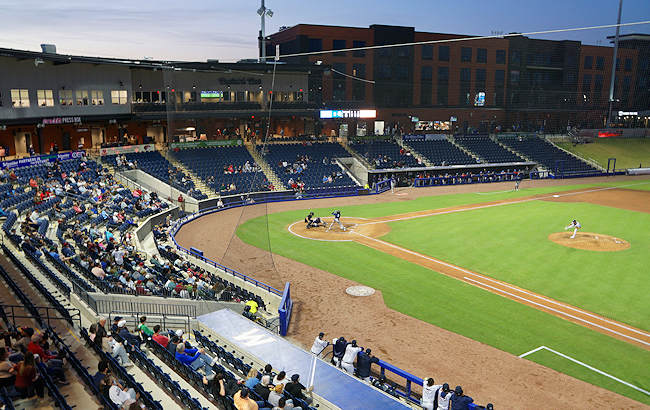
Even though there aren’t countless fun attractions at Wilson Ballpark compared to, say, the new parks in Chattanooga or Richmond (each of which cost roughly double to build), it’s still a fun place to take your group or family. And it’s affordable, like Minor League Baseball ought to be.
One way it is fun is that it doesn’t take itself too seriously. Again, this is how baseball should be. The team’s mascot — an eagle, I guess — is named Wilt.
Most people won’t give it a second thought, but since I overthink everything (have you seen how long these ballpark reviews are??), I asked city manager Lentz if the city used be named “Wiltson.” He explained that long-time residents have consistently pronounced the name of the city with a “t,” even though it’s never been spelled that way. “For instance, with our longtime mayor Bruce Rose, who was the fire chief for a long time, there would be a ‘t’ when he would say it.” He added that the non-profit to raise funds for downtown redevelopment made T-shirts that spelled the city’s name as Wiltson. They sold those shirts at the annual Whirligig Festival, and sales “really took off.”
The team even has a promotion called “Wilt-son Wednesdays,” where Wilson County residents can purchase $16 tickets for just $12. I think that might be a first, where a team builds a promotion around the mispronunciation of the city’s name!
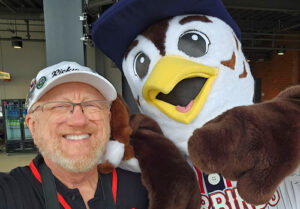 If you want to watch the antics of Wilt — the eagle often attired like a WWII aviator (shown with an over-age ballpark reviewer) — you probably want to know what it’s like to attend a Warbirds game.
As we’ve mentioned, the parking is free, but it’s not concentrated in a single lot. Lentz says that the naysayers all said “it’s going to be a disaster for parking and traffic. It’s going to be horrible. But we have ten parking lots you can choose from, which if you think about it, also helps traffic, because there are ten ways to get out of downtown.”
The largest lot holds about 600 vehicles. It’s behind the third-base side of the exterior, near the hotel. For other lots that are several blocks away, the team operates a free shuttle. “Parking is the first touch that a fan has with the organization,” notes Ricciutti. “When you think about the linear path of the fan experience, it starts in the parking lot. So our focus was to preserve that fan experience.”
Seats in the main seating bowl are $16, plus fees if you order online (they are $18 if you walk up to the ticket windows on the day of the game). At the four-top tables down the first base line, tickets are $30 plus fees, and that includes food and drink from a stand behind the section. You have to buy all four seats at a table. Tickets for the Poba Party Patio are $40, which includes a buffet. To get into the Captains Club and eat their “upscale buffet,” it’s $60.
All in all, these are reasonable prices.
The merch store down the third-base line is big and beautiful. It doesn’t have a door directly to the street outside, but it doesn’t need to, since the ballpark is left open when there’s no game going on, so fans can walk right in to go to the store.
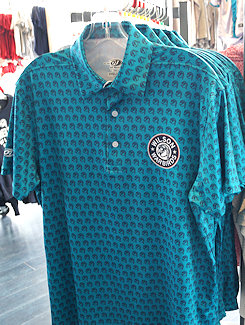
OT, an apparel company based in Burlington, NC, is the naming partner for the store, plus they produce some of the jerseys and shirts sold in the store. They offer jersey tops in two colors for $120 that sold out during the first homestand. Of the high-end apparel, there’s a quarter-zip jacket by Antigua for $80, and one by OT for $72. There’s an Antigua hoodie for $90 and short-sleeve polos for $70. Perhaps my favorite is a polo by OT for $72 (below).
  |
A hoodie for women by Bella is $68, and tees by Cutee are $25 and Soft As A Grape are $32.
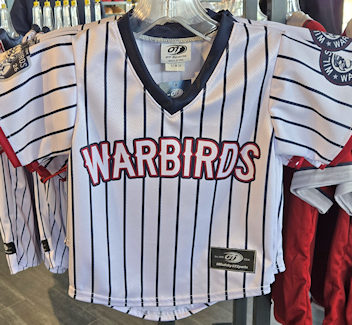
There are kids hoodies for $34 and $40, and long-sleeve tees for $24. OT makes replica jerseys for kids for $70 and $95 (above).
There are lots of cap styles. For men, fitted caps are $48, while adjustable ones are $35 and $46. Women’s caps are $30 and $34, while for kids they are $34.
And my favorite souvenir at a ballpark are lapel pins. I’m overjoyed to report that they have six different styles, ranging from $8 to $10.
As for food, the Warbirds decided to “self-operate,” as Ricciutti puts it. In other words, they didn’t hire an outside firm to manage the concessions. “That way, you get to determine what goes on the plate, and you get to determine the price. We get to maintain control over the definition of what’s affordable, and we want to provide affordable family entertainment.”
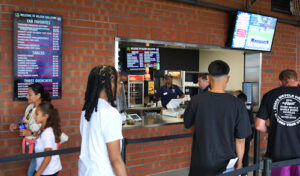 The stands behind the main seating bowl have pretty typical ballpark items, such as hot dogs ($5.25) by a North Carolina firm called Bright Leaf, and the ever-popular chicken tenders and fries ($10.25). If you like your meals on a bun, they also have a jumbo dog ($7), Carolina red hot ($7), a footlong dog ($10), and a brat with sauerkraut ($11). Ricciutti is indeed offering affordable eats.
Cole points out that these stands were designed with extra room for food prep, so what is a fairly basic menu now can be expanded greatly in future seasons. “The difference between a cookie-cutter ballpark, where you just do what has been done somewhere else, and this is that here we’ve left room on the canvas to grow with the community. I guarantee you the food will be slightly different in the concession stands next season.”
But you don’t have to wait for next year to partake in some elevated food items now. Lentz says that Ricciutti wanted there to be food carts along the concourse near the right-field foul pole. “He kept telling me ‘That’s where the good food is going to be.'” So during the first homestand, Lentz wandered down to “try one of these darn cooking carts that Joe wanted. What I found was that the best deal in the ballpark is the cheesesteak. It’s fresh because they make it right there in front of you. And the people (working there) are really nice. I’m like, this is the best.”
Indeed, these carts (not all of which are open at every game) serve up BBQ smoked on the premises (see below for the system used to do the smoking), theme burgers and Lentz’s favorite cheesesteaks.
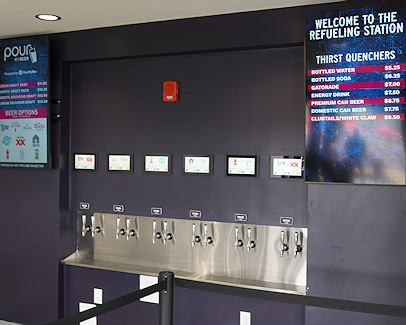
As for drinks, there are innovative self-serve beer taps in an area called the Refueling Station behind third base (below). Here you’ll find standard favorites like Miller Lite, Dos Equis, Blue Moon and Michelob Ultra. And if you’re keeping score, this is a Pepsi facility.
 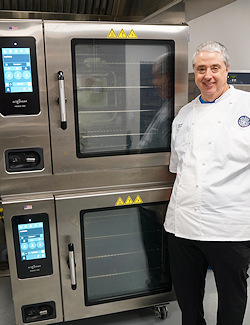 |
Speaking of facilities, the commercial kitchen behind the scenes is stunning. Ballparks with twice the seating capacity don’t have half of the sophisticated equipment found here. Executive Chef David Larson proudly showed me the Alto-Shaam Prodigi Pro system that can steam food (up to 800 hot dogs every 11 minutes), act as a smoker or as a convection oven — or a combination of these methods. And the Warbirds have two of these top-of-the-line beasts (see above) — plus they have automated Frymaster fryers that even shake the food after lifting it out of the cooking oil.
For the kids, there is a wonderful playground beyond left field. The city plans for it to be accessible even when there is no game going on. So go look at Whirligigs and let your kids whirl like tops at the nearby playground.
All in all, there is a very solid gameday experience at Wilson Ballpark.
Summary
With the undeniable link between the Whirligig Park and Wilson Ballpark, why didn’t the team adopt the nickname of Whirligigs? Wouldn’t kids have loved that, like Trash Pandas or Sod Poodles?
Aside from possible trademark issues, there was a desire to tap into the fact that “Eastern North Carolina is military-centric,” explained Lentz. “There’s also an airport nearby that was used for training during World War II, and that’s where we made the announcement (about the team’s nickname of Warbirds).” Plus there was a motivation to honor Vollis Simpson, who served in an aviation unit in WWII before he started creating kinetic sculptures on his farm in Wilson County. “And when you look at all those whirligigs, tell he how many look like airplanes.” The answer: the vast majority of them.
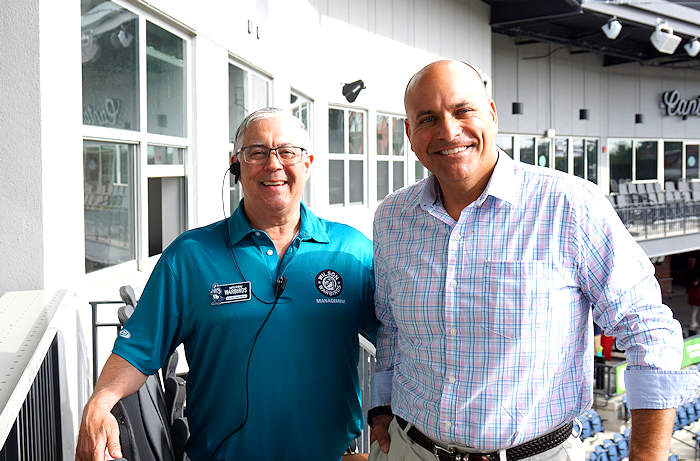
This is but one successful partnership between the team and the city leaders. “We had a good relationship with our previous home in Wake County (with the Mudcats) during the 35 years we were there, but within a very short period of time of getting to know the folks in Wilson, it felt like I had known them and worked with them for 30 years,” said GM Lawrence (on the left in the photo above). “These aren’t just words. It’s the actions. You not only feel it, you see it.”
Adds president Ricciutti (on the right above), “The crowds here feel that, too. People were coming up to me (on Opening Night) saying that they couldn’t believe that this is only Game One. It feels like you guys have been doing this here forever. And the reason things have run so smoothly is because of the partnership (between the team and city).”
And Jonathan Cole’s assertion that right-sized Wilson Ballpark is “pound for pound” the best value — without feeling small — among the recent crop of new ballparks certainly seems to hold water. After all, the parks in Hillsboro, Chattanooga, Ontario and Richmond (the other 2026 parks) — as well as San Antonio’s new stadium coming online in 2028 — all cost well, well above $100 million, while Wilson’s impressive entry came in around $64 million. And by no means are those other parks twice the facility that Wilson Ballpark is.
Plus none of the others have whirligigs.
Provide a comment below with your thoughts about Wilson Ballpark or this review.
Another ballpark review triumph! It made me want to move to Wilson. I appreciate the ramp up with the very cool whirligigs history. I love the love you have given to Jonathan Cole. He and his team have come a long way, and Pendulum is deserving of every accolade! While the military connection in the branding is cool and smart, and I understand moving away from Wilson’s historic tobacco past, I miss the Tobs name. I hope one or two throwback promotional nights will be planned in the seasons ahead at this amazing new park!