Back to page 1
The Design
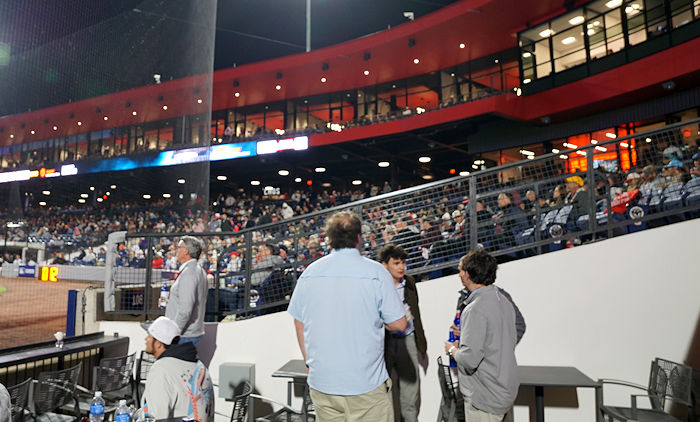
CarMax Park cost in the neighborhood of $135 million to build. As we’ve seen, the exterior is not where the majority of the dollars went. What is on the inside, though, is worth every penny.
Let’s start with the park’s most outstanding features — even if many fans won’t get to experience them. These are the “premium” spaces and group areas, and CarMax Park has more of them than nearly all Triple-A parks, and some on the Major League level.
Exhibit A of the premium spaces are the two Dugout Suites. The photo above was taken from one of them, and the shot below shows the breathtaking view of the action from the outdoor portion. Note that there are sliding glass doors that separate the outer portion from the inner. The latter is where the food and drinks are served — and the menu for these suites offers the best the kitchens at the ballpark have to offer. Also, a larger group (up to 100 guests) can book both of the spaces, as there is a sliding barndoor-like structure that can be opened or closed accordingly. There is also a gate between the railings separating the two outer areas, as you can see below.
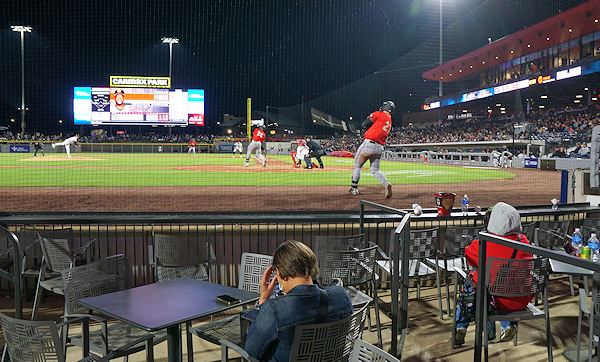
Such Dugout Suites have become fashionable at newer Minor League parks — you’ll often hear “you’re closer to the plate than the pitcher is” — but the size, flexibility and view of the action are unrivaled in Richmond.
You’ll find high-end lounges on the upper level behind home plate at most newer parks, but here the designers took a different approach. The middle spot is where the pressbox is located — the first new pro park in years to place the media spaces directly behind home. Instead, the Flying Squirrels’ upper-level club is the huge Atlantic Union Bank Lounge (the team refers to this as the “AUB Lounge”) at the very end of the third-base side. Montgomery said that from the beginning, the City and the team placed an emphasis on “how do we maximize for concerts, community events, weddings or parties?” This 6,000-square-foot space is the answer.
Note that the design team bucked the trend of putting partially covered picnic decks at each end of the upper level. Instead, on the third-base side is the AUB Lounge and on the first-base end is the City View Suite, which is about triple the size of a standard suite and accommodates groups of up to 50. In between are the pressbox and 20 normal-size luxury suites that each hold 24 fans — although each suite is larger than is typical at new Minor League parks.
But the AUB Lounge is by no means the only enclosed premium space. Directly behind home plate on the level of the main concourse is the gorgeous Legacy Club, with its own seating sections right in front of it. Similar to the Budweiser Home Plate Club in Charlotte’s Truist Field, it is the most luxurious space in the entire stadium (below).
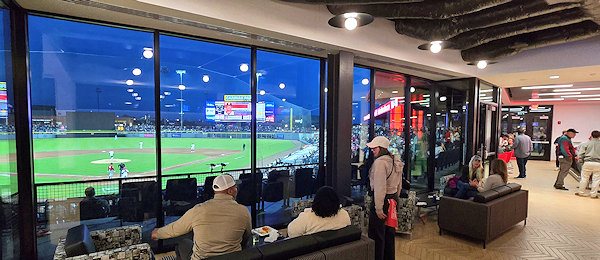
But wait. There’s more!
Oppermann explained that the team owners really wanted “to have another premium option within the venue if there was a market for it.” When the team and architects met to discuss this, they acknowledged that The Legacy Club would be blocking the view of the field from the concourse behind home plate, creating the potential for “dead real estate,” as Oppermann called it.
He gives LaBella’s designer Anthony Hersey credit for the solution. “In the middle of this conversation, he ends up literally drawing on the screen we were looking at.” Hersey suggested widening the concourse behind The Legacy Club, positioning a bar there and putting garage doors at each end. On game days, those doors would be up, allowing easy passage for fans walking through, and on non-game days, those doors could be lowered, enclosing the space. This would permit air conditioning in what is essentially a third hospitality lounge, ready for birthdays or fantasy-team-draft parties.
“Once he drew that on the screen and designed it in that moment, we were like ‘That’s it!'”
So give the credit for the bar that is today called The Backstop to Hersey. Says Oppermann, “That is a small example of the close collaboration between our team, the LaBella team and ultimately the (Gilbane) construction team to bring that to life.”
Believe it or not, we’ve only scratched the surface when it comes to CarMax Park’s group spaces.
In the right-field corner is the covered Woodfin Yard, the largest (non-premium) group space in the park.
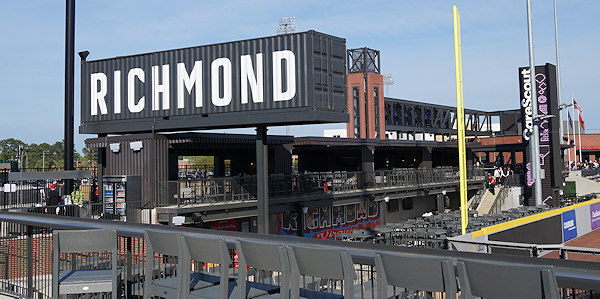
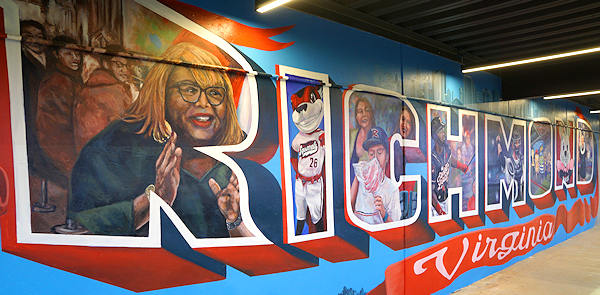
In the left-field corner are four distinct group areas — two up on the main-concourse and two down on the field level. There are four covered Rail Car Suites that each hold up to 20 fans. They are just below the “boxcar” that says RICHMOND in the photo above. These were inspired by the Triple Railroad Crossing in downtown Richmond. Just to the right is the group space called the Power Alley Terrace.
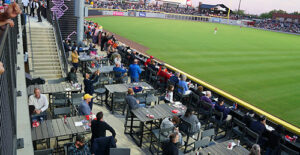 In a true maximization of space, there are two hospitality spaces down below the Rail Cars and the Terrace. Closest to the left-field foul pole is The Landing (which reminds me a little of the field-level space in left field at SRP Park in North Augusta), and more toward left-center field is the Power Alley Porch. Be advised that the only thing separating these two spaces from the playing field is the top of the left-field wall — and there is no netting to block balls rocketing your way. Stay alert during batting practice!
For those needing wheelchair access to these two lower-level spaces, there is a lift (it’s not technically an elevator. Beats me what the difference is). Instead of building the shaft for the lift only as tall as necessary, the designers built it extra tall. Why? So the side of the shaft facing the seating bowl can be used as an auxiliary video board — really, a tall skinny ribbon board. It’s perfect for listing the standings, or league statistical leaders. The shaft — dubbed the CareScout Power Tower — “combines functionality, sponsorship and game interaction,” says Hersey. This video board is one of the more clever design features of CarMax Park.
There’s an open space adjacent to the visitor bullpen called The Patio that anyone with a ticket can access. Two important things to note: there is a bar there (of course) and you can really heckle the opposing pitchers as they are warming up.
Let me make this observation about the multitude of group spaces and, in fact, the overall look of CarMax Park. Perhaps because it was designed over such a long period of time or because so many designers were involved (see below), each space seems to stand alone. In other words, there doesn’t seem to be a theme in color and/or construction materials that is consistent from one space to another to another. Each space is lovely on its own, but other new parks like Knoxville or especially Salt Lake City have a more consistent theme throughout. Fans probably couldn’t care less, but it’s something I noticed because I do nothing but scrutinize ballparks!
 As much as the architects wanted the main concourse to be on exactly the same level as the streets and parking lots, there was a problem: water. Even though the James River is three miles away, the water table was closer to the surface than the early designers had hoped. Therefore, they couldn’t excavate the field as deeply as they wanted, resulting in everything being a little higher/taller than desired. This necessitates that fans climb several steps or ramps to get to the concourse when emerging through either entry gate.
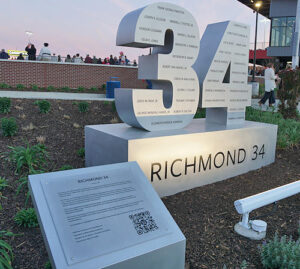
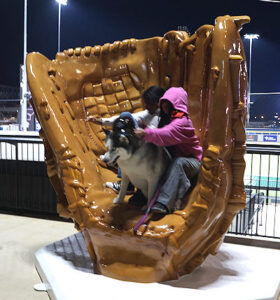
There are definitely some really special touches in the park, things that don’t have to be there, but add to the gameday experience by their presence. One is a massive glove down the third base line that makes for a great family photo opp. Another is the set of photos of past Richmond baseball greats (notably longtime Richmond Brave Tommie Aaron) on the back of the batter’s eye. Still another is a memorial to the “Richmond 34,” protestors who were prominent in the city’s integration achievements in the 1960s.
You certainly can’t see it all in just one visit.
We’ll talk more about the non-group seating areas and concession stands in the next section … but before we leave The Design section, let’s talk about the entities that brought CarMax Park to life.
 Richmond’s desire for a new park goes back decades and was known far and wide. As a consequence, every sports architect in America has made a pitch or had a hand in this project. Odell, who helped design several ballparks in the Southeast including North Augusta and Charlotte, worked on early plans for this park. In November 2021, Odell and its architects were acquired by LaBella Associates. Notes Montgomery, “projects follow the people and the relationships you make along the way,” so LaBella became the architects of record on the Flying Squirrels’ plans. Martin DiNitto of Ballpark Design Associates, who had worked with Odell on Charlotte and North Augusta, assisted them, particularly on matters relating to compliance with Major League Baseball’s ever-tightening standards for Minor League parks.
Montgomery also explained that the Richmond Economic Development Authority “had a really aggressive and I think well-intentioned goal of having up to 40% participation from historically disadvantaged businesses. So KEi fit that role, and they played a part on our team. We did it together through the entire process.” KEi also had a lot to do with the interior decor of the park.
Acting as the owner’s representative on the project was the Machete Group, which specializes in arenas and stadiums. Handling the construction was Gilbane.
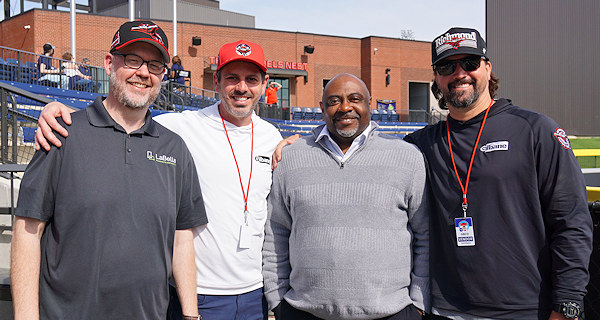
Here are the folks who showed me around the ballpark before the gates opened on Opening Night. From left are: Michael Montgomery, LaBella; Charlie Sursa, Gilbane; Anthony Hersey, LaBella; Patrick Albrecht, Gilbane.
Certainly there were plenty of other contractors and specialists involved, but it is my understanding these are the key players.
Now with that out of the way, let’s dive into what it’s like to attend a Flying Squirrels game at their shiny new facility.
The Essentials
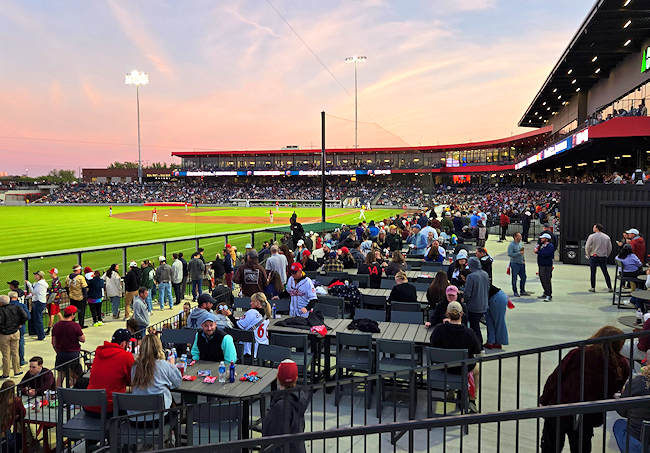
So you want to attend a Flying Squirrels game. Where do you park? How much does it cost? How expensive are tickets? Is the food any good? Let’s find out!
The parking lots for CarMax Park are essentially the same lots as for games at The Diamond. The biggest area is the Green Lot, which is beyond The Diamond’s and CarMax Park’s centerfields. The cost is $10. Note that the drop-off and pick-up points for rideshare services are on the north side of The Diamond, which is the opposite side of CarMax.
As far as tickets go, there is a stunning variety available — and a number of options that aren’t available. For instance, there are no memberships left for The Legacy Club, and the entire 2026 season is sold out for the nightly suite rentals, the City View Suite, and the Atlantic Union Bank Lounge. The other group areas, including the exclusive Dugout Suites, do have some availability.
As for the non-group sections, only the Home Plate Prime seats directly behind the backstop are sold out. Between there and The Legacy Club are the regular Home Plate seats that cost $30 per game. The other eight seating sections in the infield have a similar “Prime”/”Non-prime” organization, with the rows right behind the dugouts going for $28 per seat, and the rest at $24.
The five sections farther down the foul lines are called Baseline Prime ($24) and simply Baseline ($20). The farthest two sections in the main seating bowl are Corner Prime ($22) and regular Corner ($18).
At the backs of most of these sections are reserved Drinkrail spots that cost $16. Interestingly, reserved spots at the Bullpen Drinkrail right behind the home bullpen cost $10 more, at $26 — plus note the setting sun will be in your eyes here for an inning or two. Elsewhere in the outfield there are reserved bleachers called Knothole Seats for $12. This is a great, affordable spot for families because the playground (and restrooms with changing stations) are close by.
There really isn’t a difference between a ticket on the outfield berms or a standing-room ticket. Either way, the cost is $10, which as a get-you-in option is a reasonable price.
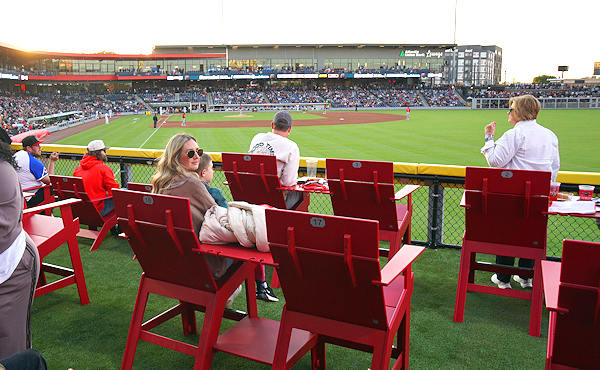
One of my favorite spots in the ballpark is the Yard Club (above). Positioned between the Woodfin Yard and the right-field wall, these uncovered seats are essentially upscale Adirondack chairs (in a beautiful red) set up in pairs with a shelf in between. These are sold only as a two-seat package for $60. I love the vantage point from this spot.
Overall, I find the ticket prices to be just on the high side of “fair,” but considering you can get in the gate for just $10, there are inexpensive ways to get into this luxurious $135-million showplace. “I think fans are going to be surprised at how intimate the park is, and at the variety of seating products available,” observed Montgomery in an interview prior to Opening Night.
Intimacy was something The Diamond never possessed, although the team did everything they could with the facility. A huge difference between the two parks is in the outfield. At The Diamond “we didn’t have fans in the outfield, while now we have four different price points and four different kinds of tickets there,” says Montgomery.
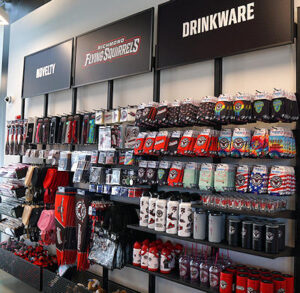 While there is a smaller merchandise store on the main concourse behind the first-base on-deck circle, the main store — called The Squirrels Nest — is in center field, near the ticket windows and the main entry to the park. This is smart positioning because the shop can be open even when a game isn’t going on.
With a logo as cute as a flying squirrel, you’d expect there to be a lot of adorable merchandise for sale here — and you’d be correct. In fact, there’s an entire wall of novelty items.
The cost for kids’ caps range from $16 to $24, while boys’ t-shirts are $18-$35 and girls’ tees are $17-$22. Women’s caps are $30 and $34, and a really cute pinstripe tee is $40. Sweatshirts range from $52 to $75, and crop-top tees (there are a lot of styles of this) are $24-$40. They have a stunning women’s jacket for $115.
For men, adjustable caps are $26-$40, while fitted models are $38 and $40. Tees range from $24-$40 and sweatshirts are $65. Nike Dri-Fit shirts are $45 and a sharp high-end Columbia short-sleeve button-down sport shirt is $72.
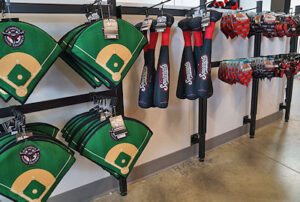 My favorite items, since I collect them, are lapel pins. I’m very happy to report that the store carries four different designs, all at the reasonable price of $7.
A surprise was the sheer quantity of novelties for dogs (see photo). I mean, why not?
As we move on to Food & Beverage, we need to note that Professional Sports Catering (PSC) is the food service manager here — the same company as at the Salt Lake Bees’ ballpark that opened last year. This is noteworthy because PSC brought two stars from Salt Lake here to Richmond to help the launch of operations at the new park: Dom Derboghossian, VP of F&B, and Chef Leonard Love. It was awesome seeing them at CarMax, because their creations for the Bees were otherworldly.
The permanent GM for PSC in Richmond is Mike McGhee. He explains that their philosophy for CarMax Park is “to get good food to you in a timely manner, so that you can enjoy the reason you’ve come here.” He adds that while there are no concession stands or food trucks from local establishments here, “we took our concepts from some of the local food trends.” This includes fried chicken and barbecue. “Richmond has a great history of barbecue,” he notes.
McGhee says the most popular concession stand since the park opened is the Squirrely Bird, down the third-base concourse. Here fans can find Nashville Hot Chicken on a sandwich with pickles, coleslaw and hot honey ($12), as tenders ($12) and with Belgian Pearl Sugar Waffles ($11).
Another hit is the Capitol Q stand, also behind third-base. This is where you will find the Richmond-Cue Brisket Sandwich topped with Sweet Baby Ray’s BBQ sauce (an inspired choice), coleslaw and pickles for $16. Their James River Pulled Pork Sandwich with similar toppings is $14. If you are really hungry and want the best this ballpark has to offer, order the $22 Q Combo Plate. This includes their brisket, pulled pork, baked beans, mac ‘n cheese and pickles.
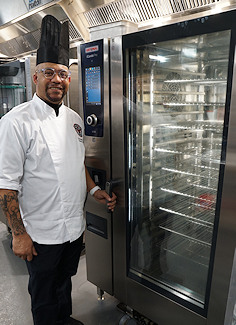 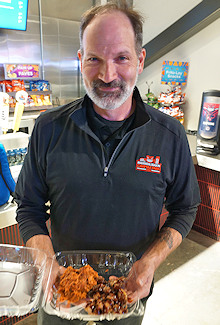 |
| Thankfully, smoked meats are a high priority at CarMax Park. Chef Wilson is showing off the brand-new smoker which is behind the Capitol Q stand. The pulled pork (the lighter color) and brisket are presented by PSC GM McGhee. |
Here’s the important thing about their barbecue: it is all smoked just a few feet away from this stand, using apple wood, hickory or maple, depending on the type of meat they are smoking. Says McGhee, “We have a gentleman here (Chef Wilson) who has been smoking meat for a very long time. He’s a real pitmaster.” I sampled both the brisket and pork, and they are both A+ … although the brisket doesn’t look like it does in my home state of Texas. That’s because it’s diced, rather than sliced or chopped. “We do that to keep the brisket moist and tender, and because it’s easier to serve.” Believe me, it works. The smoked pork is from bone-in pork shoulder, and the taste is smoky, almost sweet, with a tiny bit of heat. I could eat pounds of it.
Pro tip: they tend to run out of brisket first, so don’t wait until the late innings to buy some!
Scattered around the main concourse are self-serve areas called 804 MKT, where patrons select their food from heated shelving, then pay for it at touch-screen kiosks. This is where most fans will buy Nathans hot dogs ($5) and 1/3-pound burgers ($8.50).
There are also lots of free-standing servicing stands with things like Kona Ice and beers.
And speaking of beverages, note two things: this is a Pepsi facility (although Diet Pepsi and Pepsi Zero seemed to be absent at most stands, while Diet Dr Pepper was plentiful); CarMax Park taps into Richmond’s rich tradition of craft beers. Just a few blocks from the ballpark in the Scott’s Addition Historic District is Ardent Craft Ales. Hardywood Craft Brewery is in the West Creek part of town, and Falcon Smash from Triple Crossing Beer (yes, named for Richmond’s famed railroad crossing) is brewed downtown. “These three are great breweries that we’re lucky to have here,” notes McGhee.
Not all ballparks have as much for kids to do as CarMax. Ground Zero for fun for youngsters is the Bon Secours Base Camp playground in centerfield. On one side are features for toddlers, and on the other is a tower with a long slide for older children.
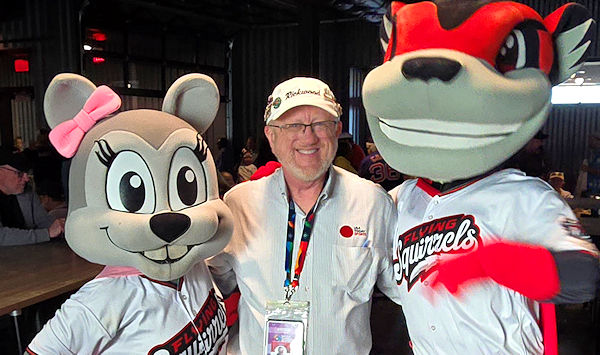
The mascots are fun, too (note that the Squirrels typically spell the word “FUNN” because, they say, there is simply too much fun at their games to fit into a three-letter word). They are named, cleverly, Nutzy and Nutasha. I couldn’t resist being photographed having some funn myself.
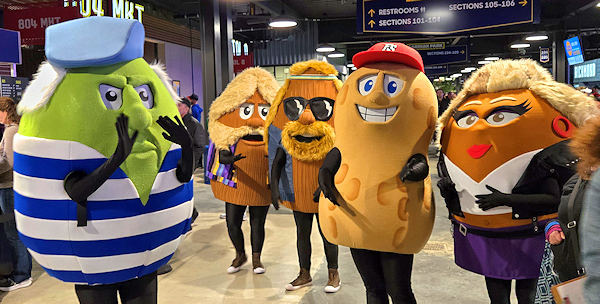
And speaking of nuts and mascots, the Mixed Nuts Race at CarMax Park is the most hilarious I’ve ever seen. It pits mascots dressed up as various varieties of nuts — Cashew, Pistachio, Almond, Peanut and Walnut (although the exact participants sometimes vary). After the race, the nutty mascots mingle with the crowd on the concourse and pose for pictures (below). No matter which nut finishes first, this race is a winner.
The audio in the park is first-rate, as the 385 strategically placed speakers deliver excellent sound quality. As for visuals, the main video board in right field offers 3,648 square feet of the highest resolution possible, and is supplemented by the CareScout Power Tower and ribbon boards on the facing of the upper deck.
All in all, the gameday experience is polished and a lot of funn … I mean fun.
Summary
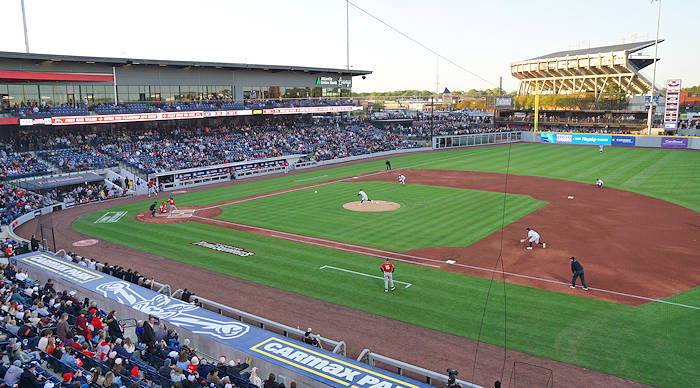
I attended the first game ever at this park (the first pitch is above, with The Diamond gleaming in the background), but it was perhaps more fortunate that I also attended Game Two. That’s because the lines for concessions were the longest I’ve ever seen at a sporting event on Opening Night. Did they not build enough concession stands? Hardly, as evidence by the fact that the lines were quite short at Game Two, even though it was another huge crowd.
The line problem for the first game was a perfect storm of events. Thousands upon thousands of fans were in line when the gates opened, meaning right off the bat, the concourses were packed with people. Because they had waited in line so long, they were hungry, plus they were anxious to try the new food offerings. McGhee reported that almost 4,000 fans were in line for concessions within 20 minutes after the gates opened. “We just got hit really hard.”
Adding to the lines were the facts that fans were unfamiliar with the menus and staff weren’t experienced at keeping the food flowing and the cash registers ringing. As PSC’s Derboghossian put it, “there was panic buying,” as fans figured that they’d better buy four hamburgers or five hot dogs since the lines were building.
I don’t view this as anything but a very short-term problem. What it really indicates is just how anxious baseball fans in Richmond were for this new park. They’d been waiting for decades to have the same kind of gameday atmosphere that other Minor League markets have been enjoying, so they couldn’t wait to experience it all.
And the problem was solved by the following night.
During my wide-ranging conversation with GM Oppermann, he described the objectives that the team’s owners had for their new ballpark. First was making the venue “accessible and inclusive,” since it was a struggle to make The Diamond — built before the Americans with Disabilities Act — compliant with Federal regulations.
“CarMax Park was meant to be welcoming.” This box can be checked off.
 Oppermann also pointed out an obvious fact: “Baseball is a very different sport than it was back in 1985 when The Diamond opened.” The modern fan has very different expectations when they are considering a ticket purchase. Therefore, “We really wanted to focus on a mix of seating types. We paid close attention to the percentage mix between fixed seats, social spaces, group areas, premium hospitality (and) some standing room places.”
At The Diamond, all 10,000 seats looked at the playing field, so “staring at the game was really all you could do. CarMax Park was designed to be a place where you could come with your family and friends and enjoy it as a social space.” You can put a checkmark by that box, too.
Just as you can with the third objective. “It was really important to have operational flexibility and versatility.
“Like all modern sports venues, CarMax Park isn’t just a baseball stadium. It’s a 365-day-a-year event and entertainment space.” The lounges and suites give the Squirrels enormous opportunities to do things that were never possible at the old place next door.
Oppermann summed it up perfectly: “There are features you can find in CarMax Park that you can find in other stadiums, but very few — and I can’t really think of any — Minor League stadiums in the country have all of them.
“I think CarMax Park is fully loaded with amenities for the fans.”
Provide a comment below with your thoughts about CarMax Park or this review.
I went the second night it was open. The ticket prices are outrageous. There is no longer General Admission seating. The “regular Joe” and retiree like myself can no longer afford to go to a Double A baseball game. Nor can a young family. It appears to be done on purpose. The program and printed schedule are printed without the ticket prices on them like they used to. It is a beautiful place, but not worth the price of admission.
Season ticket holder here. Opening night was nuts! As the week went on, while the crowds stayed high, the concessions ran a lot smoother. As I’m writing this, we’re midway through our second home stand. Crowds are back to normal (4500-6500) and the concessions system is moving nicely.
Glad to hear it. I hope you enjoy CarMax Park for many years to come. I’m anxious to compare it to the new parks in Wilson, NC and Chattanooga. Be watching for my reviews of them!
The ballpark master has done it again! Thank you for the incredibly thorough article. Well done! Once again, I felt like I was there.
Like you, I am kind of digging the Yard Club! I would definitely enjoy sitting there!
It’s kind of crazy to see The Diamond towering over in left field. Oh my, has ballpark design changed. It is truly great to see Richmond finally get a new park after all these years. It’s definitely a market you didn’t want to give up on
Overall, a very nice ballpark. I didn’t care for the long distance from centerfield around the park to the seats along the baselines. I suppose there’s not much they could do from a design standpoint according to the well-written article? As the site is developed, will they FIX this issue? I REALLY didn’t like the lack or as in my case, the nonexistent number of HANDICAPPED parking spaces remaining. Need to create more. Never saw so many home runs hit in a Braves/Squirrels games at the Diamond. The Diamond has DEEP outfields. CarMax Park may have “normal” outfield distances and it definitely will change the dynamics of the games we watch. It won’t be over until it’s over. Don’t leave the Park too early, eh? Other than entrance prices for a baseball game and food prices, the Park makes for a FUNN event