Article and photos by Joe Mock, BaseballParks.com
Used by permission of USA TODAY. All rights reserved
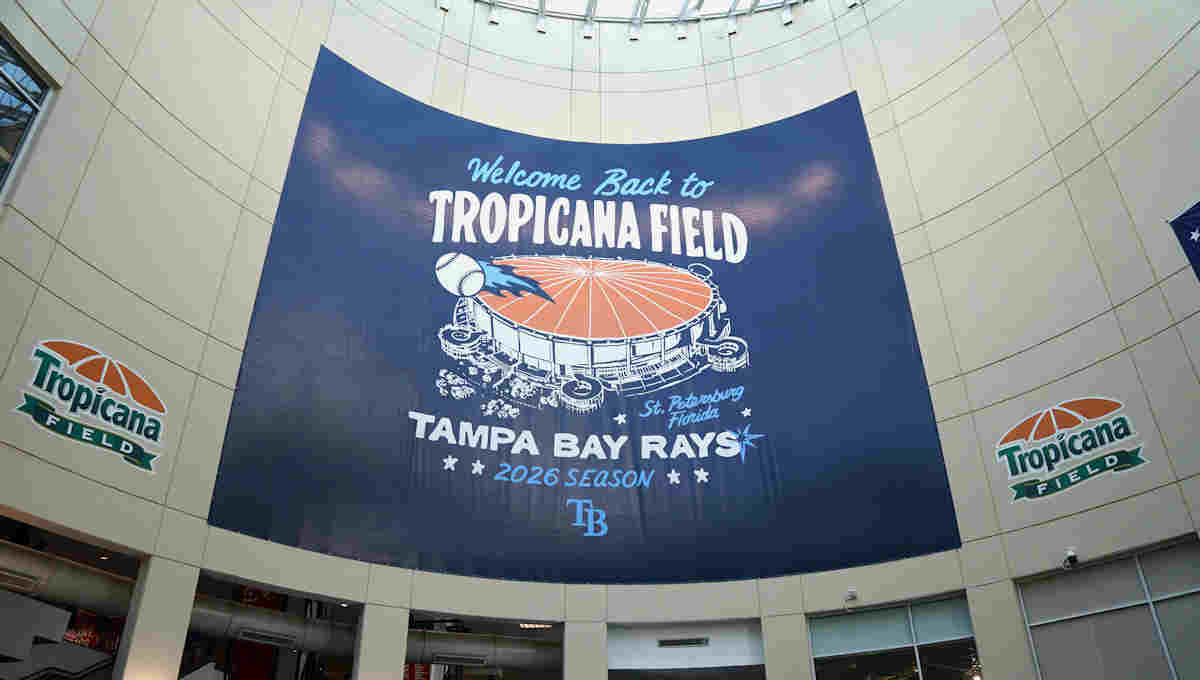
St. Petersburg High above the entry rotunda beyond center field at the home ballpark of the Tampa Bay Rays is an immense banner with this cheery message: WELCOME BACK TO TROPICANA FIELD.
| Ballpark Stats |
 |
| Team: Tampa Bay Rays of the American League |
| First game after rebuilding: April 6, 2026, a 6-4 win over the Cubs |
| Capacity: 20,025 |
| Dimensions: LF – 315′; LCF – 375′; CF – 404′; RCF – 370′; RF – 322′ |
| Architect: original HOK Sport; for renovation AECOM |
| Construction: original Huber Hunt & Nichols |
| Price: original $130 million; 2026 renovation $56 million |
| Home dugout: 1B side |
| Field points: north by northeast |
| Playing surface: artificial |
| Naming rights: Tropicana Brands Group |
| Ticket info: Rays website |
| Betcha didn’t know: When the 24 roof panels were replaced in 2025, each panel weighed 5,000 pounds |
It’s certainly uncommon for a team to welcome fans back to its home ballpark, but in the case of Tropicana Field, it’s literally appropriate, since no games were played there in 2025.
It was an unforgettable image. In October, 2024, Hurricane Milton unleashed unprecedented wind and rain on the Gulf Coast of Florida, tearing the Teflon panels away from their supports on top of the Trop. Footage of the tattered remains of those panels was seen far and wide, becoming the symbol of the storm’s wrath.
The Rays were in the midst of sometimes contentious negotiations with the city of St. Petersburg on a stadium to replace the Trop. Suddenly the team found itself without a venue to use for the 2025 season, as repairs were predicted to take over a year.
Missing the AC
“We had a lot of options of where to play during the rebuild of the Trop, but the team was committed to keeping our home games in this area,” explains Rays CEO Ken Babby. The solution came when the New York Yankees offered their spring-training park in Tampa to their AL East rivals to use throughout 2025.
“It says a lot about the Yankees and how gracious they were,” says Babby. “But as our (president of baseball operations) Erik Neander said, playing at Steinbrenner Field was a little bit like sleeping on a friend’s couch. That’s good. And we love our friend, and we love this couch, but there’s nothing like being home.”
Indeed, the players and fans had gotten used to playing in the air conditioning of the Trop. Steinbrenner Field in Tampa offered no such comfort last year.
“At the beginning of last season, many of our fans were saying ‘You know, it would be nice to have an open-air stadium like this,’” relates Patty Flack, a fan host for Rays home games. “But then when August arrived, those same people were saying that they understood why we should play indoors.”
St. Pete steps up
Meanwhile, the city of St. Petersburg was organizing all the repairs at the Trop, as was their contractual obligation.
Fans didn’t realize the extent of the damage. Most saw the tattered roof panels, and assumed that once they were replaced, the Rays would be back in business in the Trop.
Not true. Not even close.
 Tropicana Field never operated as an outdoor facility. Consequently, there was no drainage system to remove the millions of gallons of rainwater that fell into the venue from Hurricane Milton. Imagine a bathtub with no drain. Water accumulated, leaving a catastrophe in its wake.
Practically no aspect of the stadium was left undamaged. That made the cleanup and repairs one of the biggest efforts the city had ever undertaken. Further, it was reported at the time that the city only had $25 million of insurance coverage on the stadium, while repairs were expected to approach $60 million.
Babby points out that whether St. Petersburg was legally responsible or not, “the city really stepped up. Frankly, what it took to repair this place is nothing short of a miracle.”
The city brought in national construction and engineering firm AECOM to oversee the work. Aspects to be replaced included the playing field, lights, drywall throughout the building, all electronics, player spaces, concession stands, team offices and more.
The way the roof was replaced is fascinating. The Teflon panels ripped away by Milton had pretty much exceeded their lifespan anyway, and looked dingy and let little light through. The new, stronger panels are made of a Teflon-coated fiberglass called PTFE. The material was created in France, manufactured into rolls in Germany, and cut into 24 panels in China, with each panel weighing in at two-and-a-half tons.
Once in St. Pete, it took six hours for workers (suspended 200 feet above the field) to stretch each panel into place, with an additional six days for incremental adjustments before being secured permanently.
And this process had to be repeated for each of the two dozen panels.
Fans coming to the Trop today are witnessing a significantly different look than before, as these new panels allow in more light. Previously, day games and night games were played in a similar amount of gloominess. Today, the difference between the ambient light at a day game versus one in the evening is, well, night and day.
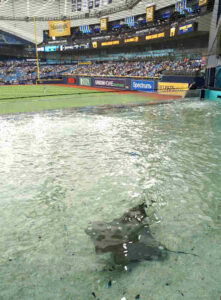
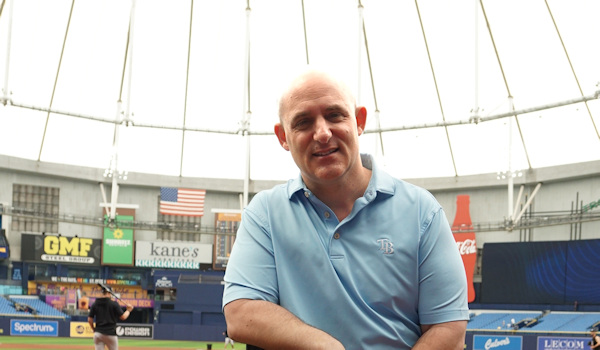
A very welcome improvement indeed. (That’s Babby below prior to a day game on July 9, 2026. And, yes, as shown above, the rays tank is back in its original spot beyond the outfield.)
An elevated experience
The Rays took advantage of the yearlong shutdown to make enhancements. “We didn’t believe in providing our fans a temporary solution,” says Babby. “We wanted to elevate the experience that was here before.”
The Rays, with new ownership under Patrick Zalupski starting last year, made it their mission to improve, not just repair.
And all of this was happening with the understanding that under no circumstances did the Rays intend for their return to the Trop to be permanent. Their desire for a new stadium was quite public. In fact, the previous ownership under Stuart Sternberg had invested tens of millions of dollars in plans for a new ballpark and commercial development adjacent to the current stadium.
With new ownership likely on the way, the Rays allowed the proposed ballpark deal with the city and Pinellas County to expire in March 2025.
The team’s desire for a new stadium – somewhere — never waned. It’s all the more impressive that the team invested in so many improvements at the Trop even though they expect to be playing elsewhere in just a few years.
As Babby puts it, “We didn’t want our fans to have to wait until 2029 to have these new experiences.”
He says the most noticeable improvement is in the Baldwin Group Club for season-ticket holders. “We didn’t want it to feel like you were eating at a ballpark. We are now providing a great culinary experience here.”
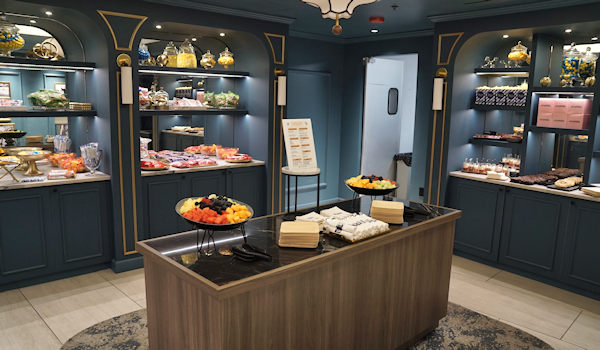
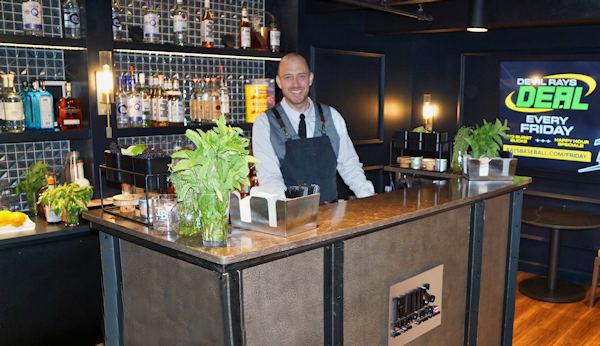
On the field level behind home plate, the team converted a room used for storage to an upscale candy shop (above), and next to it, a speakeasy (below), both with high-end touches inspired by European cafes and lounges. “We wanted to create a new adult experience, but also make something great for families.”
Home
While there are governmental and financial hurdles ahead, the team hopes to build a new stadium in Tampa across the street from the NFL Buccaneers’ Raymond James Stadium. It will have a roof, but with panels that look more like clear glass. New renderings created by sports-architecture giant Populous were revealed to Rays fans during their home game on July 8.
While it will be in a different city (Tampa) and county (Hillsborough), it will still be in the Tampa Bay area. Babby says the new ownership group wants to do all it can to stay local.
Following the massive damage to the Trop in 2024, Babby says baseball fans in the area “were emotional. Many felt that baseball would never be played here again, and maybe not in this area again. We weren’t going to let that happen.
“Our view is that this is our home. Not our temporary home. Our home.”
The Rays have certainly enjoyed their return to the Trop, as they have the best record in the American League at the All Star break. Compared to their last year in St. Pete in 2024, attendance is up, but not by a lot (3.2%, according to attendance expert David Kronheim).
St. Pete mayor Ken Welch said the following during a recent debate, defending the city’s actions after the hurricane damage to the Trop: “I knew that we had an agreement that said we would repair the Trop. And so we had to do that. So I moved forward and now the Rays are back.”
Just as it says in the Trop’s entry rotunda.
Mock, co-author of the new book Rickwood, covers sports facilities for USA TODAY Sports