Back to page 1
The Design
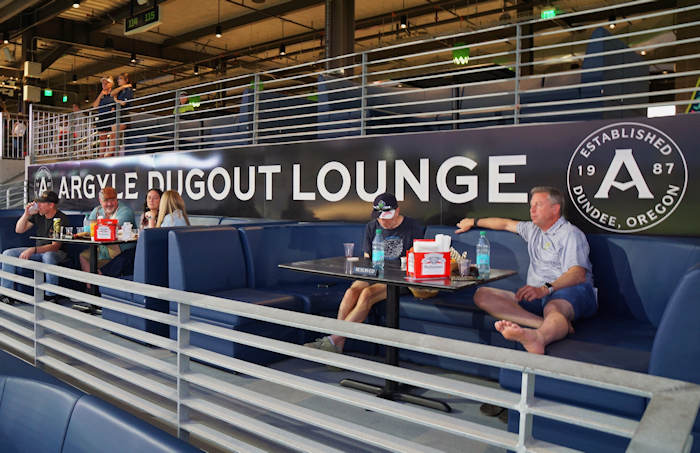
As we begin our look at the architectural design of Hops Ballpark, I need to point out a major element that is missing here. And in fact, I can’t think of a pro ballpark that omits these: luxury suites.
That’s right, where you’d expect to see suites on this stadium’s upper level, there simply aren’t any. Instead are club seats and the team offices on the third-base side, and the pressbox and a party patio on the first-base side.
Don’t think for a second that this omission is an oversight. “The biggest thing that led to that decision is the feasibility studies we did,” explained Wombacher. “Luxury suites did not test well at all. People just weren’t interested in them.” Fans indicated they preferred open-air seating over climate controlled spaces. That led to the installation of far more upper-level club seats and mini-lounges at the rear of the seating bowl than you normally see at Minor League ballparks.
There are eight of these Argyle Dugout Lounge suites on the third-base side (see photo at the top of this page), and they’ve been wildly popular. Note that they more resemble a booth in a restaurant than your typical concourse suite. Kornegay feels that “they are the most premium experience in the ballpark.”
Credit Wombacher and the McMurrays for delivering what this market is demanding instead of going with the prevailing wisdom.
In addition to the Dugout Lounges, other “premium” seats on the main level include Meridian Platinum (see photo), which are huge, comfy seats in the last five rows behind the backstop, and Home Plate Reserved, which are the nine rows closest to the backstop. There are also concourse suites that accommodate 25 fans (Home Plate Suites) and 15 (Infield Suites).
 Much of the upper level is dominated by the word Meridian. The lounge with that name “is the largest I’ve ever worked on, at any level of baseball,” noted Kornegay. You have access to this top-shelf space and its very top-shelf food if you buy a ticket in one of the 560 club seats in front of the lounge, and down the third-base line.
This 9,000-square-foot lounge is beautifully appointed, and is ready to host large receptions or banquets. The staircase leading up to the main space has a clever “mobile” of sorts, with hop vines interspersed with baseball bats. A very artistic touch. It’s shown here with Whitney Ranson of Populous’ Portland office. Her talents were part of the design effort for Hops Ballpark.
At the first-base end of the upper level is a party deck called the Lookout, that can accommodate groups up to 75. On the third-base end are the team’s offices, most likely the nicest I’ve ever seen at a sports facility — especially since there are windows on three sides of the space, allowing in lots of natural light (a commodity in short supply in most front offices).
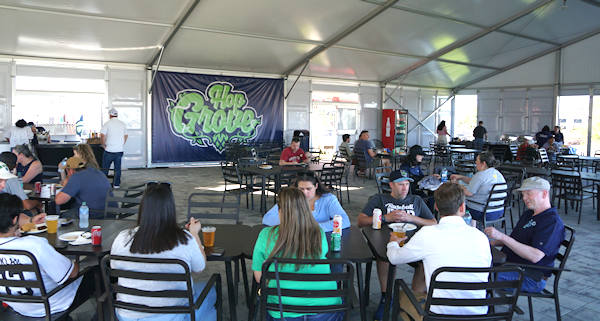
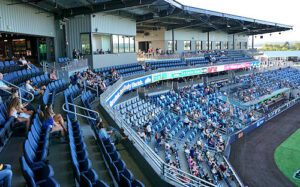
There are berms in the outfield “corners” of the triangle, and two rows of four-top tables near the right-field foul pole. The latter is one of the first areas to sell out for games. The Hop Grove tent (below) in the northern corner of the triangle is for the biggest groups, up to 300.
There is a phenomenon that I noticed when looking toward the infield when on the outfield berm. I also felt it when looking down on the field from the club seats on the upper level. You feel like you are really, really close to the action. Your brain tells you that you are a normal distance away from the playing surface, but your eyes convince you that you are actually closer. Is this an optical illusion?
Jeff Yrazabal, who runs Populous’ Portland office and was active on the design team for the park, explained it like this. It helps that the concourse is elevated above the playing surface “and the way the roof extends so far over the seats creates a balance of intimacy and a sense of community.”
Added Wombacher, “With so much protective netting now, we said (to the designers) get the fans as close to the action as possible.”
Yrazabal summed it up like this: “Architecture plays a big role in how fans feel in a venue.” Hops Ballpark walks the tightrope of spaciousness and intimacy as well as any ballpark I’ve seen.
One way spaciousness is achieved on the main concourse is by keeping the concession stands — and their lines — out of the main traffic lanes. This is accomplished beautifully at the food court on the third-base side (below) and at the most popular stand in the entire park down the first-base line. Note the light-colored wood tables where you can stand and eat your food. This is a very “Pacific Northwest” touch.
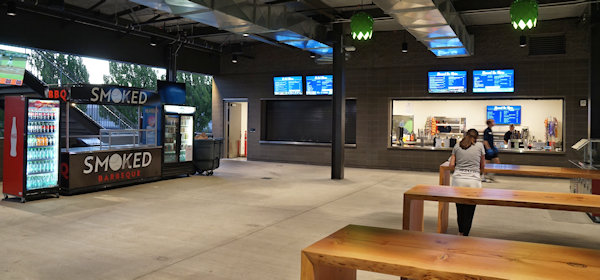
Much more on the glorious food in the next section.
You certainly feel the spaciousness in the player areas on the lower level. The new PDL standards require certain minimums, “but we are advising all of our clients to build beyond the current minimums, in case there are changes to the PDL down the road where they require larger spaces,” revealed Kornegay.
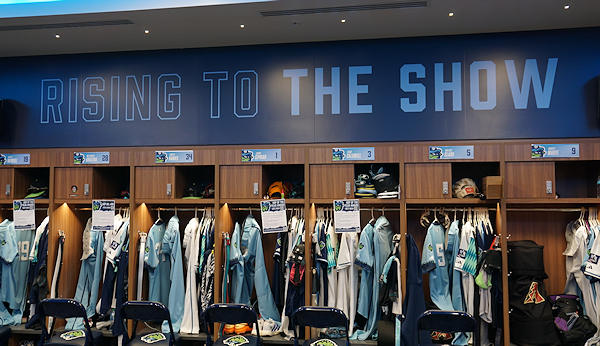
The home clubhouse, by the way, couldn’t have more of a big-league feel.
But one aspect of Hops Ballpark that doesn’t exist at the Major League level — or any current Minor League park for that matter — is the playing surface used here. And here comes the word “pivot” again.
Wombacher was given a tip by a friend at Adidas Baseball to check out a new kind of playing surface for the new park. It’s called Pivot Performance Turf, made by a company called TenCate. Wombacher learned that only one baseball field in the country (University of San Francisco) had installed it — and it was only in the infield. So he, Populous and Mortenson flew to USF to check it out in person, “just so we could rule it out,” he recalled. I guess you could literally say that the group made a “field trip.”
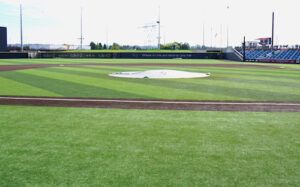 A key to the Pivot playing surface is its lack of “infill.” For years, artificial turf has relied on little pellets of rubber or other materials within the blades of the surface. You’d see them flying everywhere when a baseball bounced or a player was tackled on a football field. What was considered an innovation for player safety has instead turned into a health hazard, as those little pellets get into players’ eyes or open wounds — and are being banned by cities around the country. Plus that infill creates a threat to the environment as it washes into drainage systems and water supplies after a heavy rain.
“Not only is this the highest performing system that we’ve ever developed, the way it’s manufactured makes it very sustainable,” explained Charles Dawson, CEO of TenCate Sports. It eliminates the microplastics of previous surfaces, plus it is recyclable and doesn’t have to be replaced nearly as often.
From the players’ standpoint, it’s 20 to 30 degrees cooler than older systems, plus it plays more like natural grass. “This product will change the way baseball is played on artificial turf,” added Dawson. “From the maintenance, to the sustainability, to the longevity, we’ve got the whole gamut covered.”
But it was the first time Pivot turf was being installed at a pro ballpark. “To us, it was worth the risk,” said Wombacher. “The upside was pretty significant. We like doing things for the first time. We’ve never been afraid to try something new.
“And the feedback from the players has been tremendous.”
So the pivot from a renovation to a brand-new park allowed for Hops players to play on this revolutionary Pivot turf.
With the players happy with their spacious new facilities and fancy playing surface, what’s it like for fans to attend a Hops game at the team’s new digs?
The Essentials
After doing over a hundred of these reviews for new ballparks, I’ve learned the favorite topic of our readers: food. So let’s get right to it.
For years, I’ve maintained the opinion that the best food in the Minors is at El Paso and Charlotte. In my mind, there is now a new #1: Hops Ballpark.
And before you say “well, Joe, that’s because you get to eat at the fancy upstairs lounges that average fans never get to see,” understand this: what I’m about to describe to you is available on the main concourse, most of it in the food court behind third base.
Tony Hendryx and his wife Brandi operate Northwest Roots Hospitality, which mostly is tasked with overseeing the concessions for the Hops and non-baseball events held here. Essentially, this means the team is responsible for what is served to the fans in Hops Ballpark. Wombacher calls Hendryx “one of the best food-and-beverage people in sports. That was really our key to bringing food and beverage in-house.”
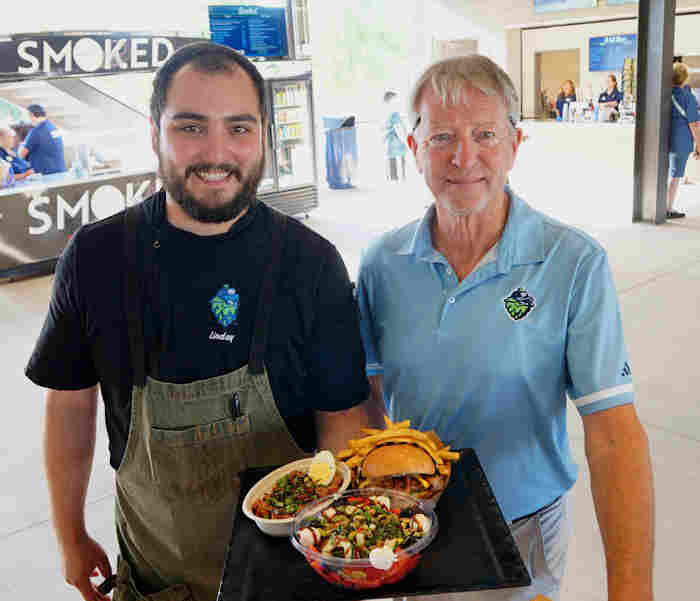
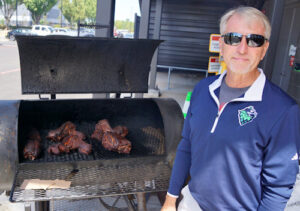 Before I got to sample the incredible concession items here, Executive Chef Lindsey Castelluccio (pictured above on the left) and Hendryx (above on the right and next to the smoker) showed me the stunningly efficient and well-equipped commercial kitchen on the lower level. The most magical area, though, is just outside of the building, tucked under stairs. It’s the smoker used to create the best barbecue I’ve tasted at a sports facility. Using mesquite wood in the smoker box, over 1,000 pounds of pork are smoked here each homestand. It’s also used to smoke brisket (of course), turkey, tri-tip, ribs, chicken and even salmon.
While there is good barbecue at most new ballparks, it’s almost always made in high-tech ovens in which smoking is just one of the cooking methods the device can handle. There is no substitute, though, for cooking a pork shoulder or brisket for four or six hours at the low temperature of 200 degrees, in an honest-to-goodness smoker, then finishing it in a hot-box in the kitchen (Hendryx’ research shows four hours or so allows the meat to absorb the maximum amount of smoke flavor).
“Those newer devices just don’t provide the smoke ring we’re looking for,” observed Hendryx … although the Hops’ fancy new kitchen does have four Unox Cheftop units that each cost $40,000. They are used with great results for all manner of baking and other food prep.
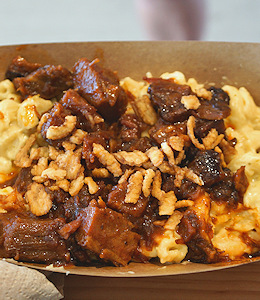
The crowning achievement from the smoker and the commercial kitchen is the Brisket Burnt Ends Mac & Cheese ($17), served at the “Smoked” stand in the food court. It’s shown below. It features juicy, sauced cubes of smoked brisket mixed with crispy onions, fresh hatch chilies, all over a bed of creamy macaroni and cheese. The combination of flavors and textures receives an A++ from me.
I have never, ever consumed a better dish at a ballpark.
  |
But that’s not all. At the Fowl Territory stand is a juicy, delightfully seasoned Chicken Caprese Sausage Dog ($9). At The Signature stand is a mid-season addition of a meatless Elote bowl (only $7) with fire-roasted corn, mayo, sour cream and queso, a delectable Turkey Caprese deli sandwich ($14), and a beautiful dish called Barley’s BLT Dog ($11). The all-beef hot dog is almost hidden by all of the shredded lettuce, chopped bacon and diced tomatoes. It is a delectable combination.
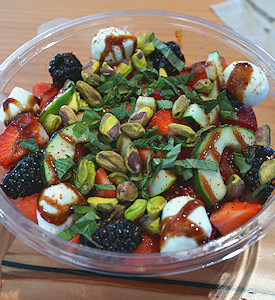
Another highlight is the Melon Berry Caprese Salad ($14), shown above. It features local strawberries, watermelon, blackberries, pistachios, mozzarella, basil, mint, all with a delicious balsamic drizzle. Depending on what produce is in season (sometimes marionberries), the ingredients might be different, making this “Oregon summer in a bowl,” astutely remarked Hendryx.
Spam Musubi Bowl (just $13) traditionally has an egg, so this version does, too. This tasty Asian entree is at the Around The Horn stand, also in the food court. “We have players coming here from around the world, so we try to have flavors to match that,” explained Hendryx.
At the same stand you’ll also find Fish and Chips ($12) and a Hawaiian Plate ($15).
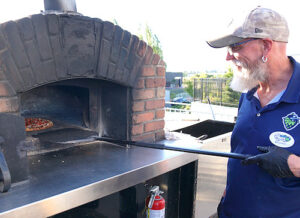 Other highlights include: a Gyro Basket ($14), made the correct way with lamb meat; pizza ($5-$7 per slice, depending on toppings) baked in front of you in a 700-degree wood-fired oven; and at the Meating Place stand is a Bacon Bacon Burger ($18) with bacon on and in the burger patty.
And this barely scratches the surface of the food items available.
An adjective that occurred to me over and over was “fresh.” The sandwich, salad or burger you purchase is made to order. That necessitates the use of a pager that goes off to tell you when your custom-made order is ready to be picked up at the stand. This is a system that provides freshness that is unheard of at a sporting event.
Wombacher couldn’t overstate the importance of the “infrastructure we put in for food and beverage. It was not an afterthought. It was very intentional. On every square inch of the food and beverage (operation), we were intentional on the design to make sure we could execute the experience we wanted.
“We wanted to have a premium food and beverage experience in a sports stadium,” he added. “We knew we needed the kitchens, the space, the layout, the loading docks, everything. And we nailed it.”
I concur. But I’ll add an additional element to Wombacher’s list of imperatives: experienced people. Tony and Brandi Hendryx and executive chef Castelluccio — there’s even a sous chef — create a level of expertise unmatched at ballparks. And they were all on board last year preparing to pull this off for 2026.
Again, the dishes I just described are available on the main concourse, not in the upstairs, $115-per-person lounge. And naturally a team called The Hops offers beer. There are more than twice as many taps here as at the previous ballpark.
It’s not just concessions that Wombacher insists on keeping in-house. In an age when more teams are farming out food and beverage, merchandise and even parking, the Hops don’t. “It’s not so much about profitability. It’s more about controlling the (fans’) experience. Even with parking, that’s the fans’ first impression. We want to control who those people are, what their attitudes are like, how they treat fans, and we want to be able to hold them accountable.”
So let’s talk about what it costs to attend a Hops game. Whether you buy parking online or at the event, you pay $9.50 — which is $8.00 plus $1.50 in fees paid to governmental entities. A private company called Planar owns property adjacent to the ballpark’s west side. They charge $8.00 for parking in their lot since they aren’t required to collect the fees. So you have a choice.
 As for tickets, you’re likely to feel some sticker shock. But this requires some explanation.
While I’m overjoyed to report that the Hops don’t do confusing dynamic-ticket pricing (where the prices of seats fluctuate based on day of the week and demand for tickets), I have to admit that some of the highest prices for tickets in Minor League Baseball are charged here — including two categories in triple digits. The Meridian club seats (which include the upscale food) on the upper level are $115, including fees. Even higher are the plush, huge seats in the Meridian Platinum area on the lower level. They are $130.
Before you freak out, please consider two things:
First, the Hops have already decided to lower the ticket prices in at least the two Meridian areas for 2027;
Second, the Hops are Portland’s only pro baseball team. They don’t compete with, say, the Eugene Emeralds or the Everett AquaSox. They compete with the big-league Trail Blazers of the NBA and Timbers of the MLS (not to mention the very successful Thorns of the NWSL and Fire of the WNBA). As such, the Hops are seeking to provide a big-league experience for Portland fans — and they deliver it. By the way, a rough calculation reveals that the average cost of a ticket for a Blazers game is about $84. The cheapest ticket for a Timbers match is about $34, so most Hops tickets compare very well.
Indeed, ticket costs in the rest of the stadium look like this: it’s $48 for the Home Plate Reserved directly behind the backstop; $37 behind the dugouts; $28 down the foul lines; $23 for the seats near the left-field foul pole (that are twisted toward the infield); and $140 for four seats at the four-tops near the right-field foul pole.
General admission tickets work a little differently. For the first 100 purchasers for a given date, the price is $8.00 plus $3.50 in fees, which equals $11.50. After the first 100 are sold, the price goes up to $12.00 + $3.50 = $15.50. While this isn’t technically dynamic ticket pricing (DTP), it could be viewed as being DTP-adjacent. Anyway, even at $15.50, that’s less than half the cost of the cheapest Timbers seat.
Groups have lots of options here, from three adjacent four-tops for 12 people (at roughly $64 per person which includes vouchers that can be spent on food, drink or merchandise) all the way up to 300 in Hop Grove.
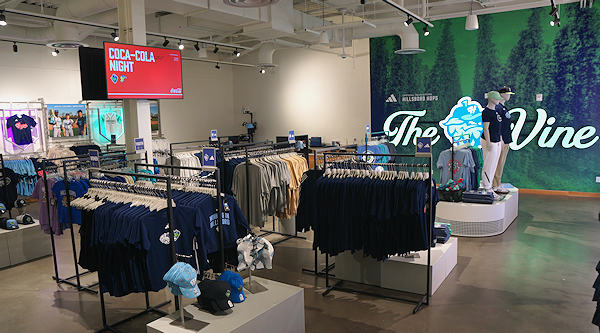
Speaking of merch, The Vine is the team’s main store. It is just inside the main gates, behind home plate. It is a really nice space, over three-and-a-half times the size as at the old park. And it isn’t over-stuffed with racks, so you can move around more easily than in, say, Ontario.
And like Ontario, you can have jersey tops customized while you wait. Adult Hops jerseys are $115, plus $30 if you want it customized. Ones for kids are $110.
Adult tees run from $32 to $42, while brand-name tees by 47 are $50 and $52. Men’s Adidas polos are all $88, and incorporate variations of the Hops’ team colors: navy, light blue, medium blue and gray.
There’s a very nice selection of caps. Adjustable adult caps are $35 and $38, while fitted models are $45. Caps for kids run $24 to $32.
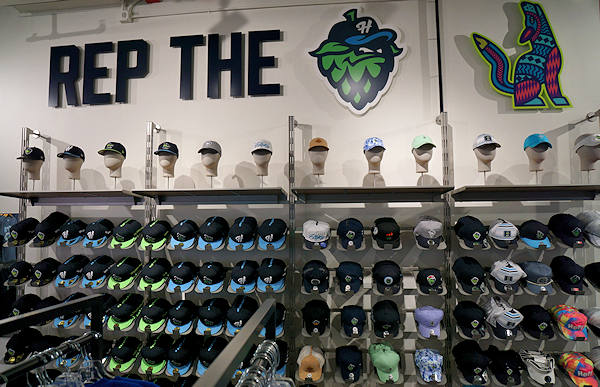
While there isn’t much that plays up the fact that the team is in a new ballpark, they really lean into their “Copa” alternate identity as the Soñadores de Hillsboro (that translates to “dreamers”). The logo is quite colorful, and apparel for it is a big seller.
And I’m happy to report that they carry three different styles of my favorite collectable merch item: lapel pins. They are a reasonable $8.
Not a lot gets written about a ballpark’s sound system, but the one in Hillsboro is top-notch. Based on the recommendation of a consultant, “We wanted the best sound system ever in a Minor League stadium,” noted Wombacher. “I don’t know that we got it, but we love it.”
For kids, I’m happy to point out that Hillsboro is like Ontario: no inflatables. There is very nice playground equipment in the Hillsboro Medical Center Family Zone, right behind the elevated berm in right field.
Honestly, I’m hard pressed to point out anything that is missing from Hops Ballpark.
But to make sure I’m not getting carried away, exhibiting “recency bias” because this is the most recent new park I’d visited, I asked two intrepid ballpark chasers to weigh on with their thoughts on Hops Ballpark. These are guys whose ballpark opinions I greatly value. Click here to read them. Spoiler alert: they had more negative things to say than I do.
In other words, not everyone fell head-over-heels in love with Hillsboro’s new park.
Summary
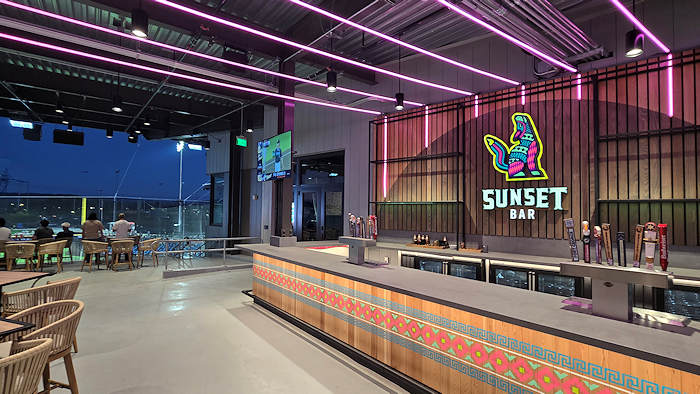
Before we summarize where this ballpark stands in relation to all other Minor League parks, let’s take a moment to list the features of the park that I didn’t like:
1. There is no door to the merchandise store outside the gates (although it’s not far away).
2. The way the stands down the third-base foul line are twisted toward the infield have the unintended consequence of creating an abnormally large area of foul territory. However, the orientation of those seating sections provide exceptional viewing of the infield.
3. After seeing what some other teams have done carrying out “themes” for their parks (North Little Rock as a railroad station and Ontario as an airport are two great examples), it occurs to me that there really isn’t one in Hillsboro.
 But that’s it. And those are three pretty minor gripes.
Overall, I think Hops Ballpark joins two other 2026 parks (Chattanooga and Ontario) in the top five in all of Minor League Baseball. I found the food to be the best I’ve ever encountered in the Minors. The architecture creates an unmistakable sense of intimacy while catering to their market’s preference to eschew luxury suites. The player spaces and playing surface are as forward-thinking as is imaginable in this day and age.
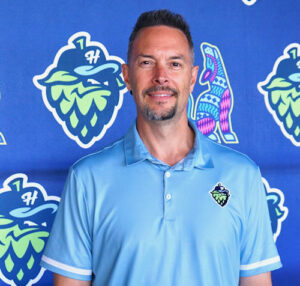
“If there is an expansion team granted to Portland, Major League Baseball is going to need two new Triple-A teams,” surmised Wombacher (see photo). “We tried to build more of a Triple-A venue than a single-A venue, for the exact reason of positioning ourselves” to be in the running. I met with the folks trying to bring MLB to Portland while I was in the area, and they are 100% in favor of Hillsboro being the franchise’s top affiliate. And that will be a plus for Portland’s big-league aspirations.
Thinking big like this was all made possible because of the pivot from renovation to new ballpark.
Provide a comment below with your thoughts about Hops Ballpark or this review.
Can’t tell you how much I enjoy your ballpark reviews. I’m hoping to visit Hillsboro in the near future. These new ballparks in the minor leagues are leaps and bounds better than just 20 years ago. Keep up the good work!