Back to page 1
The Design
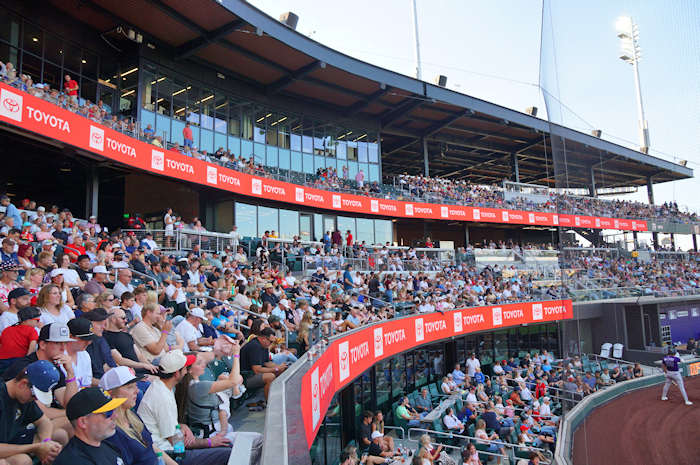
As good as the exterior is, inside is even more magical.
As long as you’re not yet sick of the comparisons with Las Vegas Ballpark, consider this: If you stand on the concourse in Vegas beyond center field and look at the main seating bowl, you see sleek, modern lines. In fact, it’s meant to invoke a fighter plan coming at you, with the suites stretching down each foul line acting like the wings, and the pressbox on the roof appearing to be the cockpit. It’s very nice.
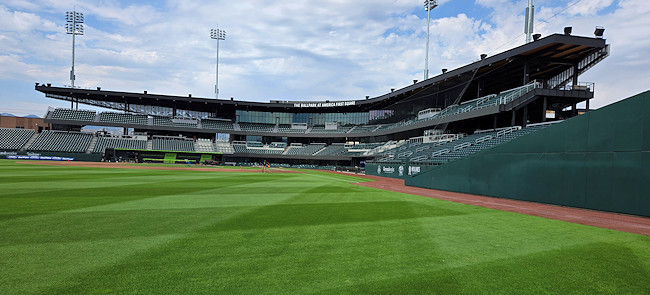
When you stand in center field in South Jordan, it’s not a fighter plane you see. Instead, you see the seating bowl broken up by numerous different seating sections and levels. You also see the steel panels that form the upper level of the exterior. This creates not just visual variation, it allows the Bees to attract different kinds of fans. “Ensuring we have price points to accommodate every appetite in the market is really important to us,” explained Smith (Michelle that is, not be confused with the grocery chain Smith’s that owned the naming rights of the old ballpark).
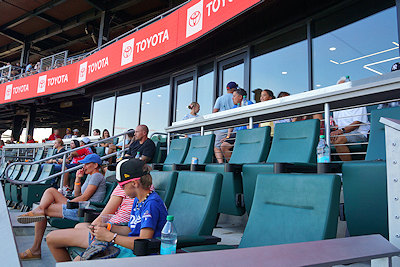 Norton refers to this as the “stratification” of seating types. “We created a situation where we have a mixing to a certain extent between different premium levels. The ‘middle’ is all kind of condensed to behind homeplate, which is unique to this scenario versus squarishly down the lines.”
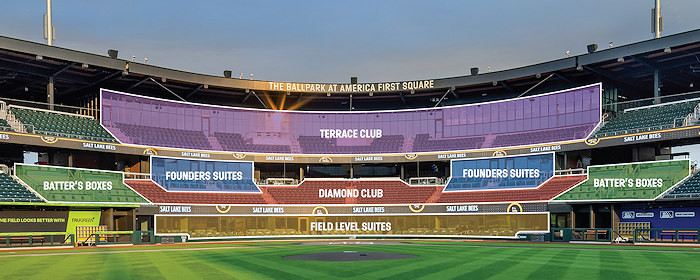
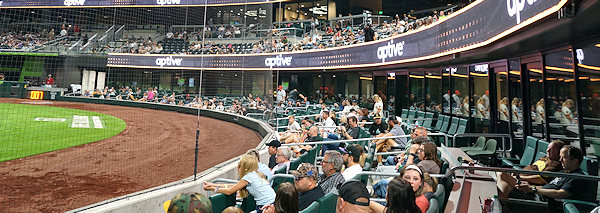
This is accomplished by breaking up the seating into what amounts to three different levels behind the backstop (see the photo above). On ground level are the Field Level Suites, which Smith said was inspired by the ones at Globe Life Field in Arlington. Just behind that in what would ordinarily be called the field level is a mixture of seating types, including the Diamond Club which includes a buffet line of sorts directly behind the seats, Founders Suites which you enter directly from the main concourse (photo) and the amazing sections directly behind the on-deck circles called Batter’s Boxes, where the seats match the recliners in LHM’s Megaplex theaters beyond center field. These special seats are covered following home games to protect their fancy upholstery.
On the upper level are the seats in front of the beautiful Terrace Club and the more conventional suites.
The image below was provided by the Bees. It does a superb job of illustrating exactly where these premium areas are located — and how beautifully they break up the monotony of row after row of seats, like at most other parks.
Smith’s Ballpark allowed for practically none of this “stratification.” Not only that, it was simply too large.
This is where the less is more lesson comes into play. In addition to not overbuilding the new ballpark (which could potentially cannibalize a future MLB stadium), Smith stressed that “our guiding principle in building was the experiences inside the ballpark. We ended up at 6,500 total (fixed) seats and a total capacity of 8,000, with the seating experiences to be diverse. We are now surpassing revenues that we could have had with the traditional 10,000-15,000 capacity ballpark. That’s because we introduced multiple premium options but still kept the traditional berm, the deck seating and group areas.”
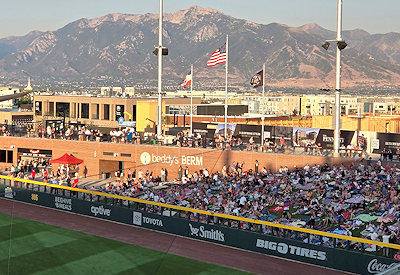 Beddy’s Berm is shown here at a sold-out night game.
And when it came to total capacity at The Ballpark at America First Square, Smith said, “I think we hit the sweet spot.” Yes, less is more.
My longtime friend Alan Poff (you’ve probably visited his Ballpark Biz site) joined me to scrutinize the Bees’ park. He shared my positive reaction: “I love the many seating options and entertainment spaces within the park, including the Terrace and Diamond Club areas. They provide the comfort, welcoming classiness (without being pretentious), and true feel of a Major League park. Definitely first class.
“I also love the different suite options, which provide unique texture to the design. The field suites are especially attractive and definitely have amenities I would use to entertain clients and reward my employees as a corporate suite holder.” Maybe an account executive in the Bees front office should give Alan a call!
Just because the Bees rolled out a dizzying array of premium seating options, they didn’t lose sight of the critical group-sales component. For instance, at each end of the upper level are traditional party decks. Each is so large, in fact, that it can be divided into two distinct group areas. There is also a group area called the Right Field Yard down the first-base line.
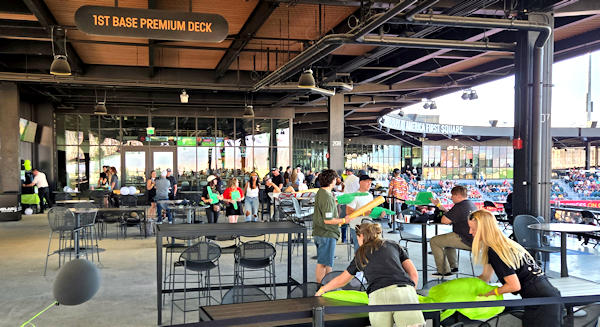
Norton added that with any project, “we’re designing architecture, obviously, but we’re also designing entertainment for people. Whatever we can do to embrace that entertainment or fan experience is the biggest thing. One thing that is front-of-mind is how do we keep people engaged.
“It’s just intuition creating the entertainment all around the ballpark, creating that 360 (degree) concourse so that everyone can experience different things.”
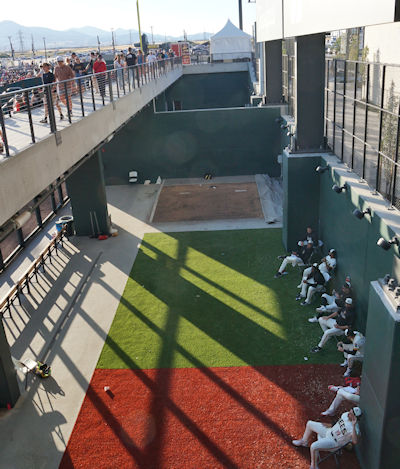 Indeed, when you come to Downtown Daybreak to attend a game for the first time, you owe it to yourself to make a trek all around the concourse. You’ll be exposed to the impressive variety of concession options, as well the miniature golf course down the third-base line, various play areas in the outfield, and the most interesting placement of bullpens in the sport.
It’s no longer in vogue to place bullpens in the “traditional” spot down the baselines. After all, teams’ high-priced talent could easily get smacked by a foul liner while warming up. So most new parks are positioning them beyond the outfield walls. HOK took this a step further, and placed them end-to-end beyond a see-through left-field wall.
But there’s more to it than that. As the photo shows, the elevated concourse runs above the bullpens, giving fans a fun vantage point to look down on relievers warming up. Further, the sidewalk in the extreme right of the picture is the one described above that’s between the ballpark and the Megaplex building (where the murals are). This gives passersby a really cool look into the ballpark through the bullpen.
I love this design.
In the left-field corner and center field are open spaces along the walkway for attractions for kids. It also provides space for future activation ideas. If you go down the steps in center, you’ll find the main entry to the park and a side door to the merch store. If you continue on the upper level, you’ll find yourself behind the very impressive triangle-shaped berm.
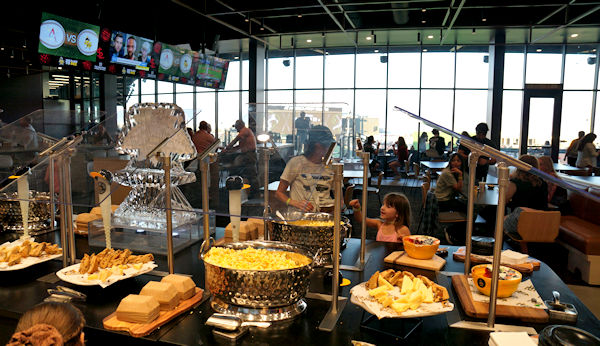
If you get to visit the upper level, you’ll find the Terrace Club is extraordinary. Vegas is all about its premium spaces, particularly its opulent lounges, but the spacious Club in South Jordan is beautifully laid out, with food stations galore. It’s so large that a non-baseball event with up to 500 people can be accommodated here.
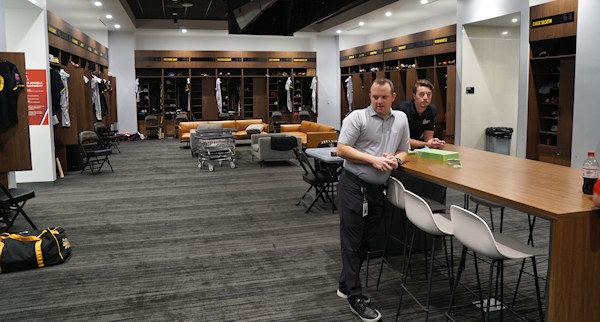
Unless you’re on the active roster, you’re not likely to visit the ground level … but if you get to, you’ll be amazed at the exceptional player-development spaces. Derek Amicone, the Bees’ Senior Director of Baseball Operations, showed us everything — including the batting tunnels on the visitors side! The clubhouses are as nice as any in the Majors. “Remember that there was a chance the A’s were coming here to play before going to Vegas,” Amicone reminded us.
Director of Field Operations Brian Soukup is in his 14th season taking care of playing surfaces, and he is exceptional at his job. He proudly showed us the turf at The Ballpark at America First Square. I had to get down on my knees to convince myself it was truly natural grass (Kentucky Bluegrass, grown originally in Washington State) because the length of the blades were so perfectly uniform and the edges were straighter than a ruler.
So the players are well taken care of here, but what about fans? Read on to learn about the Bees’ gameday experience.
The Essentials
“It’s an operator’s dream.”
That’s the way Dom Derboghossian characterizes the set-up to keep the fans fed at The Ballpark at America First Square. He would know, since he’s the VP of Food & Beverage Operations. He works for the food-service vendor PSC, a division of Levy. And PSC moved him here from the ballpark in Charlotte, which I’ve always felt was one of the top two concession parks in all of the Minors. So he arrives with great accolades.
But before we dive deeply into the F&B, let’s examine what it costs to attend a game at the Bees’ new hive.
Parking in the lots adjacent to the ballpark are $10 on weeknights and $15 on Fridays, Saturdays and holidays. Of course, take the TRAX train if you can.
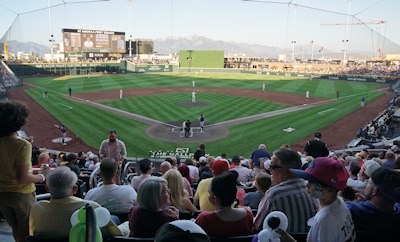
Ticket prices vary, because the team utilizes “dynamic pricing.” That means your mileage might vary, as they used to say in car commercials. It’s interesting that the Bees sell a ticket that simply allows you in the door, but you don’t get a seat or have access to the berm. Those are $7 or $8 when purchased in advance, depending on the game — but they jump up to $13 on Saturdays. To buy a general-admission ticket that does allow you on the berm is $13, or $20 on Saturdays. Seats in foul territory down the lines are $21 ($28 on Saturdays) and $40 ($47 on Saturdays) just beyond first base and third base. Closer to the infield, they are $46 ($53 on Saturdays).
 Closer to dugouts and home plate, those are considered “premium” seats, which start at $71 ($78) with the all-you-can-eat buffet in the Diamond Club (see photo). Club seats on the upper level are a very reasonable $30 ($37). Terrace Club seats (that give you access to the incredible buffet) start at $86 ($93).
It is noteworthy that while the Bees could easily sell all of the suites and Diamond Club seats as season tickets, they intentionally hold some seats back for single-game sales. The extra-comfy Batter’s Box reclining seats are super popular, though, as it appears there are none available for the rest of the 2025 season.
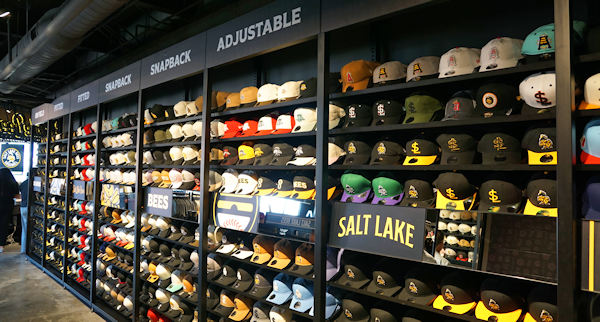
“When it comes to merchandise, there is certainly something for everybody. And the number of caps is insane,” says ballpark expert Poff. The store in center field is indeed immense, and it prides itself on having the largest number of caps in all of Minor League Baseball. “This season, we are featuring 252 different styles of caps,” noted Cory Stowe, Director of Retail. He adds that most Utahns refer to them as “hats” rather than “caps.” Noted.
The cap wall is stunning. There’s been a lot of iterations of logos for the Bees over the years, and they are all represented here. Adult adjustable caps are $30-$40, while fitted caps are $45. Youth caps are $35.
Adult tees (many are unisex) are $35-$45, with ones specifically for women costing $45. Men’s polos are $44-$65. There are also unisex hoodies, both in short-sleeve (an under-appreciated merch item in my opinion) at $55-$65 and long-sleeve at $85.
For kids, the tees are kind of pricey at $45, but there are some legit, adorable Bees jerseys running from $72-$135.
Since the Bees’ big-league parent are the Angels, there is a corner of their merch, with a heavy emphasis on Mike Trout shirts. After all, he played in Salt Lake on his way to The Show.
My favorite merch item are lapel pins, and the Bees’ shop didn’t disappoint. They offer six different styles at a reasonable $8.
Overall, the store is top-notch, if a little on the pricey side, but I’d prefer to see lot a selection and top-quality merchandise than bargain-basement prices.
You’ve no doubt worked up an appetite doing your shopping, so it’s a good thing that the food and beverage here at the ballpark is easily in the top five in all of the Minors.
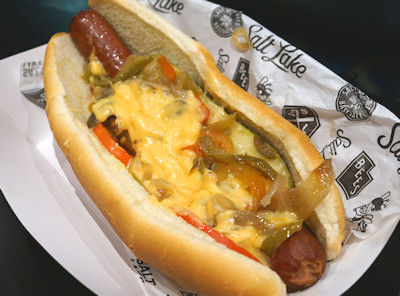 Let’s start with the dish that Derboghossian refers to as “our most signature item right now.” That’s the All-Star Dog, which combines a tribute to tradition while “bringing something new and making it more modern.
“The All-Star Dog was put together by our (late) owner Larry H. Miller and his wife Gail. They used to operate their own catering company called All-Star Catering,” hence the dog’s name. It consists of an all-beef foot-long hot dog from a company called Prairie Creek (which won a blind taste-test by LHM staff) topped with sliced tomatoes, bread & butter pickles, melted cheese, grilled peppers and onions and a secret “special sauce.” The bun is from a local bakery called (you can’t make this up) Bimbo. It’s $11 at the Franx stand. They also have Chicago-style dogs (Alan’s favorite) for $10.
Derboghossian says the runner-up for being the ballpark’s signature item is the chicken and waffle platter. It combines chicken tenders with a sugar pearl waffle (“One thing I’ve learned very quickly about Utah is that the sweeter the better”) topped with a spicy maple syrup that’s concocted in-house. It costs $10 at the Home Plate Chicken stand on the main concourse.
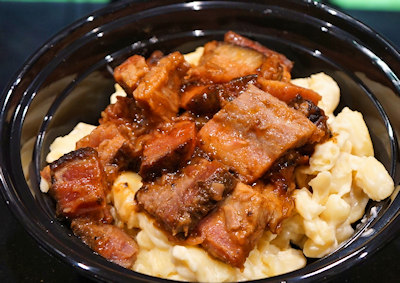 Alan and I agreed that our favorite item is the “Loaded Mac & Bees Bowls.” It’s available at the Bumble’s BBQ stand on the first-base side. For $16, mac & cheese can be topped with chopped brisket (simmered in BBQ sauce), and for $13 pulled pork or pulled chicken. It’s absolutely fantastic. And it’s worth the extra $3 for the brisket.
The BBQ served in the Terrace Club is smoked in the kitchen in the ballpark. For now, the meats served in the Bumble’s stand are smoked by an outside commercial company. “Long-term, we’d like to smoke all of our own meats here, with a smoker down on the main concourse.” That aroma would truly wake up the fans’ taste buds, so I hope they add such a smoker in the near future.
There is also a rotating menu of toppings for hot dogs and burgers, with a recent recipe calling for peanut butter and jelly.
There is a growing demand for vegetarian dishes. “We’re seeing in ballparks nationwide the desire for items for those with dietary restrictions,” so all dogs and burgers can be served on gluten-free buns, plus the Mediterranean cart has hummus nachos, which is vegetarian or can be made Vegan as well. They also have a build-your-own bowl where you pick what ingredients go into it.
Interestingly, the pizza served at the Dugout Pizza stand is actually made by Little Cesar’s and then baked at the ballpark. They are 10″ rectangles that are deep-dish. All three varieties cost $14 and are surprisingly good.
Don’t miss the Changeup stand in the left-field corner. There you’ll find burritos, enchiladas and street tacos.
Another lesson learned by Derboghossian is that Utahns have an obsession with ice cream. “The lines for ice cream are always longer than for beer.” Another local company, Farr’s, supplies the frozen delicacies. Hand-scooped in a cone is $8 and in a little batting helmet, $10.
 And, yes, quite a variety of beers are on sale here, but since Mormons don’t drink alcohol, beer sales aren’t as high as at your typical ballpark. Most places, revenue from food is roughly equal to revenue from alcoholic beverages. Not here, where the ratio is more like 60-40 or 65-35.
While all of the stands operate as walk-in markets (where the food has already been prepared), the concession stand down the third-base line carries the sponsorship name of Smith’s (the grocery chain that the previous ballpark was named after) Ballpark Market. It uses the technology very similar to Amazon stores in airports. Derboghossian said the other stands can be converted to that technology in the future if there’s demand for it.
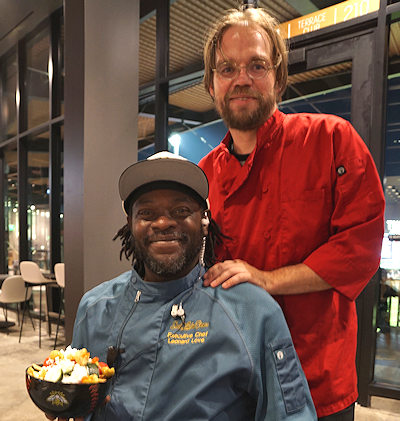
If you are fortunate enough to have a ticket in the Terrace Club, your dining and drinking options will amaze and delight you. The menu changes every day, and is the result of the magic emanating from Executive Chef Leonard Love (seated, holding hummus nachos) and Executive Sous Chef Brandon Scott. It’s Chef Love (you have to be crazy about that name) who said to us, “You eat first with your eyes, then your nose, then your mouth,” and his dishes are as beautiful and aromatic as they are delicious.
The night we were there, a pastrami burger was on the menu. It’s a wonderful recipe that originated in Utah. And the intricate ice sculpture of a bee on the first page of this review was featured prominently in the Terrace Club.
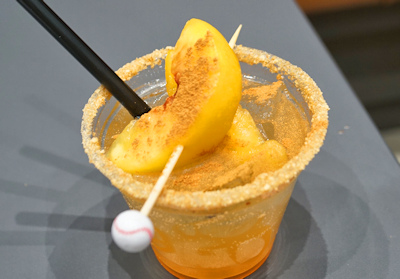 There are also premium drinks on the Terrace level, like this Poor Man’s Peach Pie. It’s a simple recipe: peach puree; Sprite and then either vodka or bourbon (my roots are from Kentucky, so I opted for the latter). I think it’s garnished with graham-cracker dust. The cocktail looked good, smelled good and tasted out-of-this-world, checking all of Chef Love’s boxes.
“Our crew here has a saying: We’re bringing you Minor League in a Major way,” added Love.
Before we leave the topic of food-and-drink all together, I need to mention Swig. I had never heard of the concept of “dirty sodas,” but they are sold by this chain (the Larry H. Miller Company is the majority investor in it), and yes, there’s one on the third-base side of the main concourse of the ballpark. They sell sodas with various flavored syrups mixed in, and they are delicious. The most magical thing about Swig is that even though this is a Coke park, if you want your “dirty” drink to be made with Pepsi or Dr. Pepper, they’ll accommodate that. God bless them!
The gameday entertainment is pleasant and polished, and certainly not over the top. Everything is very family-friendly, because in this part of the country, families tend to have lots of kids!
The sound system seemed perfect, and the massive video board provided crisp visuals and tons of useful info.
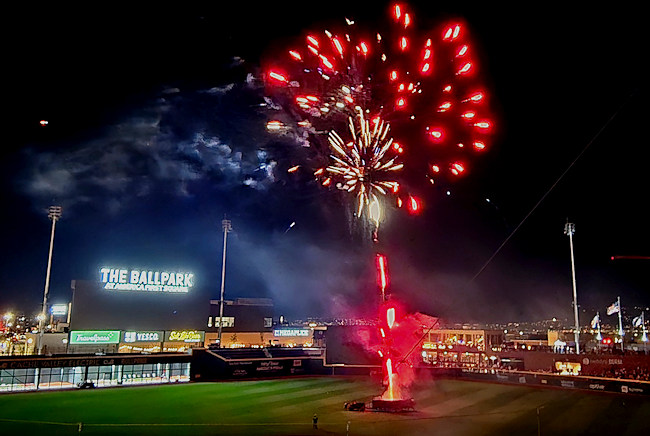
I happened to attend the sold-out contest on the state holiday of Pioneer Day, so there were post-game fireworks. By a very, very wide margin, it was the longest and most elaborate display I’d ever seen at a ballpark, including at Major League venues. Just one more way the Bees bring value to their fans
Summary
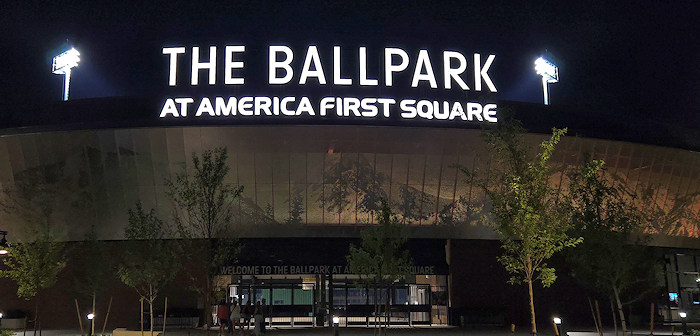
I don’t think I’ve ever learned as many lessons at a new park as I did at The Ballpark at America First Square. And the lessons were sufficient for me to conclude that there isn’t a better ballpark in the Minors.
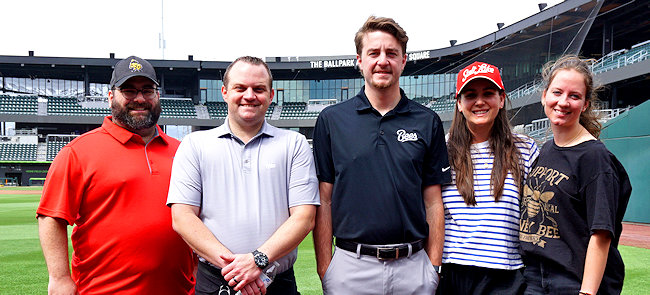
The staff handling every aspect of operating the Bees is astonishingly professional and helpful. In the photo above are some of the folks who took us on fascinating tours and answered my endless questions. From left: Devin Norton (HOK); Derek Amicone (Sr. Director of Baseball Operations); Nate Thompson (Communications Manager); Jenny Teemsma (Sr. Director of Communications); Kendall McKinnon (Communications Intern).
Jenny and Kendall basically guided us through every inch of the ballpark and arranged for us to meet with lots of department heads — and others that we simply didn’t have time for. And in the case of Jenny, I’ve never dealt with someone more conscientious in her role, and that includes in the Majors.
When I was interviewing LHM’s Steve Starks and Michelle Smith, I mentioned how utterly impressive the Bees staff is, particularly Jenny. “See? We’re ready (for MLB expansion). We’re ready all the way down to Jenny’s position,” said Starks with a smile.
He added that Utah is poised to land an expansion team because “one of the competitive advantages that we have as an organization is we just really believe in executing. We try to do it at a high level and do it smart. This (the Bees) is the best example of that. You can come and see it. It’s not hyperbole. It speaks to the breadth of our organization.”
“We’re unique in the fact that we are part of this ecosystem that has a real estate platform,” added Smith. “All of the expertise that lives there from master planning, from construction management to all of that, along with a sports and entertainment platform that knows how to operate and operate well, and how to analyze the appropriate design and functionality of a venue. And so to have those together as well as an ownership group that believes in both of those businesses and the power that it provides to the community creates these gathering places for generations.”
Norton put it best. Because the Larry H. Miller Company “has that mentality, it makes this project have the potential to be just so much more successful.”
And it teaches us many powerful lessons.
Bring on expansion! Utahns are ready.
Provide a comment below with your thoughts about The Ballpark at America First Square or this review.
El Paso still the best minor league ballpark