Wrigley’s last independent operator fights for survival
Joe Mock
Special to USA TODAY Sports
CHICAGO When John Gruber was a teenager, he wanted to be a fireman. In order to get into the proper shape, he used to break into Wrigley Field and run up and down the stairs.
43 years later, he retired as the battalion chief at Fire Truck 78, the historic firehouse across Waveland Avenue from Wrigley’s Gate 5.
Interestingly enough, Gruber’s wife Marilyn works as a bartender at the Wrigley View Rooftop directly next door to the firehouse. She encounters lots of happy patrons. “Rooftops have been around forever. It’s a Chicago thing. People love coming here.”
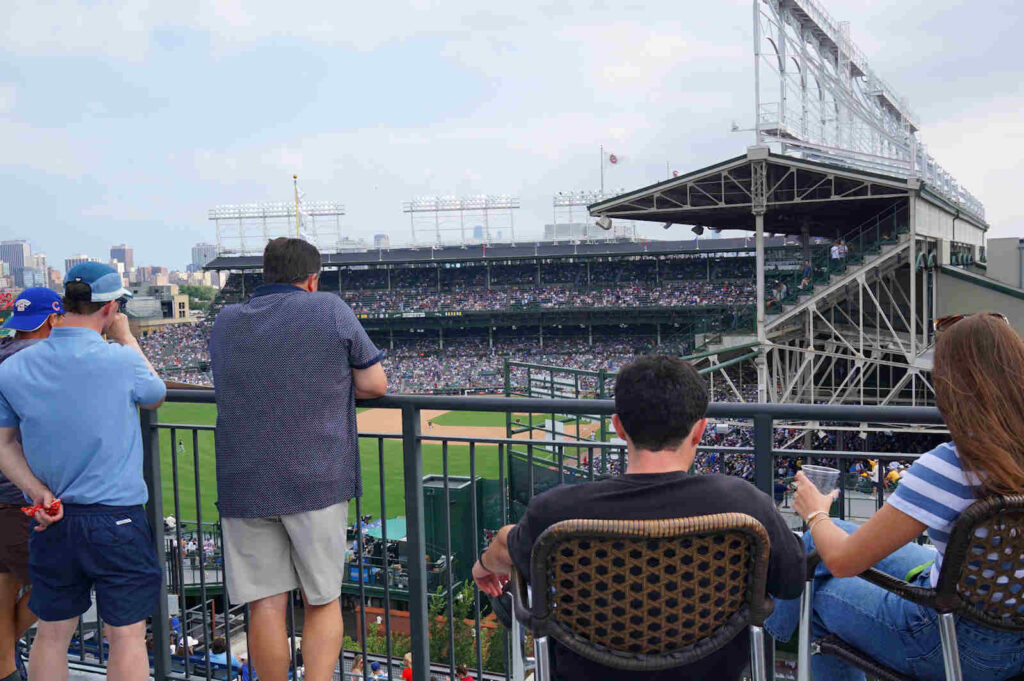
It’s a social experience. Without battling long lines at concession stands and the lack of socializing that comes from sitting in defined rows within Wrigley Field, groups congregate at the rooftops across the street from the park’s bleachers. They can still smell the aromas and hear the cheers from within the park while gathered in a relaxed atmosphere with co-workers or friends.
“I’m serious that coming here is on a lot of people’s bucket list,” says Gruber. “We’ve hosted groups that were celebrating someone’s 50th or 60th birthday. We have bachelor parties and bachelorette parties. We had one group of 150 buy out our entire facility to celebrate a girl’s graduation from college.
“When there are important events, people want to celebrate them here.”
Higher and higher
Aidan Dunican immigrated from Ireland to Chicago when he was 20. He quickly landed in the construction trade, and learned his lessons well. While working on a project near Wrigley Field, he noticed a structure that had been on the market for quite a while.
While not envisioning that the building could one day look into the ballpark, he felt he could rehabilitate the structure to make a couple of dwellings within it.
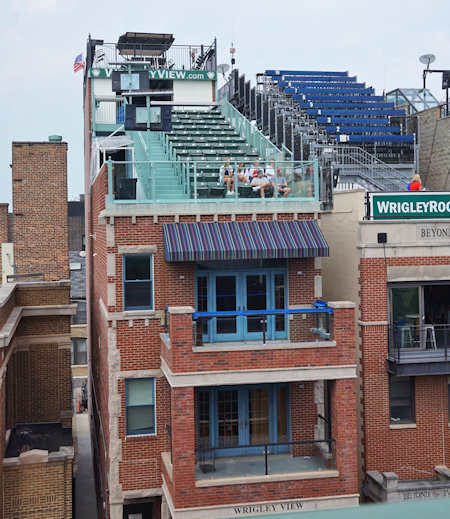 After purchasing it in the late 1990s, he demolished it and started over. He built an apartment in the basement, a nicer dwelling above it, and kept building up and up. Workers doing the construction noticed that they could watch the Cubs beyond the left-field wall.
So Dunican kept building higher. He made an apartment for himself on the second floor and a lovely indoor “clubhouse” with a bar on the third. Above was food-prep and the lower level of bleachers. After shoring up the building with additional steel supports in 2010, he added a “Skydeck” on the very top – all in a structure that is only 20-feet wide. “I don’t think it could’ve turned out any better,” he says. “Everyone who comes here loves it.”
His Wrigley View Rooftop business was off and running.
This wasn’t the only building on Waveland or Sheffield adding bleachers to its roof of course. The whole concept had captivated fans for decades, as they could buy seats and be served food and drink while watching the Cubbies play – all without setting foot inside Wrigley Field. At the height of the trend, 16 different buildings had rooftop seating.
Understandably, the Cubs were irked that their product on the field was being sold to fans without any of the revenue going to the team. In 2004, Dunican and the other rooftop owners were convinced to sign contracts with the Cubs, to whom they paid 17% of their gross receipts. The agreement was to last for 20 years.
Life went on and fans continued to flock to the rooftops.
The revenue from Dunican’s building at 1050 Waveland was his main means of support. He did nightly rentals on the luxury apartment (which features a jacuzzi) on the first floor as an Airbnb and welcomed groups to his rooftop bleachers to watch Cubs games and concerts. City ordinances prohibited the rooftop owners from renting their spaces when there was no event going on at Wrigley – even if there was a bachelor party looking for space with a cool view of the city’s (empty) landmark ballpark.
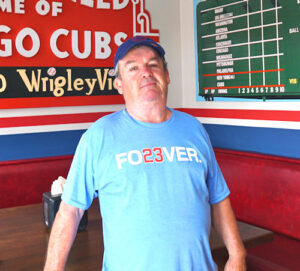 Dunican actively participates in the J1 Program that permits college students in Ireland to come to the U.S. to gain work experience. He brings them onboard to act as servers and do cleanup. “We’re known in Ireland as the place to come to work. A lot of bars around here won’t hire J1 workers at all,” explains bartender Maya Cribbin.
“Aidan is the epitome of the American dream,” observes his friend and advisor Sean Duffy. “He was an Irish immigrant who came here with nothing, but worked hard and built a business that allows him to showcase his innate skills as a host. It lets him give back to the community, as well as give opportunities to the youth of his birthplace of Ireland through the J1 program.”
All was going well, then Project 1060 happened.
Project 1060
Soon after the Ricketts family purchased the Chicago Cubs in 2009, the team embarked on an ambitious program of renovations, restorations and huge additions. Named for the street address of the ballpark, Project 1060 had a budget of $525 million.
The list of projects in and around the ballpark was quite long, with the most important being the reinforcement of the steel and concrete in the aging ballpark. Also included were more ramps, better player facilities, new elevators, huge video boards (that, yes, blocked the view from a number of rooftops), expanded bleachers, a new building housing team offices, a plaza along Clark Avenue, the Hotel Zachary across the street and dozens of commercial ventures on street level on Addison and Clark. All told, about $1 billion was spent.
The project also included the team’s desire to purchase the buildings with rooftop seating along Waveland and Sheffield Avenues. Soon a company associated with the Ricketts family owned 11 of the 16 rooftop businesses.
Even with the reduced view of the playing field, fans continued to buy tickets for the rooftops because they loved the atmosphere.
When the 20-year agreement expired, the few remaining independent rooftop owners were shocked with the terms in the new contract offered by the Cubs. According to Dunican, his business wouldn’t survive if he had to pay the new percentage of revenue required by the team. One owner on Sheffield elected to get out of the rooftop business altogether, opting instead to demolish his building and erect condos.
That leaves Aidan Dunican as the lone holdout. The Cubs offered to buy his building, but he felt their offer was far below its actual worth.
“Aidan has devoted his life to the rooftop,” notes Duffy. “I truly hope he gets a fair deal, which is all he wants and deserves.”
Gruber says that groups continue to book Dunican’s establishment “because most people know we’re the last independent rooftop here and they want to support us.”
Fighting the Empire
Wrigley Field is a mecca for baseball fans. Fans tolerate the exorbitant parking prices and expensive concessions to enjoy a Cubs game, often during a sunny afternoon. But it was inevitable that the “neighborhood” feel would take a hit with all of the new buildings, video boards and surrounding commercial ventures. What was once a throwback to a bygone era now has a far more corporate feel.
As you can imagine, the Cubs and Dunican are facing off in court since no new contract was signed when the 20-year agreement expired.
Peter Waitzman has a YouTube channel called Expedition Money. Most of his videos on investing and reducing debt attract a few thousand viewers. On June 13, 2025, he released an episode called “How The Last Rooftop Owner Is Fighting the Chicago Cubs Empire.” Yes, it is about Dunican’s dust-up with the Cubs.
Within a month, it had been viewed over 800,000 times. People love David-versus-Goliath stories.
Meanwhile, groups continue to rent out the Wrigley View Rooftop. Josh Costello lives a ten-minute walk from Wrigley. His group from a Chicago tech firm partied in Dunican’s clubhouse the evening of August 18 — even though the Cubs’ game had been postponed.
“This is great because we can socialize within our group,” he explains. “Inside the ballpark, you don’t know who you’ll be sitting next to. Here we can enjoy great camaraderie even if the game is rained out.”
“Our rooftop brings back the feeling of a neighborhood experience,” says Gruber. “But I tell people that we don’t live in Wrigleyville anymore. I say we now live in Rickettville, and they don’t seem to care about what’s good for the neighborhood.”
When you say the rooftop owners were “convinced” to sign contracts with the Cubs, just what does that mean? Kneecappings? Threats of arson? Lawfare? I don’t see that the owners owed the Cubs anything, much less 17%. Why didn’t the Cubs just put up a wrap-around windscreen…you know, to curb those pesky winds off the lake?