How the Guardians extended the life of Progressive Field
by Joe Mock
All rights reserved
CLEVELAND Some metaphors simply fit.
As the end of the lease on Cleveland’s Progressive Field neared, the Guardians saw numerous areas in the aging structure that badly needed attention. After interviewing every prominent architect in the sports realm, the team tabbed David Manica and his firm to reimagine the ballpark that opened in 1994.
And the budget wasn’t flexible.
“They had a very fixed amount of money, and it wasn’t extravagant,” Manica tells USA TODAY Sports. “They had a very specific list of areas in the building that needed attention. They needed us to spread that peanut butter across that one piece of toast to make sure that everyone benefits.”
Brian Barren, the president of business operations for the Guardians, likes Manica’s analogy. “We had to make sure that this peanut butter on this knife covers this bread, and we can’t go back for another scoop. There wasn’t enough time and there wasn’t enough money.”
Or peanut butter.
Three long years of planning and construction resulted in a transformed ballpark for the 2025 season, with both obvious structural changes and behind-the-scenes upgrades. All of this was done to extend the lifespan of Progressive Field.
‘Don’t count us out’
The franchise then known as the Cleveland Indians signed a 30-year lease to inhabit the new ballpark then known as Jacobs Field. Its gates opened in 1994.
As the ballpark aged, the team recognized that repairs were going to become more costly as time went by. They also noticed that teams like the Atlanta Braves and Texas Rangers were leaving behind facilities that by all appearances still had a lot of life left.
Unlike the exploding areas of Atlanta and Dallas Fort Worth, the Indians knew that a new park simply wasn’t in the cards in their market. As Barren points out, until 1970, Cleveland was one of the ten biggest cities in the U.S. In the 2020 census, the city’s population rank had dropped to 53rd. In addition, of the 20 cities that have NFL, NBA and MLB franchises, Cleveland has by far the smallest population and the lowest household income.
So the billion dollars it would take to build a brand-new stadium wasn’t available to the Indians like it was for the Braves and Rangers. They would have to make do with the park that was now called Progressive Field.
“This speaks to the mutual interest, both from a public and from an ownership standpoint, to figure out how to work this for all of us,” explains Barren. “There is a lot of pride in Cleveland that we may not be the big city we once were, but it’s Cleveland against the world, man. Don’t count us out.”
In 2019, with five years left on the original lease, the Indians initiated negotiations with the three entities that are essentially their landlords: the City of Cleveland; Cuyahoga County and the Gateway Economic Development Corporation.
With funds chipped in from the Ohio State Legislature plus $67 million from the team, the grand total available to extend the life of Progressive Field was pegged at $202.5 million. Much like when a player is granted an extension before his contract expires, the original lease was torn up and a new 15-year extension went into effect January 1, 2022 – two years before the 30-year lease was due to expire.
“We decided not to wait until our last year before free agency,” chuckles Barren.
Name change
Negotiations on the lease extension were underway when another issue arose. “As we looked at our team name more deeply in 2020, we learned through a process of listening and learning that we had an opportunity to unite and inspire by picking something that was not divisive,” says Barren.
“As we learned from Native American leadership, there were challenges with the (Indians) nickname being a race, not an ethnicity.”
On July 23, 2021, the franchise announced that starting the following season, the team would play as the Cleveland Guardians. Terry Francona, the team’s manager at the time, said that in making the decision, “we tried to be really respectful and I’m really proud of our organization.”
The fact that this change was occurring while major renovations were about to start at Progressive Field “just happened to be coincidental,” says Barren. “We knew we were touching all the things that fans can see (like) the concourses, the seats, the outside of the stadium, and the ballpark itself. So cleaning up and converting everything to ‘Guardians’ was actually something we were able to fold into the improvement process.”
Start, stop, remobilize
Once Manica and his team were awarded the $202.5 million contract, a timetable had to be formulated. The Guardians and the architects decided to spread the project over roughly three years. The 2022 calendar year was spent meticulously planning every move, understanding that each part of the renovation impacted other parts. For instance, to tear out the field-level seats and excavate to enlarge the clubhouses, the playing surface would have to be destroyed and rebuilt.
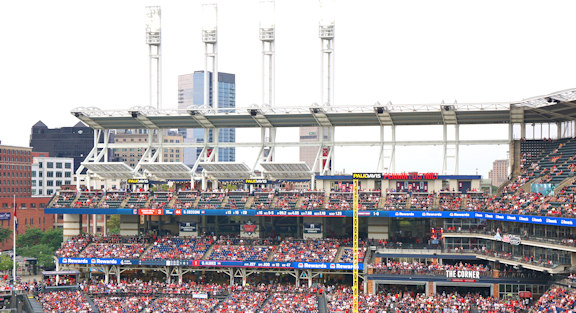 The first wave of construction – dubbed Phase 1 – would occur during the offseason following the 2023 season. It consisted of two major operations: ripping out seating sections in right field to prepare for expansive group spaces; an expansion of the freestanding building behind right field where the commercial kitchens are located.
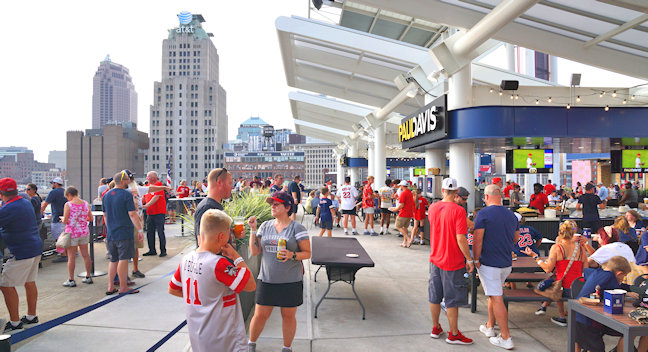
During the 1990s when the Indians sold out nearly every game, the stands in the upper deck were always packed. Then much like the Colorado Rockies encountered when the sellouts became infrequent, that space in right field could be rebuilt to meet modern fans’ demands. In Denver, they called it The Rooftop. In Cleveland, where the square-footage is noticeably greater, it’s called the Paul Davis Pennant District. Accommodating groups up to 1,500, it features a beer garden, bars and food-service areas.
“That’s the area that the spectators got to enjoy before the whole project was finished the following year,” notes Manica.
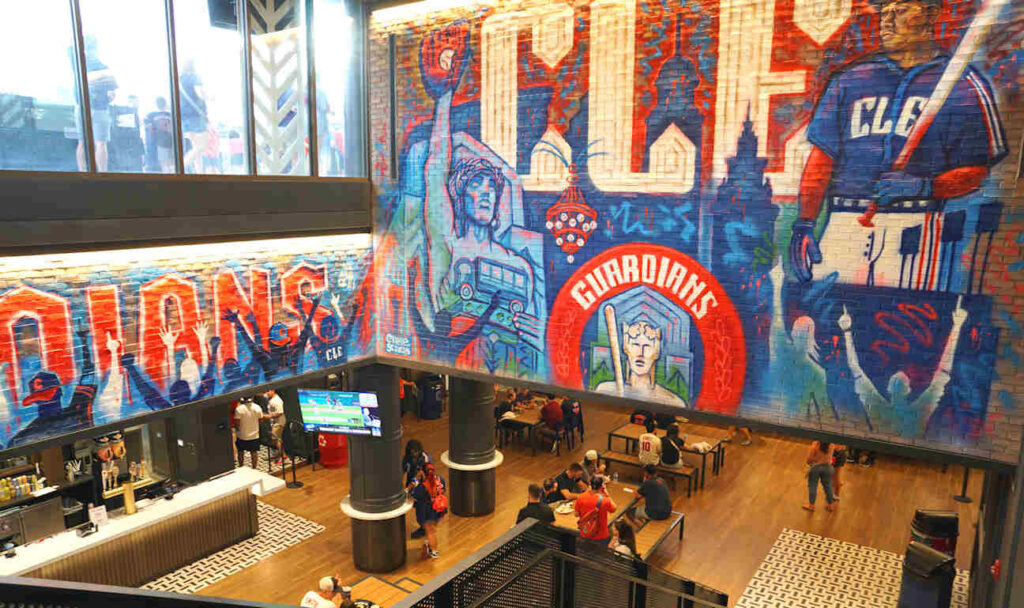
Phase 2 was to be ready for the 2025 season. It features a reimagined lounge space down the third-base line with a beer hall and terrace, a massive rebuild of the team’s administrative offices (the first renovations in the park’s history), and expanded clubhouse and team spaces.
While ambitious, that all sounds manageable. But there was a thorny problem – chiefly that the construction of Phase 1 had to be complete and all of the heavy equipment and materials had to be removed before the 2024 season started … and then everything had to start over again once the 2024 season ended.
“It’s one thing to get to start and finish your project,” notes Manica. “It’s quite another to start, stop, remobilize, and then finish. The Mortenson (construction) team did a great job.”
Good news and bad
But there were timing challenges here, too. It’s a story of good news and bad news.
The great news for Guardians fans was the 2024 squad under first-year manager Stephen Vogt rolled to the American League Central title. They then knocked off Detroit in the Divisional Round before falling to the Yankees in five games in the ALCS.
The bad news, of course, is that greatly delayed the start of Phase 2. Even if additional funds had been available, “you can’t buy your way out of four lost weeks,” observes Barren.
Even though MLB had granted the Guardians’ request to play its first three series on the road this season, the days leading up to Opening Day on April 8 were chaotic. “You can’t have a construction zone with Major League teams trying to compete. That’s non-negotiable from the League.”
Just in time, everything involving the players – the playing surface, the dugouts and the expanded clubhouses – was finished by April 8. All that was left undone were new season-ticket-holder premium lounges under the stands. Those opened on April 26.
Barren feels that the modernization efforts not only bring Progressive Field on a par with other MLB venues, they cater “to the next generation of fans. They aren’t as interested in grabbing a number-two lead pencil and a scorecard (and) sitting in their seat scoring the game.
“What they really want is to be able to be inside the ballpark in the environment and interact and have a social experience with their friends.”
Manica is proud of the resulting changes, particularly that “we were really respectful of the character of the building, carrying that forward into, honestly, the next century. All the while, we kept it on-track and on-schedule and on-budget.”
All of this was made possible because the team and its landlords entered into discussions about the lease several years before they had to.
Observes Barren, “If you enter lease negotiations with an open mind, (and) we wanted to find out how to extend the life of this ballpark, you’re going to take a collaborative approach to solving a complex problem.”
Without opening a new jar of peanut butter.
This article previously appeared in USA TODAY Sports Weekly. Used by permission.
I went back in 2018 to see all of the renovations from a decade ago and it sounds like I need to go back again!