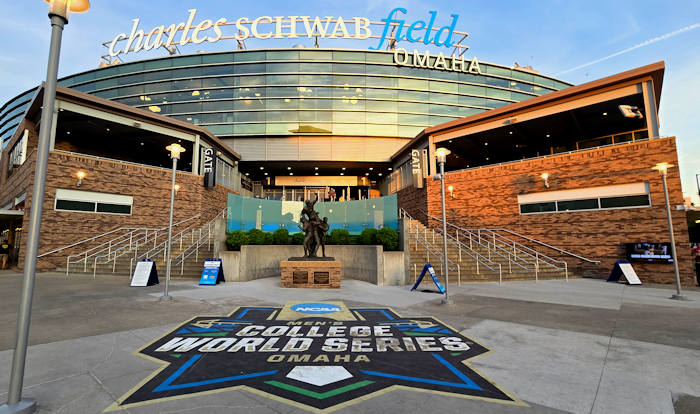
Text and photos by Joe Mock, BaseballParks.com
All rights reserved
OMAHA, NE For all the same reasons that basketball’s Final Four or the College Football Playoff attract massive attention, the Men’s College World Series captures the hearts of fans every June.
There is something endearing about watching young men joyfully representing their schools while harboring hopes of playing in the Majors one day. Indeed, attending the 11-day event should be on the bucket list of any sports fan, even if you’re not from an SEC school!
What are the behind-the-scenes elements that make the event so compelling? Here are observations and what I learned at 2026’s event.
Purpose-built
Twenty years ago, other cities were envious that Omaha had hosted the event at Rosenblatt Stadium every summer since 1950. Markets like Oklahoma City and Indianapolis had well-regarded Triple-A ballparks – the latter being a matter of blocks from NCAA headquarters – and they wanted to be on a short list to host the annual extravaganza.
Omaha’s biggest attraction of the year is the MCWS, and the city was determined to prevent that from happening. In 2008, the city pledged to build a new, very modern ballpark designed specially for the event. In exchange, the NCAA agreed to keep the tournament in Omaha for another 25 years.
Populous was one of the three architecture firms tasked with designing what is now called Charles Schwab Field. “The park’s size, character and fan experience were intentionally shaped to create an authentic, welcoming atmosphere that continues to resonate more than 15 years later,” notes Jason Michael Ford, principal at Populous.
“It provides a fitting end to the Road to Omaha.”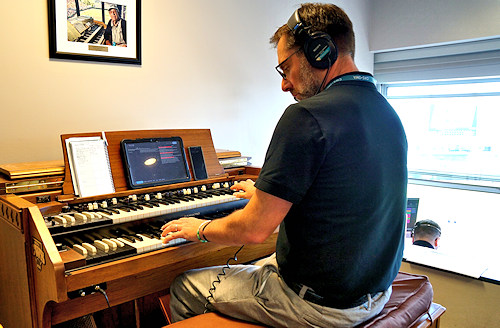
Organ transplant
Generations of fans enjoyed the traditional sound of an organ at Rosenblatt. “The move to the downtown stadium was somewhat controversial,” notes Kathryn Morrissey, the former executive director of CWS Omaha, Inc. “Bringing the organ was one of several gestures to preserve that legacy.” Another was moving the famous dogpile statue to the front steps of Charles Schwab.
Morrissey adds that the feedback from fans has been “overwhelmingly positive. The organ represents the living thread connecting the new stadium to 60-plus years of CWS history at Rosenblatt.”
Shown at the organ in Omaha is Josh Langhoff, who also plays at Wrigley Field for the Cubs.
Even media members love it
Mike Ferrin has done baseball play by play for Sirius XM, various ESPN networks and Westwood One so far in 2026 — including calling the championship game of the World Baseball Classic. But he feels the MCWS “is a one-of-a-kind event. You know what they say: there is no bad season that ends in Omaha.”
“All I do is cover college baseball,” notes Jacob Rudner of Baseball America. “But this is the best. This is the pinnacle.”
Taylor McGregor, sideline reporter for Marquee broadcasts of the Chicago Cubs, is working the MCWS for ESPN. She is used to knowing everything about one team, “but here you have to learn all eight.” She doesn’t mind, “because the atmosphere here is like nothing else.”
Hitting performance of the event
If there was an award for this, the winner would be Texas shortstop Adrian Rodriguez. In the Longhorns’ 14-2 win over Alabama in an elimination game on June 15, the sophomore went 5 for 5 while tying the MCWS record for RBI in a game with 7. For good measure, he hit for the cycle, only the third time it’s happened in the MCWS.
Had he ever hit for the cycle before? “No. Well, maybe in T-ball where they let you just run around.”
Runners-up for the best offensive game would go to: Owen Hull of North Carolina (4 for 5 against West Virginia on June 17, including three extra-base hits); and a trio of Oklahoma Sooners who each had two-homer games — Dasan Harris, Jason Walk and Deiten LaChance.
Best overall hitting performance? Oklahoma shortstop Jaxon Willets, who went a stunning 13 for 25 over the Sooners’ six games. That’s why he was the CWS Most Outstanding Player.
An institution
Omaha native Howard Borden likes to say he has seven-and-a-half decades of experience on this planet. He started attending the College World Series at Rosenblatt as a toddler in the 1950s.
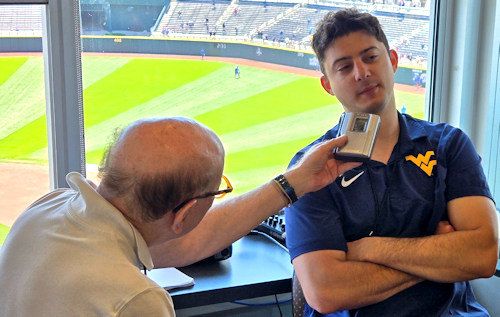 Not only is he a beloved radio personality in Omaha, he is an institution at the MCWS. He can be seen wandering Charles Schwab Field interviewing celebrities and media personalities, gathering content for his radio shows.
He records all the interviews on a battery-operated cassette recorder. They stopped manufacturing these devices in the 1990s. (In the photo, Borden is interviewing WVU radio voice Andrew Caridi.)
“I’m as old-school as it gets,” he says. “And, of course, old school is cool again.”
And when Borden completes an interview, he sets the tape recorder next to his flip phone.
Hard to get here
How hard is it for schools to earn a trip to Omaha? Last year’s winner LSU didn’t make the field of 64 for this year’s NCAA tournament. Arizona was here in 2025, and they didn’t even finish in the top 12 of their conference’s regular season in 2026, meaning they couldn’t participate in the Big 12 tournament.
Well, maybe the Southeast Conference doesn’t feel it’s so difficult, as five of the eight participants this year were from the conference where “it just means more.” It had folks around Omaha referring to this year’s event as “The SEC Invitational.” And for the seventh straight year, the World Series was won by an SEC team … a team that happened to finish 11th the conference’s final standings.
Even harder to win
The UNC Tar Heels made their 13th visit to the MCWS, and left still in search of their first title. To that, the Seminoles of Florida State say “hold my beer.” They’ve made 24 trips here with zero championships to show for it.
The economy of tickets
Ticket buyers coming to Omaha are optimistic that their favorite team will go all the way to the championship. Usually that doesn’t happen, meaning lots of tickets are up for grabs as those fans head home once their school is eliminated.
Never fear. Ticket brokers are happy to assist those fans with unloading their seats. Fans find helpful flyers on their windshield and leaflets handed out at the exits, informing them that there are enterprising folks willing to take those unneeded tickets off their hands.
Most important group in the building
If you thought the players were the most important people at the MCWS, you’d be wrong.
The event has changed radically since, say, the 1980s. Back then, to find out the results of CWS games, you had to read the newspaper the following day, or Baseball America a week or two later. ESPN changed the entire perception of the event when they went all-in on the tournament in the 1990s.
“ESPN being so pervasive really added visibility to an already-great event,” observes Mike Rooney, a pre-game analyst for ESPN. “It’s the way a lot of sports fans were exposed to college baseball.”
A quaint event turned into must-see TV. And now, must-see streaming.
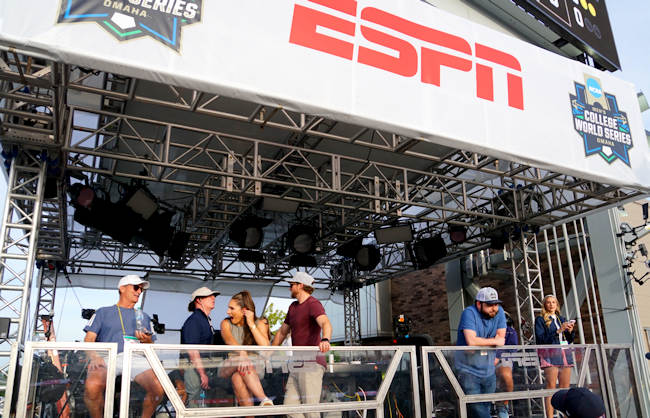
Today the network has its own compound at Charles Schwab, as well as a set beyond left field (above) and by far the biggest space on either the suite or press level for their game broadcasts.
Simply the best
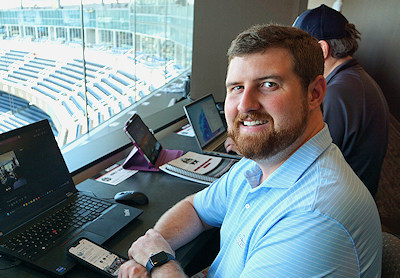
Although he admits there’s no statistical research to back this up, William Soulé (see photo) lays claim to having the highest winning percentage of any Sports Information Director in the U.S. during this academic year.
You see, he is the SID for North Carolina’s field hockey program (that went 21-2 this season) as well as their national-runner-up baseball team (53-12-1 heading into the final round of the MCWS). “Nobody is as blessed as I am to work with two of the very best programs in the country,” he says.
Being good versus being hot
This lesson is the biggest of them all.
Which is more helpful when your team makes it to the MCWS — having a superior roster or having momentum? I’ll take the latter. Clearly.
Many felt the Georgia Bulldogs had the most talent of the eight teams here, which makes sense as the highest remaining seed to make it to Omaha. They were eliminated after four games.
The Sooners are the poster children for making hay when your team is red-hot. They finished 11th in the SEC this season, which is still hard to comprehend. Yet their lineup caught fire when it mattered most, blasting their way to the national championship behind an offense the team hadn’t displayed all year. And the poster child of the poster children? OU’s Deiten LaChance, who hit exactly zero HRs during his first 31 games, and 18 in the 34 games after.
In sports, nothing trumps momentum.
All Tourney Team
As a member of the media, I was given the privilege of voting for the All MCWS Team. Here are my choices:
1B – Erik Paulsen, UNC*; 2B – Gavin Kelly, WVU; SS – Jaxon Willits, Oklahoma*; 3B Cooper Nicholson, UNC; C – Deiten LaChance, Oklahoma*; OF – Owen Hull, UNC*; Jason Walk, Oklahoma*; Dasan Harris, Oklahoma*; SP – Cord Rager, Oklahoma; RP – LJ Mercurius, Oklahoma; Most Outstanding Player of the Tournament: Jaxon Willits, UNC* * – these match the consensus of the media who voted on this
Ode to joy
In addition to these lessons, it’s impossible to deny the pervasive sense of joy throughout the MCWS proceedings.
Bill Steckis is a multimedia specialist with Nebraska TV. When the fans of the West Virginia Mountaineers descended on Omaha, he was struck by the joy and the sense of unity they brought with them.
And they brought a song: John Denver’s “Take Me Home Country Roads.”
“Their love of that song is the most authentic thing I’ve seen here,” Steckis says. “For Mountaineer Nation, it’s more than a song. It’s home.” (Here is the video segment produced for local TV by Steckis. Disclosure: I was interviewed for it.)
Borden also believes the joy that abounds at the MCWS isn’t always evident in the way the games are delivered to fans electronically. He says the appeal of the event is in witnessing the essence of the games being played, a throwback to a bygone era.
“What I learned from being a little boy in the 1950s at Rosenblatt is that with all the ways that the game is brought to the people now, it’s still baseball,” he explains. “It’s like when you rode your bike down to the park and got lost in the game of baseball for a few hours.
“It’s still the same. The memories are always there. They are etched in your mind forever, and you’ll always recall them with joy.”
And with that, we can turn off the cassette recorder.
Mock, co-author of the new book Rickwood, covers sports facilities for USA TODAY Sports. Used by permission by USA TODAY.
Thx for the article. The CWS was an event I would take my grandkids to for many years. The tix were $10 for General Admission with no seat guarantee. Now Mecca has out priced the locals from attending. Our family can no longer attend the games in person. No more general admission, no longer a home run derby, and nearby parking is out of sight. Another ‘family activity’ kicked to the curb thanks to those who have $$$ … and to those that don’t, they are eliminated.