Text and photos by Joe Mock, BaseballParks.com
All rights reserved
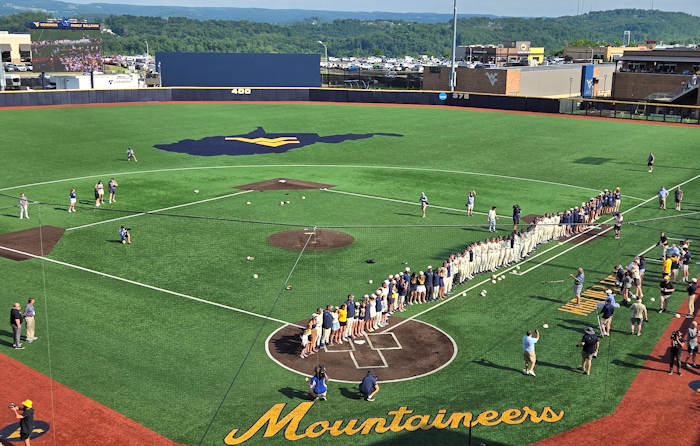
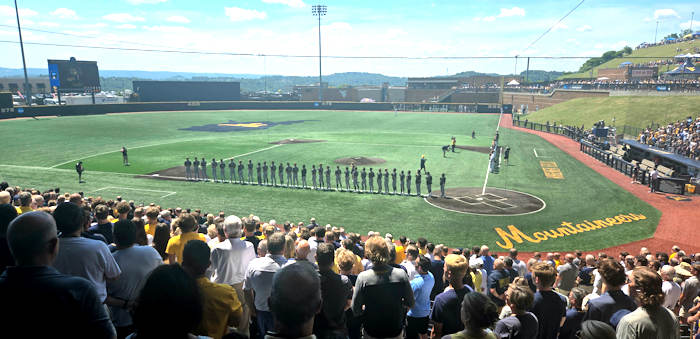
MORGANTOWN WV There’s a tradition at West Virginia University. Following a Mountaineer victory, players line up and sing John Denver’s 1971 classic “Take Me Home Country Roads” with the fans.
Following WVU’s sweep of the Cal Poly Mustangs in the Morgantown Super Regional Saturday, those Country Roads lead to Omaha. This will be the Mountaineers’ first trip to the Men’s College World Series. The program dates back to 1892.
“Mountaineers are going to Omaha!” proclaims head coach Steve Sabins following the clincher. “It’s 135 years in the making. (It’s) pretty special to do something that’s never been done before.”
Not bad for a program that was nearly shelved in 2012.
Almost disbanded
The university was in the process of joining the Big 12, a conference of baseball royalty like Texas, Oklahoma, Baylor, TCU, and Oklahoma State, all of which had competed in the College World Series. WVU’s Hawley Field was seriously deficient, and replacing it – as well as funding the other expenses of fielding a competitive program – was going to be prohibitively expensive.
“Our players had to change (into their uniforms) in the parking lot,” notes current Director of Athletics Wren Baker.
So scrapping the program, which hadn’t made the NCAA tournament since 1996, was seriously considered.
Instead, the university’s leadership decided to make the investment to go all in. A new stadium was constructed on a hillside overlooking the campus and Randy Mazey, a high-profile coach with extensive program-building experience, was hired to lead the team.
A key hire for his staff was Sabins. He was Mazey’s second in command, and prior to the 2024 season, he was named the “coach in waiting,” as Mazey announced that he was retiring following that spring’s campaign.
The trajectory of the program was clearly upward as Sabins was taking the reins. The Mountaineers won their first Regional in 2024, leading to a Super Regional at the University of North Carolina. WVU was swept in two games by the Tar Heels in Mazey’s final contests as coach.
In Sabins’ first year in 2025, WVU also won a Regional, this time at Clemson. Their reward was traveling to the Super Regional at Baton Rouge, where they were knocked off by eventual national champs LSU.
The 2026 campaign has been the most successful in program history. This time, the Mountaineers hosted the Regional. To prevail, they had to fight their way out of the losers’ bracket, ultimately walking off the Kentucky Wildcats in 10 innings in the deciding game.
Those five games in four days while constantly facing elimination, left them battle-tested. It also allowed West Virginia to host a Super Regional, another first in program history.
Cal Poly had won the Los Angeles Regional hosted by top-ranked UCLA. Thanks to St. Mary’s two wins over the overall number-one seed, Cal Poly was able to breeze through the Regional without having to face the mighty Bruins.
It was a very different story in Morgantown.
“We just ran into a real good ballclub,” says Mustang’s head coach Larry Lee after the two-game sweep at the hands of the Mountaineers. “(They are) multi-faceted. Not a good match-up for us. We just weren’t able to hang with them.”
WVU won Game 1 12-2. If that was a boat race, Game 2 was a tsunami, as they rolled over the Mustangs 17-1. The 29 runs was the third most ever in a two-game Super Regional.
“We were trying to string together three singles to score a run. They did it with one swing,” laments Lee.
No one saw WVU’s power display coming. They finished last in the 14-team Big 12 in home runs, then banged 12 long balls in seven games thus far in the NCAA Tournament. The crescendo came in Saturday’s clincher against Cal Poly, as five Mountaineer blasts left Kendrick Family Ballpark.
It’s the most in a game in Sabins’ two seasons as head coach.
Ben Lumsden and Armani Guzman had failed to homer during the regular season. Lumsden then went deep three times in the two rounds, while Guzman’s first homer came in the clinching game against Cal Poly.
“It was cool. I’ve been trying to hit home runs for a while,” Guzman reveals.
Catcher/infielder Gavin Kelly, predicted to be a top choice in the 2027 MLB draft, gave scouts plenty of reason to drool. In the seven tournament games, he batted .414, his seven walks contributed to an on-base percentage of .528, and his eight extra-base hits helped him slug .897. That’s an other-worldly OPS of 1.425.
‘We needed to host’
“If the team had one deficiency during the regular season, it was a lack of power,” notes Andrew Caridi, in his fourth season as the radio voice of WVU Baseball. “We’ve sure rectified that in the postseason.
“It’s been amazing watching the team’s progression year over year,” he adds. “We went from just making a Regional, to advancing to two Super Regionals and now to Omaha. We’d learned to get where we wanted to go, we needed to host.”
It worked.
This year’s team wasn’t an offense-first squad. The top three ERAs turned in by pitchers in the Big 12 this season were all by Mountaineers: 2.01 by Maxx Yehl, the conference Pitcher of the Year; 2.85 by fellow weekend starter Chansen Cole; and 2.95 by reliever Ian Korn. Heading to Omaha, the three have a combined record of 24-4. WVU’s team ERA led the conference by nearly a run.
Sabins’ team also led the Big 12 with the fewest fielding errors, and had the leading base-stealer in Guzman, generally regarded as the Mountaineer with the most obvious tools. In ten postseason games (including the Big 12 tournament), WVU has stolen a staggering 23 bases in 24 attempts.
The Mountaineers, who’ve won 17 of their last 20 games, are bringing a lot of weapons to Omaha.
Closing it out
With a 16-run lead going to the 9th inning of the clinching contest against Cal Poly, Sabins sent left-hander Ben McDougal to the mound to close out the game. The Bridgeport, West Virginia native grew up idolizing WVU athletics.
 Not a top prospect out of high school, he pitched at Potomac State before Sabins offered him a spot on the Mountaineers. The image of him getting the final strikeout to send his team to its first College World Series will be seared into West Virginians’ memory for generations to come.
“To see the support from the entire state is beyond special … A program that was nearly disbanded (has become) one of the best in the nation,” notes Sabins. “And for Ben McDougal to be the one to send us to Omaha is a movie script.
“I was almost in tears in the dugout.”
After the heroics in front of boisterous, packed Kendrick Family Ballpark, and thousands more on a hillside overlooking the field, McDougal lined up with his teammates to sing the song he’d learned as a toddler.
This time, though, the Country Roads lead to Omaha.
Mock, co-author of the new book Rickwood, covers sports facilities for USA TODAY Sports. Used by permission by USA TODAY.