
By Joe Mock, All Rights Reserved
BRISTOL, TN — When I’m scrutinizing a new ballpark, you’ll get my standard in-depth review that looks at how the stadium came to be, what it looks like, what the gameday experience is like, etc.
Bristol Motor Speedway is decidedly not a new stadium, since it opened in 1961. But it is new from a baseball perspective. When MLB decided to bring a game to a place with a big stage, they couldn’t have picked a bigger one than the place nicknamed The Last Great Colosseum.
I wrote two articles for USA TODAY regarding the 2025 MLB Speedway Classic. The first previewed the event, and came out in print three days beforehand. The second was posted on USATODAY.com immediately after the game, which took two days to play thanks to the unrelenting rain.
So here is my Preview article followed by the “What I Learned” recap (both appear by permission). If you attended the game, post a comment at the end describing your experiences at the event.
PRE-GAME PREVIEW
This appeared in the July 30, 2025 USA TODAY Sports Weekly under the headline Turning an uneven NASCAR racetrack into MLB ‘spectacle’
Using a cliché to describe a sporting event has become, well, a cliché.
Some clichés have made a complete 360, where they start as a description of a sports situation, graduate to becoming totally figurative, and then come home to roost. Such is the situation in Bristol, Tennessee, where the NASCAR track has such an uneven infield that “leveling the playing field” is literally the task at hand.
When Major League Baseball brings its 2025 jewel event to Bristol Motor Speedway on August 2 at 7:15 p.m., it will require sufficient gravel to create a level surface for the artificial turf. Longtime MLB ballpark consultant Murray Cook of BrightView explains that it required 18,000 tons of gravel to be trucked into the venue to account for the four-foot difference in elevation between the track and the center of the infield.
Think about that. Legally, a fully loaded concrete truck is limited to a weight of 80,000 pounds, or 40 tons. That means when the Cincinnati Reds and Atlanta Braves take the field this Saturday, they’ll be running across the equivalent of 450 cement trucks worth of gravel.
That’s just one of the impressive feats undertaken by MLB and its partners to be able to present a baseball game where none has been attempted before.

‘We’ve explored that’
“You never know who’s watching when you’re putting on events,” says Jerry Caldwell, president of Bristol Motor Speedway, better known as “BMS” in NASCAR circles. For instance, in 2016 the facility hosted The Battle of Bristol pitting the football teams from Tennessee and Virginia Tech.
It sure took a lot of gravel to level a whole football field.
But apparently MLB noticed the way the event was staged. Around that time, MLB had started looking for unique places to hold games.
Five years went by. Caldwell then received a call saying some executives from MLB headquarters were in the area conducting business with Appalachian League teams, and they wanted to look around the racetrack. Caldwell gladly obliged.
During the tour, one BMS manager spoke up and said jokingly, “You know, we could put a baseball diamond inside here. It would fit.”
There was stunned silence when an MLB exec replied, “You know what? We’ve explored that.”
“The driving force behind our ideation phase of looking for new events is always trying to find a diversified offering year over year,” says MLB’s Senior VP of Global Events Jeremiah Yolkut. “We want to bring attention to baseball outside of the 81 home games that all of our clubs play.
“Bristol checked a lot of boxes for us,” he continues. “Number one, it achieves the Commissioners goal of playing games in states that don’t get them all the time. Also, is there a fan base that would be interested in a game there?”
Based on the number of tickets already sold for Saturday’s game, the answer is yes.
Once it was decided to bring a game to this facility, there was the problem of logistics. Just because MLB wanted to play a game in Bristol, how do they pull it off? After all, this will end up being “the most complex field build that we’ve ever had,” notes Yolkut.
While Cook is enjoying the fact that this project is the closest to his home in Roanoke that MLB has ever planned an event, he still knows this is going to be a challenge getting everything installed in between events already scheduled at the venue.
The heat and long days in Bristol have been a challenge for the Brightview crew. He likened this project to preparing the Olympic Stadium in London for MLB’s games in 2019, 2023 and 2024. He faced similarly tight schedules there, and in fact is utilizing some of the same fencing and other materials used for those London Series contests. But “this project is bigger. It was only 4,000 tons of gravel over there.”
He felt better after the artificial turf had been rolled over all of that gravel. “It’s always great to see the green side up,” he chuckles.
The surface being used is made by AstroTurf. It’s the same material installed at Rogers Centre in Toronto when the Blue Jays made major renovations two years ago. Most jewel games have been on grass, but the very temporary nature of this year’s event, plus the gravel underneath, makes a natural surface impossible.
Creating a ‘spectacle’
There’s been a noticeable progression in MLB’s one-off jewel events, beginning with 2016’s salute to the military by playing a regular-season game at Fort Bragg, North Carolina. This was followed by games at the College World Series park in Omaha, the Minor League park in Williamsport, Pennsylvania while the Little League World Series was happening across the river, the Field of Dreams movie site in Iowa and last year’s tribute to the Negro Leagues at Rickwood Field in Birmingham.
“We’re always looking for our next event to be bigger and to shine a light on the sport,” explains Yolkut. “We knew that what they do around racing and also the football game they hosted, Bristol knows how to put on big events.
“We knew Bristol could create a spectacle.”
To make the scheduling work around this spectacle, the Reds and Braves face off in Cincinnati this Thursday at 7:10 and Friday at 12:40. Then it’s off to the hills of East Tennessee for Saturday’s night game.
A rare Sunday off-day is scheduled the following day. This is to permit a game if Saturday is washed out.
Progressing
There’s also been a progression in the entertainment and gameday experience presented prior to the games in these jewel events. The first at Fort Bragg was basically the game itself between the Braves and Marlins, and that was it. Last year, MLB scheduled three days of events, starting with a Minor League game, followed by numerous tributes to the recently passed Willie Mays, a celebrity softball game, and a stunning musical performance by Jon Batiste that rivaled a Super Bowl halftime show.
And all of this was before the first pitch of the Cardinals-Giants game had been thrown.
This year in Eastern Tennessee, the festivities will start the day before the MLB game. The Appalachian League (a “partner league” of MLB) will conduct its championship game in its showcase ballpark in Johnson City at 7:00 on August 1.
Boyd Sports, owners of the Double-A Knoxville Smokies, possesses five franchises in the Appy League. “Considering we own half the teams in the circuit, we’d love for fans coming to Bristol to also attend the league championship game the day before,” says Boyd’s president Chris Allen. “TVA Credit Union Ballpark is a really cool place, and it’s only about 20 minutes from the racetrack.”
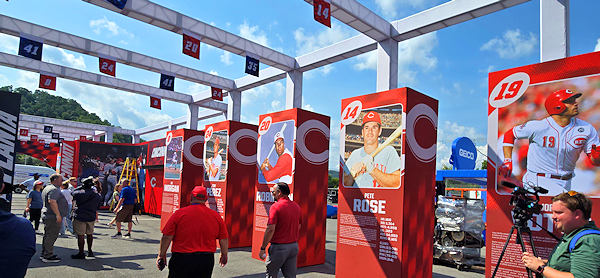 During the day Saturday, those with tickets will find an enormous amount to do in and around the Speedway. If you’ve ever been to a NASCAR race, you know there is as much going on outside the seating bowl as within.
“We’ve really leaned into the operations of how this venue works,” says Michael Kinard of Populous, MLB’s longtime event-planner for special games like this. “It’s such a massive venue, but we didn’t want to change too much when we put an MLB thumbprint on it. As you walk around outside, you’ll be able to stop at (various) fan activations.”
There are smaller stages with performers outside, plus sponsors have tents and stands showing off their wares. And there will be no shortage of merchandise that mixes baseball and racing themes.
Adjacent to the main stadium is the Bristol Dragway, the quarter-mile drag-racing track that has as busy a schedule of races as the stock-car track a few feet away. While drag races aren’t scheduled this weekend, fans would no doubt enjoy a 40-yard dash pitting the Reds’ Elly De La Cruz against Atlanta’s “The Freeze.”
Once batting practice is concluded, those inside the massive seating bowl will be entertained by two of the biggest names in music – Country legend Tim McGraw (whose father Tug racked up 180 saves during his big-league career) and Latin hip-hop star Pitbull.
MLB has hinted that the player introductions will be handled with a true NASCAR feel as the Braves and Reds are raced around the track.
Going Really Big
Bristol Motor Speedway and its neighbor to the east in Martinsville are the two shortest tracks on the regular NASCAR schedule, both coming in at about half a mile. Even though BMS is a “short track,” you won’t find it the least bit undersized when you step inside.
For one thing, it’s rare for a race track to have its grandstands completely encircle the track, with roughly the same number of rows all around. Imagine the Rose Bowl in Pasadena. And if your ticket is for the top row, you’ll be watching the action from the equivalent of the roof of an eight-story building.
You’ll also have 189 very steep steps to reach your seat, as there are almost 100 rows of seats in the venue nicknamed The Last Great Colosseum.
“Many people are going to be further away from the field, so we’re trying to make sure that we’re doing things in different locations in the venue so you’ll still feel connected,” notes Brian O’Gara, the VP of Special Events for MLB.
If you think that it was a tight fit getting the baseball field into this “short-track” venue, think again. Because the baseball field only occupies half of the track’s infield space, “there is so much space left for the concert stage, clubhouses, our tent village (for media and other operations), concessions, bathrooms and a fan plaza,” explains Yolkut. “All of these have always been outside the ballparks at the jewel events, but now there’s space for all of that on the inside.”
If you’re wondering why the baseball field isn’t situated in the very center of the racetrack’s infield so there would be grandstands on all sides, there’s a very, very large reason: Colossus.
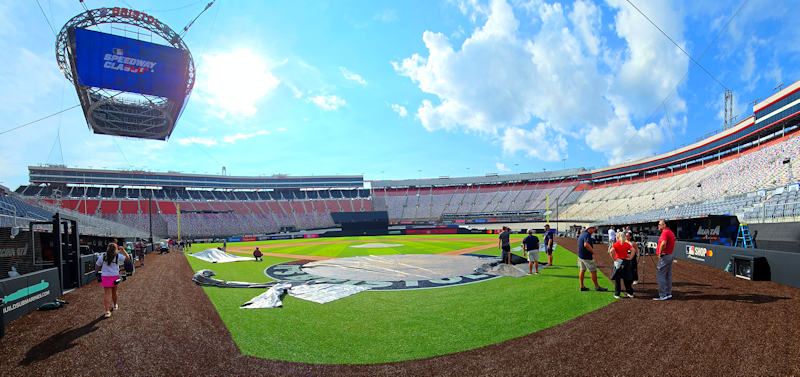
Colossus is the massive video board and sound system that is suspended over the very center of the racetrack’s infield. The 30-foot-tall screens on the 700-ton beast can be seen from all points in the grandstand. However, it’s only 155 feet above the level of the infield. That’s higher than the lowest catwalk at Tropicana Field in St. Petersburg, but far too low to hang over the middle of a playing field.
So the solution here was to place the baseball field on one end of the infield, with the outfield fence hugging what would be Turns 1 and 2 of the track. Colossus then hangs roughly over the third-base dugout.
Yolkut notes that the placement of the stage where McGraw and Pitbull will perform opens up the opportunity to promote tickets that would ordinarily have limited or no visibility of the baseball action. With reserved seats sold out, “perhaps there are fans who still want to come to the venue and experience the fan zone, see the concert, watch the game on Colossus, but just not have a traditional seat.”
Until July 29, Ticketmaster was indeed selling “obstructed view seating” for as little as $23 (now the site is showing SOLD OUT). Elsewhere in BMS, prices are much higher. The cost of most seats in the grandstand wrapping around Turns 1 and 2 ranged from $117 to $160. There are about 3,500 seats in temporary bleachers right along the foul lines. While most of these seats go to MLB’s sponsors, some were included in the public sale. They went for $350 down the foul lines and $600 closest to home plate. On the secondary market, expect to pay double to triple those figures.
All told, attendance should be about 85,000 for MLB’s first regular-season game in the state of Tennessee. This would make it the biggest crowd of 2025, since the largest ballpark currently in the big leagues is Dodger Stadium, with about 56,000 seats.
Says Yolkut, “We knew we could go really big at Bristol.”
Telling the story
Yolkut notes that the Fox TV network “had a great interest in this event. They know the venue because they’ve done races there. They also love the idea of a spectacle, a show that they could put on TV in the middle of the summer on a Saturday night.”
Perhaps most important if you’re watching from home, “Fox really knows how to tell a story. One of the benefits of them as a partner is that they really know how to bring to life what’s happening in the venue.” Never was this truer than last year when MLB honored the players of the Negro Leagues at America’s Oldest Ballpark, Rickwood Field in Birmingham.
As for the batters hoping to hit a long drive onto the racetrack in Turn 2, the dimensions aren’t that different from big-league norms. It’s 330 feet down each foul line, 400 feet to center, 385 to left center, and 375 to right center, where the wall is a little higher because there’s a building that couldn’t be moved.
“It’s just striking to see that baseball field plopped down in the middle of this half-mile track,” exclaims Caldwell. “It’s going to be one of those memorable events that you’ll be glad you were here. It will be a spectacle.”
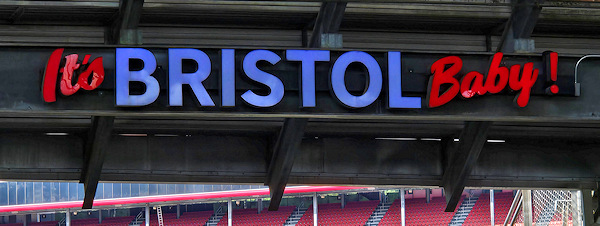
‘It’s Bristol, baby!’
When Dale Earnhardt, Jr. won the 2004 Night Race on this track, he exclaimed a phrase that has echoed through the surrounding valleys ever since.
“It’s Bristol, Baby!”
Expect to hear those three words on Fox’s telecast Saturday evening. Often.
Cook knows the clock is ticking as soon as the last out is made Saturday. “We’ll be packing up and getting everything out just as quick as we can, so they can get back to racing here.”
And part of the “everything” to be removed is many, many tons of gravel. And that’s no cliché, Baby.
POST-GAME TAKE-AWAYS
This appeared on USATODAY.com under the headline MLB Speedway Classic: What we learned from historic baseball game at Bristol
This town of 28,000 year-round residents is typically a little on the sleepy side. When NASCAR comes to Bristol Motor Speedway (BMS) two weekends a year, the place explodes with visitors from every corner of the country.
This weekend, though, the explosion in visitors was due to a once-in-a-lifetime event sponsored by a different sport.
Major League Baseball partnered with the racetrack to present the MLB Speedway Classic, as the Cincinnati Reds fell to the Atlanta Braves 4-2 after two lengthy rain delays Saturday night pushed the remainder of the game to Sunday afternoon. Not only did it mark the first regular-season game played in the state of Tennessee, it set the sport’s all-time attendance record, as 91,032 baseball and racing fans bought tickets to the contest.
Far fewer than that number were in their seats Sunday to witness this bit of history, as many were unable to return for the final eight innings of the suspended contest. The record stands because attendance is determined by the number of tickets sold.
Some of the reserved-seating sections in the massive grandstand were over 900 feet from home plate, but even from those distant bleachers, it was obvious that the star of this two-day game was Eli White of the Braves. He provided all his team’s horsepower with a pair of home runs onto the racetrack’s straightaway beyond left field.
Fans and social media had plenty of criticism of the Speedway Classic, especially after Saturday night’s missteps – which included concession stands running out of food as fans remained at the racetrack longer than expected (there was even less food available Sunday).
While Sunday afternoon’s completion of the suspended contest went well from a “baseball” perspective, the dissatisfaction from Saturday night was a lot to overcome. And the criticisms were stinging. The Daily Mail wrote “Less Dixieland Delight and more Dixieland Disaster.” A commentor on X.com who attended the event said, “Complete and epic fail.” A photo that went viral showed what a customer received after paying for two hotdogs and an order of nachos: two bun-less dogs (they ran out of buns) and cheese-less nacho chips (same story). The Atlanta Journal-Constitution wrote that it was a “recurring theme that the stadium wasn’t totally prepared for the record audience.”
The players were also less than thrilled. Tyler Stephenson, catcher for the Reds, told reporters that he felt “like it could have been handled a lot differently.” His teammate Gavin Lux added “Honestly, I think it was poorly handled by the MLB. Not to call anybody out, but it was just poorly handled all the way around … “
Oh, and for the thousands of fans who couldn’t stick around for the completion the following day, they are simply out the money they spent on their tickets. According to Ticketmaster, MLB has decreed that no refunds will be made. Well, at least those folks got to see five outs of a big-league game!
So while this event might not go down in history as the most beloved “jewel” event, there were plenty of lessons to be learned from this soggy affair:
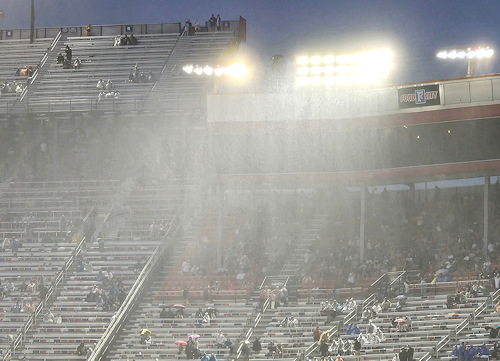 Bringing such a big event to this part of the country is risky due to the daily rain. This has to be pointed out before all other lessons. Even before Saturday night’s two rain delays and the eventual suspension of the game, it was obvious that it was risky to bring a game here at this time of year. Fans who spent the week here in Eastern Tennessee experienced rain – often in the form of a deluge – every day.
Give MLB credit, though, for scheduling an off-day on Sunday for the two teams, just in case Saturday night’s contest was washed out.
MLB keeps upping the ante with its “jewel” events. When MLB brought a regular-season game to Fort Bragg in North Carolina in 2016, there were no superstar concerts or celebrity sightings. Even the National Anthem was sung by a soldier on active duty at the base. The event proved that MLB could pull off a game in truly unusual circumstances – including constructing a temporary ballpark. Since then, there have been games in London, at the Little League World Series, the Field of Dreams movie site and the old Negro Leagues ballpark in Birmingham. With each new event, MLB has sought to make a bigger impact. It doesn’t get any bigger than Bristol Motor Speedway.
 There is much more than just a game. In addition to huge-name performing acts, fan zones, local food and numerous attractions, MLB always brings a charitable component to these jewel events. For example, the artificial playing field from this game was donated to nearby East Tennessee State University, and plywood from the build is going to rebuilding efforts from Hurricane Helene, which devastated this area in September 2024.
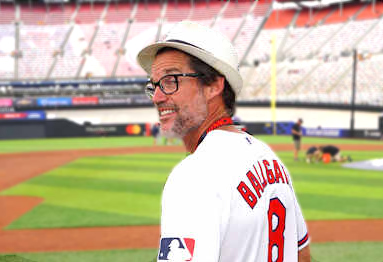
In addition, MLB’s Ambassador of PlayBall James Lowe (also known as “Coach Ballgame” — see photo) led a skills workshop for over 200 youth players on Friday. “Our goal was to inject joy and plain ol’ common sense in baseball, not a win-at-all-costs attitude toward the game,” Lowe says. “The kids really enjoyed it.”
So MLB’s heart is in the right place whenever it stages one of these events.
Some players liked this break from the routine more than others. Reds manager Terry Francona implied that some of his troops were grumbling about interrupting their series in Cincinnati to come to Eastern Tennessee. “For one time a year, if it’s good for the game, we need to put a smile on and do it,” he explains. Others welcomed the departure from their normal routine. Before the start of the game Saturday, Braves first baseman Matt Olson said he was looking forward to trying to hit a ball onto the racetrack. “That would be a first.” He adds, “It’s a really cool set-up here. I just can’t believe they did this just for one game.”
Fans are crazy about these unique events. A look at the license plates in the massive parking lots surrounding the stadium shows fans came from all corners of the country. Trey Kelley of Cedartown, Georgia says the draw of coming here, “was the experience of getting to see baseball in a different place. Bristol is really a special venue.” He had some sympathy for MLB, adding “I think Day Two showed how great the first day could have been if it hadn’t been for the rain. I thought bringing (race driver) Chase Elliott and having the players circle the track behind a pace car really married the MLB and NASCAR families together.”
Bristol Motor Speedway really knows what it’s doing. A major difference between bringing the event here versus all of the other jewel-game locations is that MLB had to do all of the heavy lifting of organizing and communicating at those other sites. Here, there was already a full staff of PR and communications professionals. They handle all the NASCAR events, and they are exceptional at their jobs. Most likely, had they been in charge of all aspects of the organization of this event, it would’ve gone really well. BMS even bought pizzas for hungry media members, stuck in their work area during the two rain delays late Saturday night.
On the heels of last year’s emotional “jewel” event honoring Negro League players, did it make sense for MLB to come to a NASCAR track? A criticism often heard when this game was announced a year ago is that it is, well, an odd choice on the heels of honoring the Negro Leagues in Birmingham last June. It’s a stretch to claim that MLB was tone-deaf, because there was no connection between last year’s jewel event and this one. Each year’s location is selected independently from all previous games. But a better question is whether MLB bit off more than it could chew in trying to stage the event in such a massive venue with 91,000 fans present. It’s a shame that so many of those fans came away from this with a bad taste in their mouths — and the thousands who couldn’t return Sunday have even more to complain about, since they can’t get a refund for their ticket purchase.
Playing in a venue with 160,000 seats allowed MLB to answer critics. If you look back at past jewel events, by far the biggest criticism from fans was their inability to buy tickets due to the very small seating capacities. This event didn’t sell out until earlier in the week, giving fans ample opportunity to buy as many tickets as they wanted, answering the critics. At Bristol, “we knew we could go really big,” says Jeremiah Yolkut, MLB’s Senior Vice President of Global Events.
Gorgeous merch, but ridiculously priced. These events are heaven for souvenir collectors, and the creative use of racing graphics made the merchandise irresistible. The prices, to be honest, were ridiculous. I bought a shirt and a cap, and the total including tax was $169. When I looked at the receipt that was emailed to me, I was shocked that the cap alone was $65 – and there were zero signs to communicate the prices on any caps. That is no way to treat fans.
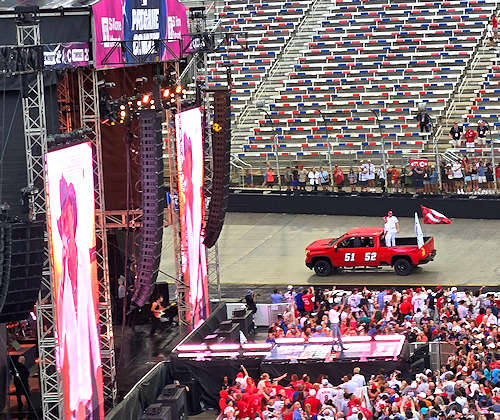 The marriage of racing and baseball provided some endearing moments. Some great ideas grew out of the partnership of MLB and BMS – and their sponsors. Chevy pickups brought the players around the track for pregame introductions. When batters struck out, the deafening roar of a revving engine blared from the PA speakers. Following both of White’s homers, a pace car raced around the track. And puns proved to be as irresistible as the overpriced merch. After the final out in the bottom of the 9th, Braves’ radio announcer Ben Ingram exclaimed “And it’s the Braves who take the checkered flag.” The Braves players were then presented with the Speedway Classic Cup, as if they’d just won a NASCAR race.
If this racetrack has 160,000 seats, why did MLB stop selling tickets when it hit 90,000? For those who attended this event, it was obvious that wide swaths of the seating bowl simply couldn’t see the playing field at all. The seats are great for racing, but not baseball, so there was no need to sell them. Those sections were covered with colorful tarps instead.
The Appalachian League matters. When Major League Baseball reduced the number of affiliated Minor League teams from 160 to 120 four years ago, it wiped out leagues like the New York-Penn League, and relegated circuits like the Pioneer League and Appalachian League to un-affiliated status. But franchises in the Appy League lived on, thanks in part to entities like Boyd Sports that agreed to acquire half of the teams in this ten-team league. The players are no longer pros, supplied by big-league teams. Instead, they are college students, much like in the Cape Cod League.
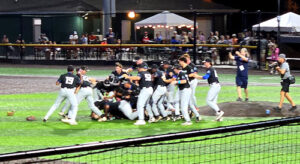 And do the communities supporting the players and the players themselves believe that this league matters? One look at the jubilation exhibited by the Bluefield Ridge Runners after the final out of the Appy League championship game Friday night (see photo) tells you all you need to know. Even if there’s no room for these teams in the affiliated world, the sport needs the Appy League. “It’s a special league. I’m sorry we don’t have it for our young players anymore,” observes Braves manager Brian Snitker, whose first games as a pro were for Kingsport in this league.
Despite what most people assume, playing here is a two-way street. This is the most important lesson. MLB emphasizes the fact that it prioritizes holding these jewel games in places where MLB has rarely or never been played. However, after spending the week going to Appy League games and dining in local eateries, I came to the conclusion that it was more important for baseball fans from across the country to experience life here, than for folks living here to experience Major League Baseball.
They may have accents that sound funny to visitors who’ve previously looked at this as “fly-over country,” but locals who live around here are as genuine and welcoming as you’ll ever encounter – and their sense of community is unmatched. The big win is allowing fans from all over to experience how these folks live, not that MLB brought the sport to them.
It would be great for MLB to continue this trend of bringing jewel games to places that turn fans into better people by virtue of visiting the locale.
Feel free to post your thoughts on the event below, especially if you watched it in person.
I was at the game they prepared for every thing except for the one thing they couldn’t prepare for rain they wouldn’t have ran out of food if they haven’t had a long rain delay I was a part of history I’m proud of that