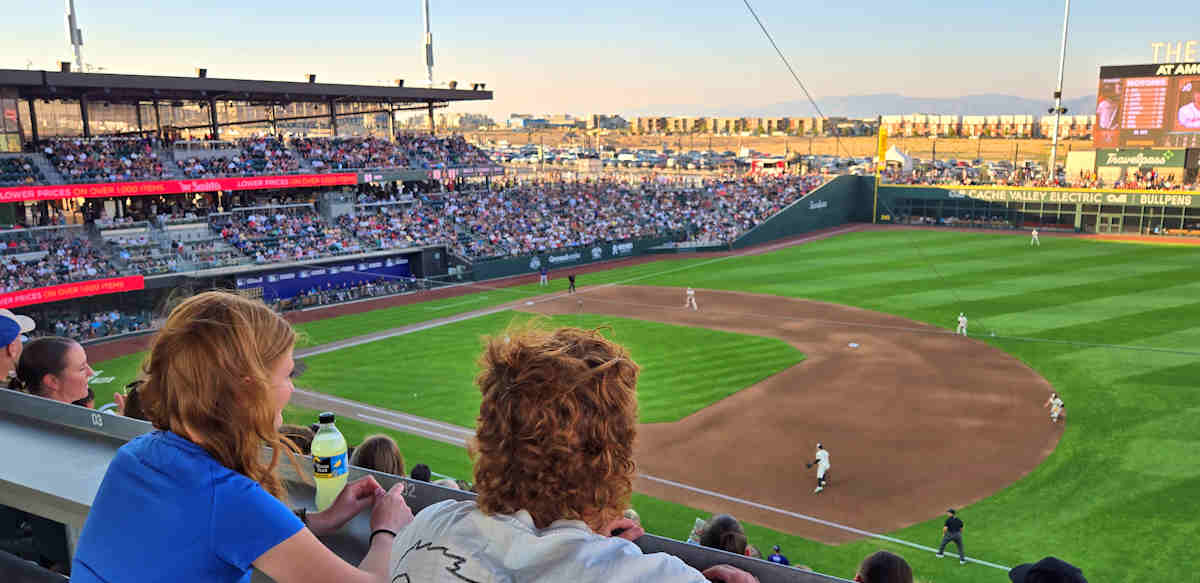
Article and photos by Joe Mock, BaseballParks.com
All rights reserved
South Jordan, Utah There are a lot of lessons to be learned from the Salt Lake Bees’ move to a new stadium:
- Sometimes you have to sell old things to be able to buy new things;
- Thinking ahead is more important than you know;
- You can try your ideas ahead of time, even on a very, very large scale;
- Less is more;
- You eat first with your eyes.
| Ballpark Stats |
 |
| Team: Salt Lake Bees of the Triple-A Pacific Coast League |
| First game: April 8, 2025, a 13-10 win over the Reno Aces |
| Capacity: 8,000, with 6,500 fixed seats |
| Dimensions: LF – 345; CF – 420; RF – 345 |
| Architects: HOK — Devin Norton, Sr Project Designer; Anton Foss, Project Principal; Bill Johnson, Design Principal for Sports; Shannon Bartsch, Director of Sports, Rec & Entertainment |
| Construction: Okland Construction |
| Price: $140 million, paid by Miller Sports + Entertainment |
| Home dugout: 1B side |
| Field points: east |
| Playing surface: natural (Kentucky Bluegrass) |
| Naming rights: America First Credit Union, one of the five largest credit unions in the U.S. based on membership |
| Ticket info: Bees website |
| Betcha didn’t know: After every game, the Megaplex-style reclining seats in the Batters Box section are covered to protect them from the elements. |
So many lessons! All of this and more can be observed by studying The Ballpark at America First Square and its surroundings. But you’ll have to wait until our The Essentials section to learn about eating with your eyes!
Let’s start our tour with a look at history.
Salt Lake City first hosted a Pacific Coast League team in 1915. Since then, they’ve fielded teams in the PCL 65 out of the 101 years. Officially, Utah’s largest city has been in the league 1915 through 1925 (known as the Bees), then 1958 through 1965 (again the Bees), 1970 through 1984 (Bees then Angels then Gulls), then 1994 through the present (Buzz then Stingers then Bees).
Note that the city also had a Pioneer League franchise for 27 seasons, spread out over six decades. The 1987 entry, known as the Trappers, was noteworthy for a lot of reasons. Comedian Bill Murray was a part owner, plus they won a Minor League record 29 straight games … and they did this despite the fact that they didn’t have a Major League parent. Yes, that year they were the only independent team in the Pioneer League.
The 2012 Triple-A roster in Salt Lake featured Mike Trout for 20 games before he was called up to the Majors. All he did was hit .403 with 10 extra-base hits against PCL pitching. Of course, he’s missed the equivalent of three seasons’ worth of games due to injury during his big-league career, but we can’t blame that on Salt Lake City.
There’s a solid reason why a bee has been the team’s symbol for most of its existence, even when it was the Buzz and Stingers. Utah’s official nickname is The Beehive State, which honors the early settlers who had a sense of community and industriousness — like bees. In fact, a beehive is on the state flag and the state seal.
By the way, the now-official term to describe a resident of Utah is “Utahn,” memorialized into state law in 1987. The New York Times hasn’t updated its style book, and still typically uses “Utahan.” But the NYT hasn’t been relevant in a long time.
The current Bees franchise moved from Portland in 1994. Team owner Joe Buzas (I remember at the time that his last name had something to do with the team initially being called the Buzz, which you have to admit is pretty much bee-adjacent) agreed to the move because he was promised a new ballpark in Salt Lake City. That park was called Franklin Quest Field before becoming Franklin Covey Field in 1997, then Spring Mobile Ballpark in 2009, and in 2015 it adopted its current corporate-sponsorship name of Smith’s Ballpark. Smith’s is a grocery chain headquartered in Utah. It is the brand that Kroger operates under in most Rocky Mountain states.
| From Franklin to Smith’s |
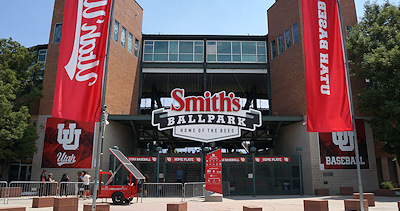 |
| Now that the Utah Utes are moving to a new on-campus park, Smith’s Ballpark has perhaps seen its last baseball. While its name has changed many times, its view of the Wasatch Mountains will never be forgotten. |
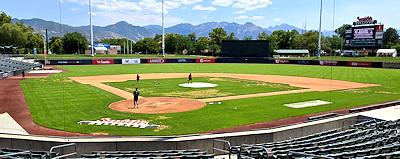 |
Smith’s Ballpark is huge, with a capacity exceeding 14,000. It also has a breathtaking view of the Wasatch Mountains to the west. When I first started attending games here, I was exposed to a phrase I’d never heard before: Alpine Glow (or sometimes spelled “alpenglow”). This refers to the way these peaks look reddish or pinkish at sunset. “Stunning” isn’t sufficient to do this optical effect justice.
Since this ballpark opened, it hosted the University of Utah baseball team in addition to the PCL franchise. Now that the Bees have moved out, the City of Salt Lake wants to re-purpose this site. That means that the 2025 season was the final one for the Utes at Smith’s. That’s OK, because the school is currently constructing a permanent ballpark on-campus where the team’s practice field has been. As the crowds attending Utes games at Smith looked absolutely lost with the facility’s enormous capacity, the new park (being built by Layton Construction, and designed by Populous –interestingly, the primary architect for Smith’s Ballpark) will have only 1,200 permanent seats and a total capacity of about 3,000.
When I visited Utah in July 2025 to check out the Bees’ new park, I visited Smith’s Ballpark one last time. With the college season recently ended, the field looked pristine. Also, because my visit was on the state holiday of Pioneer Day, the ballpark was packed with craft-beer vendors, because the venue was hosting “Pie and Beer Day” (a play on the phrase “Pioneer Day”). A good time was being enjoyed by all.
The Bees played their final game there on September 22, 2024. So let’s examine what was behind the Bees’ desire to move out of Smith’s Ballpark, by all accounts still a perfectly functional facility.
First, you need a little background on The Larry H. Miller Company (LHM). In the 1970s, Mr. Miller and his wife Gail started building an automotive empire. By the time Larry passed away in 2009, that empire consisted of 54 car dealerships, the Utah Jazz NBA franchise, the basketball arena in downtown Salt Lake City and the Bees, which they’d purchased from the estate of Buzas in 2005. Gail Miller, then well into her 60s, and her family decided to sell the Jazz and their arena in 2020 for $1.66 billion (according to Forbes). The following year, they sold their fleet of dealerships, which had grown to 61 retail locations. Asbury Automotive purchased the chain for $3.2 billion.
| ‘Do it at the highest level’ |
 |
| Steve Starks, CEO of Larry H. Miller Company, and Michelle Smith, President of Miller Sports + Entertainment, are standing in the bowling area of their Megaplex entertainment center which is adjacent to the Bees’ ballpark in Downtown Daybreak. |
So this is where the lesson Sometimes you have to sell old things to be able to buy new things comes into play.
“In 2021, we collectively made the decision that the Miller family didn’t want to pack it in,” CEO Steve Starks told us. “The next generation (Larry and Gail’s children) was really passionate and committed to building the next generation of a great business. So we looked at opportunities and decided that we wanted to be in durable industries that provided placemaking that helped people gather, that provided meaningful services.”
Aided by its real-estate platform, LHM elected to invest heavily in healthcare facilities and services for seniors, which is certainly an exploding industry these days. Their skilled-nursing facilities are rated by the Federal Government as having “five stars. We just believe if we’re going to be in business, let’s do it at the highest level.”
That also applies to the master-planned community they purchased in 2021. The previous owner — Värde Partners — is a private-equity firm that was “looking to sell because their fund life was up, so they were looking for an exit,” explained Starks.
So after being flush with cash, LHM was able to make the investments in healthcare and, important to us, real estate.
This is where the lesson Thinking ahead is more important than you know applies, because it relates to the location of The Ballpark at America First Square, and Miller’s long-range planning as it relates to Major League Baseball.
And something called Big League Utah.
The Setting
Even when the Larry H. Miller Company was selling off its basketball and automotive businesses, “we kept the Salt Lake Bees. The Miller family loves baseball. We all love baseball,” said Starks.
He described the Bees’ former home as an “aging downtown ballpark.” Since Salt Lake City owned it, the team didn’t control the facility or the land around it. And because it sat empty when baseball season was over, crime had become a problem, as the neighborhood surrounding Smith’s Ballpark had deteriorated over the three decades since it was built. Plus it was too big for a Triple-A team in the modern age.
So there were plenty of problems that were never going to be addressed if the team stayed put.
By starting over at Downtown Daybreak in a new part of the metro area, “we could create a gameday experience that was activated 365 days a year,” explained Starks. “We have restaurants. We have multifamily (dwellings) where people will live. We have a concert stage. Parking is accessible. There’s a lot here that would be a natural gathering place for people and we could do a better job creating the experience in this environment.
“That’s where we believe the trend is going.”
Michelle Smith is the president of Miller Sports + Entertainment, a division of the company formed in 2024 to operate the Bees, the soccer franchises they own in Salt Lake as well as the chain of “Megaplexes” they are developing — including one that’s adjacent to the main entry of the Bees’ new park. She explained that the executives visited a number of mixed-use developments around the country, including the one that’s considered to be the gold standard: The Battery, adjacent to the Atlanta Braves’ Truist Park.
The 1,300 acres acquired by LHM known as Daybreak is not its own city. It is an unincorporated area within the city of South Jordan, Utah. This is one of the fastest growing cities in America, as it is approaching a population of 100,000, up from about 60,000 in the 2020 census. A stunning 30,000 of the current population is within Daybreak.
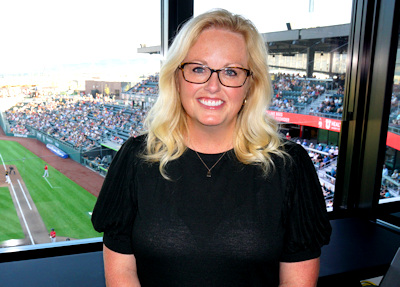 Dawn Ramsey (see photo) has been mayor of South Jordan during the development of Downtown Daybreak and the construction of the ballpark. She was nice enough to sit down with us as we were examining the Bees’ new ballpark. “The vision for Daybreak was bigger — and better — than we had even thought. I’m proud of our partnership with Larry H. Miller, because this is an amazing master-planned community. It’s an economic driver not just for South Jordan, but for the whole region.” In other words, it benefits all Utahns.
Looking back, Ramsey doesn’t think that LHM “envisioned a ballpark here when they bought the land. But it was such an amazing opportunity here that we welcomed the park.”
She’s quick to add that “the ballpark is 100% privately funded. The city doesn’t have a box here. If we wanted one, we’d have to buy it.”
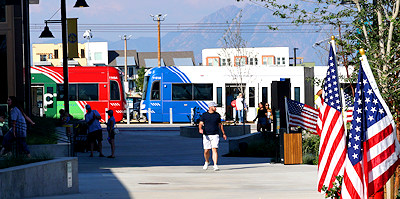
Ramsey added another element of the success of Downtown Daybreak in general and The Ballpark at America First Square in particular is mass transit. Utah’s light-rail commuter trains are called TRAX (photo below), and there were already tracks for this service running by this development. “The problem was that there wasn’t going to be a station here for another ten years. We were successful in getting the State Transportation Commission to re-crunch the number and approve it. This station is making this a destination here.”
 To understand the significance of all of this, you need to look at a map. And once you do, you might be scratching your head, wondering why LHM picked this spot to buy the land. After all, it is in the extreme southwest corner of the Salt Lake metro area. The only thing to the west is undeveloped land and copper mines. Wouldn’t it have made more sense to make the investment of building a new ballpark in the middle of the 1.3 million people in this metro area?
No. And this is the genius of this entire plan. First, it is a brilliant short-term move, because the population of the metro area — which is the 10th fastest growing major market in the U.S. — is exploding in this direction. Hence the meteoric growth of South Jordan since 2020. LHM wants to create communities where the development is done the right way. This is the perfect place to do it, and since they control the “master plan” of Daybreak, they can place the ballpark perfectly in the center of it all.
Already open between the ballpark’s centerfield entry and the TRAX station is the LHM’s Megaplex, with movies, bowling, an arcade and a wonderful restaurant. Smith noted that “I was just with families who had finished a movie. Now they’re going to bowl for an hour, eat some food, then head into the game. That’s how we designed it.”
“That was the master plan,” chuckled Starks.
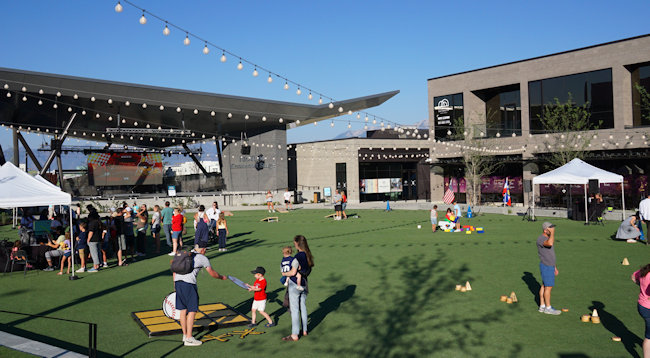
There’s also a beautiful plaza just outside the Megaplex where concerts can be held (see photo at the top of this section) — and where an ice rink can be constructed in the winter. Beyond that are more restaurants and stores, all within steps of the South Jordan Downtown Station on the red line of TRAX.
Beyond the ballpark’s right field, an apartment building is under construction. Soon a hotel will be built down the third-base line, unfortunately displacing an adorable — and popular — miniature golf course within the park’s perimeter. No doubt, the Bees will find another spot for it.
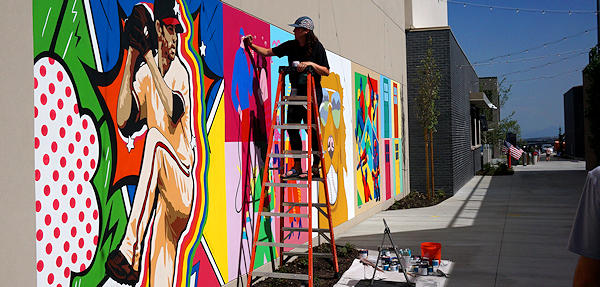
One area you don’t want to miss in walking around the exterior of the park is an extended mural, along a corridor between the Megaplex building and the ballpark’s bullpens. There is a lot of art in and around the park, and that’s very nice.
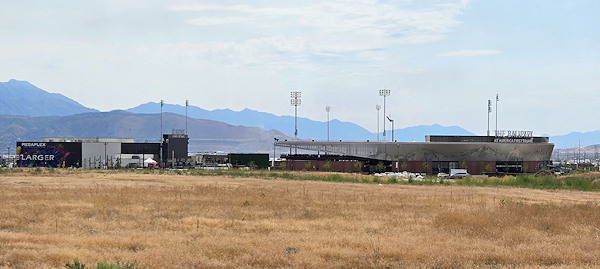
Beyond centerfield is wide open spaces, where lots more development is planned (see above). And all of this is just off the major freeway (Mountain View Corridor) servicing this western and southwestern end of the metro area. And the space immediately adjacent to the ballpark even has a corporate sponsorship name: America First Square. America First is one of the biggest credit unions in the country. Their name is not only on this square, but also the new ballpark and the MLS/NWSL soccer stadium.
And you can’t discuss the setting of a ballpark in Utah without addressing the view you get to enjoy from the seating bowl (below). Just like at Smith’s Ballpark, the view of the Wasatch Mountains is indescribably spectacular. The ballpark’s footprint points east to maximize the view.
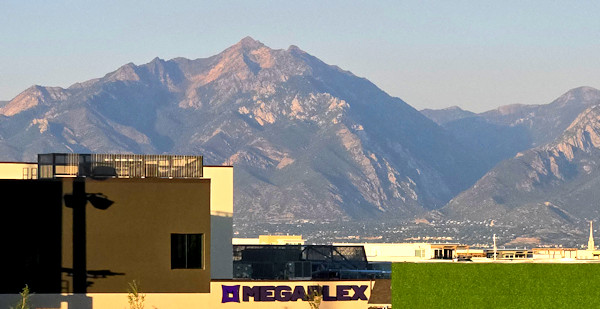
Benjamin Hill has been to every Minor League park as part of his Baseball Traveler series. He told me that the Bees’ new park “reminded me of Las Vegas Ballpark, in that it’s a luxurious (by Minor League Baseball standards) facility located in a planned community outside of the city proper. While I personally prefer a downtown location, it was gratifying to see that the mountain views remain unparalleled. Locals might be used to such a backdrop, but for out of towners it’s a real treat.”
And that’s an understatement!
So moving the Bees to Downtown Daybreak is a great idea for the present and for the coming years. The prognosis for all of this is quite rosy indeed. “We collectively said with our future in sports, it wasn’t going to be just by owning the team,” Starks divulged. “It was going to be owning the team and then creating an experience all around it. And we believe in live sports. We believe in gathering.”
But it’s the long-range element — the Thinking ahead part — of this location that is positively genius.
If you follow the business of sports, you no doubt are aware that Major League Baseball is getting itchy to expand. The last expansion — creating 30 franchises — occurred in 1998. In the meantime, the NFL has ballooned to 32 teams, so baseball needs to catch up (yes, I’m saying that sarcastically). Most observers feel that MLB’s owners — who will split the billions of dollars in expansion fees — want to add two more teams in the coming five or six years. Larry H. Miller isn’t just eager for Salt Lake City to be selected as one of the lucky markets, they are fully ready for it. In my opinion, more ready than the other contenders in Orlando, Nashville, Charlotte, Portland, Austin or wherever else.
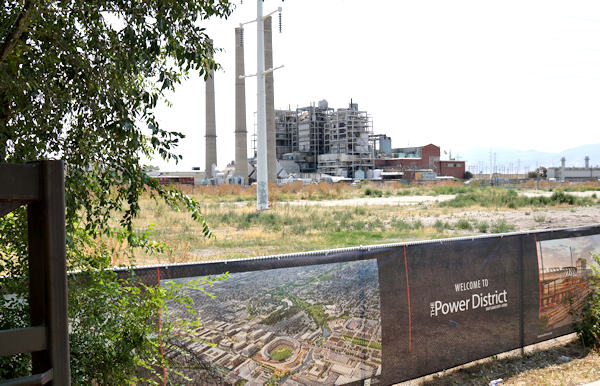
LHM formed an entity called Big League Utah. It has paid for all of the planning for a potential expansion team — including the location for a stadium directly between Salt Lake’s airport and downtown. A horribly neglected area called the Power District (photo above) would be rehabilitated with a mixed-use development, including a Major League stadium on the banks of the Jordan River. They even hired big-time architects Populous to do the site plan and create renderings of the proposed ballpark. State funding to help with the construction has already been obtained if and when MLB gives this a green light.
Another advantage that Salt Lake has over other suitors for an expansion team is that the financial backing all comes from a single source: Larry H. Miller. The other cities have consortiums of celebrities and business tycoons pooling their money, which isn’t as solid of an arrangement as a single entity like LHM, that’s ready to pay the expansion fee, build a stadium and cover a big-league payroll.
If the Bees were still at Smith’s Ballpark near downtown Salt Lake, it would never work having the team be so close to its big-league parent (Nashville: this is where you have a problem). The location of The Ballpark at America First Square “is attractive because it creates enough separation with Salt Lake that in the future, if we’re fortunate enough to have a Major League Baseball expansion franchise, that we could have both of them coexist,” said Starks. “It would be really hard to do that if they were three miles apart.”
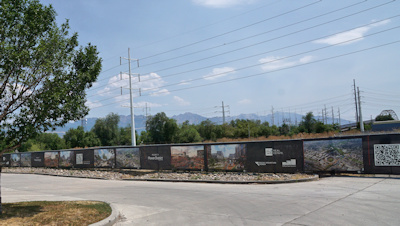 I visited the Power District while in the area. With no traffic at all, it takes about half an hour to drive there from Downtown Daybreak. This is far enough apart for two teams to co-exist, especially when they both have the same owner. Said Starks, the park in South Jordan “wouldn’t cannibalize what would be a future MLB ballpark or vice versa.” There are lots of examples of this working well: Sugar Land and Houston; Frisco and Arlington; St. Paul and Minneapolis; San Jose and San Francisco; Tacoma and Seattle; Worcester and Boston. It would work in Utah.
This is definitely thinking ahead. Like 5-D chess thinking ahead. Plus if LHM intends to create a neighborhood with apartments, condos, stores, hotels and restaurants surrounding the expansion team’s stadium in the Power District, they’ve established the perfect laboratory for all of those elements — including a first-class baseball stadium — in Downtown Daybreak.
This is where the You can try your ideas ahead of time, even on a very, very large scale lesson fully blossoms. And, as I say, it’s genius.
Smith says she isn’t concerned that moving so far from the Bees’ former home is putting them is a spot bereft of fans. “We realized coming out here that we were entering an opportunity to create new fans in addition to the ones that we already had.” Added Starks, “Our thesis was that we would import a lot of fans from Salt Lake via Trax because there’s public transit. And then we create a whole bunch of new fans — and we’re seeing that.”
We’ll talk more about the financials at the new park in a moment, but for now, suffice it to say that LHM is happy with the attendance at the new — significantly smaller — park. And Starks is philosophical about it all: “If Major League Baseball never comes, what we have here we think is the nicest ballpark experience in all of baseball.”
Mayor Ramsey agrees. “I have yet to meet anyone who has attended a game here who didn’t love it.
“This is special, and we know it.”
The Exterior
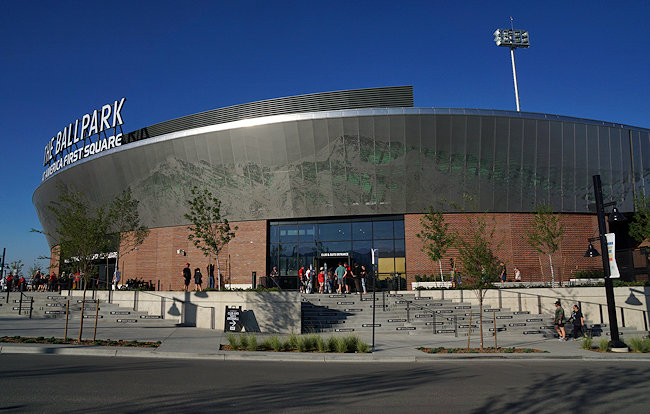
The Ballpark at America First Square is simply beautiful, inside and out. Before we venture inside, though, let’s talk about what inspired this gorgeous exterior.
Please understand that in no way am I implying that the design of the Bees’ park is a rip-off of Las Vegas Ballpark, home of the PCL Aviators. It isn’t. But the similarities between the situation in Vegas and Salt Lake are numerous, and not a coincidence.
In vast, undeveloped wasteland west of Las Vegas, the reclusive Howard Hughes acquired about 25,000 acres of land in 1952. The purchase price was approximately $3 an acre. Today that land is controlled by the Howard Hughes Corporation (HHC). That’s where they developed the master-planned community of Summerlin. At its heart is the Red Rock Casino Resort, upscale shopping centers and restaurants, the NHL Golden Knights practice facility and, oh yeah, Las Vegas Ballpark, a Triple-A stadium purported to be the most expensive Minor League stadium ever built. Interestingly, HHC spent about 1,666 times as much building that stadium as the corporation’s namesake spent buying the surrounding 25,000 acres.
In Utah, the Larry H. Miller Company purchased vast acreage that was once owned by a mining company in the southwest corner of the Salt Lake valley. Billions of dollars of development is happening there, and at its heart is a Triple-A ballpark that cost about as much to build as Las Vegas Ballpark. Parenthetically, this new park may very well have taken over the distinction of “best minor league park” from Vegas.
And the same design team at HOK, the international architecture and urban planning firm, designed Las Vegas Ballpark and The Ballpark at America First Square. And this wasn’t a coincidence. LHM liked what it saw on visits to Summerlin.
It’s unmistakable that there are design similarities between the two parks, especially when you look at the exteriors. Surrounding the upper portions around the infield in Summerlin are panels of sheet metal, giving the park its distinctive, modern look. These panels, known as Angel Hair Stainless Steel, are fabricated by a Kansas City company called Zahner.
But like many aspects of the Bees’ new park, the aesthetics in South Jordan are simply better. One example is the designs that were laser-etched into the sheet-metal panels which are in the same general spot as in Vegas. In a stroke of genius, the patterns of holes in the panels (up to 400 of them in each panel) duplicate the mountain range that you see from the seating bowl inside the park. And at night, there is wave after wave of colors illuminating those patterns. This is one of the most beautiful and unique design features I’ve ever seen in a ballpark’s exterior.
We’ll dive into more detail on the aesthetics inside the ballpark in the next section, but the exterior took a basic concept from Vegas and significantly improved it.
But you can’t look at the Bees’ exterior in a vacuum. You have to take into account the Downtown Daybreak buildings that surround it — and in the case of the hotel, will be integrated into it.
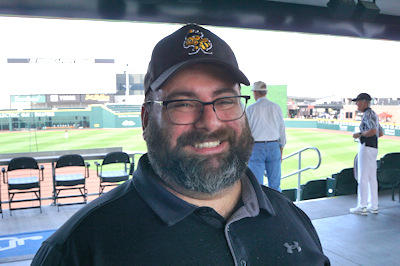 And it’s that aspect that differentiates the two stadiums. “The main component I would say that’s different is the community aspect of this,” said HOK’s Devin Norton (see photo), Senior Project Designer for both parks. “Here it is part of a bigger development with the Megaplex, the residential, the future hotel, the Trax line. It’s well thought out in that regard of creating a district. From the very beginning, there was a vision of what they wanted to do here.” He added that there was more desire for the ballpark to be “utilized as a community asset” in South Jordan than Summerlin. “So there was definitely a bigger vision.”
If you take a stroll around the exterior of the Bees’ park, you get a real sense of that vision.
Since the development thus far has been on the outfield side of the ballpark, the entryway behind home plate isn’t utilized as heavily as the one in centerfield. But it’s beautiful, and it’s done in a way that’s similar to Vegas, but more aesthetically pleasing.
If you make your way around the exterior going clockwise, you’ll see that the perimeter separating the outside world and the ballpark’s third-base line is simple chain-link fencing. But this will one day be a hotel, so there was no need for a fancy wall here.
Beyond left field, you start to understand the difference in elevation from outfield to behind home plate, a difference that necessitated stairs on the main concourse in center field. There is a very pretty walkway toward the main center-field entry where you can look through the fencing to the bullpens, and beyond that to the playing field. It was a smart move to leave this open to entice patrons of the Megaplex to peer into the ballpark and want to attend a game. This walkway includes the murals discussed in the previous section.
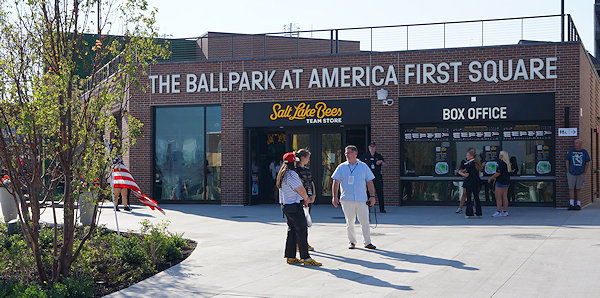
The exterior beyond center field is really where the action is. By design, this is where you enter the Megaplex and where you enter the ballpark. It’s here where the ticket windows are (see above), as well as the merchandise store. More on that in The Essential section.
The entryway itself is quite inviting (below). When you enter, you’ll almost at field level, and can make a quick left to get to the right-field berm. Or you can go to the right to take the steps or an elevator up to the main concourse.
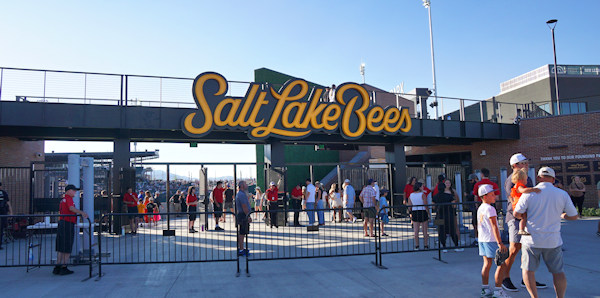
As you continue around the park’s perimeter, construction on apartments and a parking garage force you to walk down on the street, but as you emerge on Ballpark Drive and walk up the hill, the gorgeous masonry work is obvious. Note also the gleaming stainless-steel panels on the park’s upper exterior.
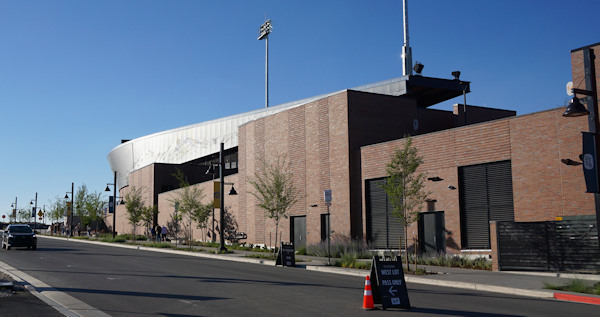
While the exterior of the park is a work in progress due to the construction, you can see the “master-planned” aspects of everything. It is indeed stunning.
So while there is a lot to the exterior — now and in the future — when we venture inside, you’ll start to understand the less is more lesson … so keep reading!