Joe Mock
Special to USA TODAY
Even devoted baseball fans are likely unaware of a development that significantly impacts the sport: a single entity now owns a sizable percentage of all affiliated Minor League franchises.
That entity is Diamond Baseball Holdings (DBH), backed by the capital from private-equity giant Silver Lake, which manages over $100 billion in investments.
Starting in 2021, DBH began acquiring Minor League teams. Since then, they’ve gobbled up approximately eight a year, and now own 48 franchises affiliated with Major League teams and one in the unaffiliated MLB Draft League. Considering there are 120 teams in the affiliated Minors, that means DBH now owns 40%.
How did this happen? Why did Major League Baseball, which now oversees the governance of the Minors, allow this? Isn’t it bad for baseball for so many teams to be owned by a single entity? Let’s answer those questions by taking a look at the rise of DBH and its impact on the sport.
48 in 48
Long before DBH was formed, Peter Freund was bitten by the baseball bug. A small investment in the Charleston (SC) RiverDogs led to becoming sole owner of the Wilmington Sharks in the summer collegiate Coastal Plain League in 2013. “We had a staff of three at the time. I was literally opening boxes and stacking hats,” he recalls.
A year later, he put a group together to acquire the Williamsport Crosscutters of the New York-Penn League. Next came two Triple-A teams, as the Memphis Redbirds and the Scranton/Wilkes-Barre RailRiders were added to Freund’s portfolio.
Since he served on the executive committees of the NY-Penn League and the Pacific Coast League, he was asked by MLB to act as a consultant as the notion of the Majors taking over the Minors was being considered. About this same time, Pat Battle knocked on the door of MLB with ideas about consolidating merchandising and licensing across the Minors, as he’d done successfully on the collegiate level.
Execs at MLB headquarters suggested that Battle contact Freund. “Pat called me during COVID out of the blue,” explains Freund. “And this whole idea was born, and that became DBH.”
The prevailing wisdom was that owning a team in the Minors was anything but a money-making proposition. “We felt that it was an opportunity, and, yes, it is a good investment.” Their original goal was to acquire ten teams in the Minors to see if their concept would work. “We felt like we could operate them better just based on our scale, our resources, our technology and our shared best practices,” says Freund.
It was consequential that MLB was rolling out an updated Professional Development License that governs facilities in the Minors. “We were just in the right place at the right time, given the fact that there was significant investment that had to be made into these ballparks. We had the resources to do it.”
That didn’t mean that the acquisition process was effortless. “It was never easy. We did 48 transactions in 48 months. I’ve got a lot of gray hair from it,” Freund admits.
Enter private equity
It takes a lot of money to buy so many franchises. That’s where Silver Lake, the nation’s 12th largest private equity firm, comes in.
After requiring Battle and Freund to establish a back office with human resources and IT capabilities, “Silver Lake stepped up and said ‘we’ll buy it and put it in one of our funds.’ I think they’re very happy they did it,” explains Freund. ”We have a wonderful partner in Silver Lake. They’ve enabled us to grow and invest.”
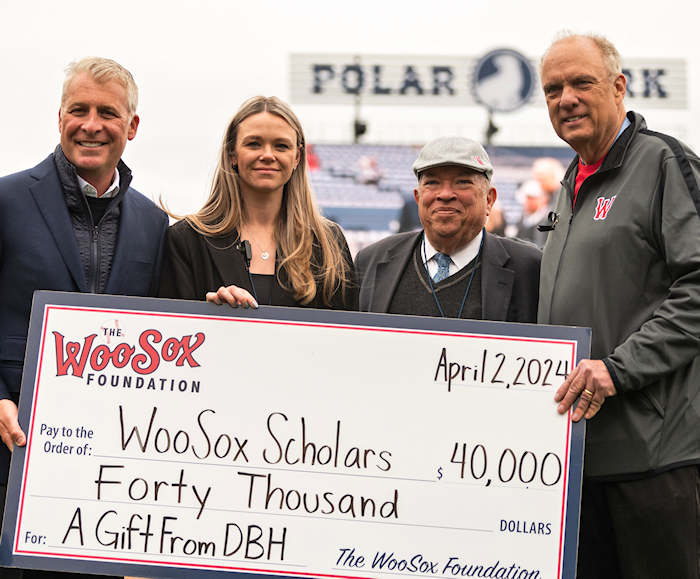
He points out that the investments haven’t all been for player facilities and fan amenities. DBH has supported the markets in which their teams operate, with community funds and scholarships. “We are doing so many wonderful things that, honestly, if we weren’t scaled to the point that we are and we didn’t have the backing of Silver Lake, we probably couldn’t do everything that we’re doing.” A great example is shown below, where DBH CEO Peter Freund, Worcester Red Sox GM Brooke Cooper and club president Dr. Charles Steinberg present a check for scholarships to Worcester Mayor Joseph Petty. (Photo credit: ASHLEY GREEN/WOOSOX)
It’s tempting to think that with MLB taking over the governance of the Minors in 2021, they’d be in favor of a single owner for all 120 franchises. “To be clear, I don’t think a single-ownership model is beneficial for Major League Baseball,” Casey Brett, MLB’s Senior VP of Business Development, explains to USA TODAY Sports. “There’s no one-size-fits-all approach that’s going to be the best thing for the Minor League system in the future.”
He adds that whether an ownership group owns five, ten or fifty clubs, “it does not matter to us as long as people are really making those investments and the communities are strong and the fan experience continues to be what it is. What we want is just healthy baseball, healthy communities, healthy players and a great player development system. DBH has been a great contributor. This has been a really sound situation for Minor League Baseball, and we’d like to see it continue.”
Adds Freund, “The momentum of us buying clubs went from skepticism to positivity. And it was owners telling other owners that, yes, the experience of us buying their club was great.”
“I have nothing but great things to say about Pat and Peter,” says Jay Miller, who returned as president of the Wichita Wind Surge after Diamond Baseball Holdings acquired the team following the 2022 season and retired in late 2024 after 42 years in professional baseball. “Those guys are doing it right and they respect Minor League Baseball. If they tell you they’re going to do something, trust me, they’re going to do it.”
And in the franchise’s first year under DBH with Miller on the ground, the Wind Surge had the largest year-over-year increase in attendance in the Minors, going from 220,528 in 2022 to 322,637 the following season, a 46% jump.
Spotting talent
John Cook, the general manager of the Birmingham Barons (Regions Field is shown in the photo below), recalls the day in 2023 when DBH completed the transaction to acquire the Double-A club. “They gave us a really good transition. Everything they said on that day transpired. They kept the staff intact, so it was full speed ahead. They told us we’d been added to their portfolio because they believe in Birmingham.”
 He notes that “probably the best part is there’s so many resources available to us. I’ve got 48 other teams that I can lean on and I can reach out to, and who would help me at the drop of a hat. (DBH) lets us run our program and provide the insights and the guidance that we need.”
In addition to the additional resources DBH brings to the table, their executives have a keen eye for talent. One example is Cook, whom DBH promoted to general manager in 2025. Following the end of his first season in the role, he was presented him with the Sam Bernabe Leadership Award, which is nominated by the leader’s colleagues and employees.
The recently retired Bernabe worked for over 40 years for the Iowa Cubs, now owned by DBH. “I was honored by that award, because Sam Bernabe is a friend,” says Cook.
Another way in which talent is recognized by DBH is obvious when you look at the roster of managers at DBH headquarters and at the GM positions across their teams. In an industry that only a few years ago had practically no women, it’s stunning to look at DBH’s org chart now.
One of the rising stars in the sport is Brooke Cooper, the GM of the Worcester Red Sox, more commonly called the WooSox. She began her career as an intern in the merchandise store at McCoy Stadium, when the franchise was still in Pawtucket. A group led by Larry Lucchino, one of the most accomplished execs in the sport’s history, had just acquired the team. It moved into brand-new Polar Park in Worcester in 2021.
DBH bought the team in 2023. “I really appreciate that (DBH) embraced and honored Larry’s vision for both Polar Park and Triple-A baseball in Worcester,” says Cooper. “They have really helped propel us forward into this next chapter for the franchise.”
She notes that there is a “sense of pride” in the Minors about being able to do more with less, but that’s not what DBH required of them. “They were trying to build and learn so that they could provide the resources to help us do more with more.
“When building Polar Park, we promised that it would look and smell and taste and feel like Worcester. With DBH’s support, we’ve been able to keep that promise.”
Cooper doesn’t view her gender as being an outlier in the industry. “From my very first conversation with Pat Battle and Peter Freund, it was clear that they were committed to having the best people at DBH and empowering them to lead our clubs. A result of that has been that you see women across the portfolio receiving the recognition and opportunities they deserve.”
Cooper’s accomplishments caught the attention of the Today Show, which profiled her in a segment in August 2026.
Freund explains that there was no “quota system” involved to hire women. “We just have the best possible people in every one of our positions, whether they are male or female. Take Brooke Cooper. She is the most inspiring leader. If I could have 48 Brooke Coopers, I would, and it has nothing to do with her being male or female.”
Like a startup
 In quick succession two years ago, DBH bought three franchises in the California League. By owning all three, they were able to transfer a franchise to a new ballpark in Ontario, even though it was only 24 miles from its team in San Bernardino and seven miles from its team in Rancho Cucamonga. Had there been three different owners, such a move would’ve created territorial conflicts galore, and the spectacularly successful Ontario Tower Buzzers might not have happened. The team’s home, ONT Field (shown in the photo), won our Ballpark of the Year for 2026.
This year, the pace of DBH’s acquisitions has slowed. In fact, MLB has a rule that no single entity can own more than 50 affiliated Minor League franchises, and MLB has not shown a willingness to raise that limit.
This is perfectly acceptable to Freund, who views DBH as being in more of a maintenance mode now, investing in the ballparks and the fan experiences at the clubs it already owns.
“I look at it like this. We are taking a 100-year-old business and treating it like a modern startup,” he observes. “I think we’ve elevated the experience for the fans, and we’ve also really elevated it for the players and the Major League player-development folks. We listen, and we’re quick to act. I’m really, really proud of that.”
Adds Cooper, “I feel really fortunate to get to be part of this time in history for Minor League Baseball. DBH is investing in our industry in a way that is completely unprecedented.”
This article appeared in USA TODAY Sports Weekly. It is used here by permission.