Back to page 1
The Design
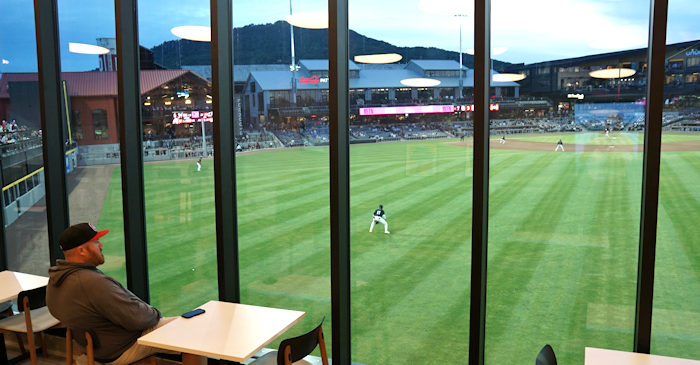
You might think that giving an architect a perfectly level, open field on which to design a new park would be preferable to having to work around existing obstacles like buildings — especially ones that are a hundred years old. You’d be wrong.
“That’s what makes it unique,” said Sabatini. “The challenges of these kinds of things create opportunities. What I love about baseball is being able to create a unique home-field advantage or unique situation that can never really be duplicated.
“You get an opportunity to say ‘How can we make this unique using the buildings that were there and create a new feeling (and) new experiences that no one’s ever had?'”
Three of the old foundry buildings form the basis of experiences that are brand new. And having to work around the old buildings dictated that the new construction be done in quite novel ways as well.
Once the decision was made to place the ballpark on the northern side of the site instead the south, things started to fall into place. This allowed these three buildings to be integrated into the park: The Shed (the 570-foot-long building, most of which is along the VIP parking lot), The Pattern Shop and The Power House.
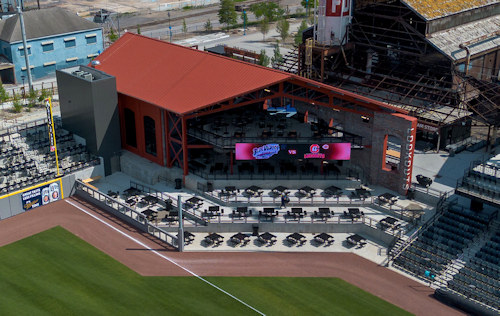 Let’s start with the smallest of these three, because it acts as the heart of the whole layout — just as it was the heart of the industrial activity that ended over two decades ago. That’s The Power House (that carries a corporate-sponsorship name of EPB Power House), which is the oldest structure on the site, dating back to 1882.
This was where power was generated to run the industrial machinery. The ballfield is situated so this structure is near the right-field foul pole. The 6,200-square-foot building exists on two levels, with air-conditioned spaces around bars and restrooms farther from the playing field. and open group spaces out in the open nearer the field. Visibility of the game was maximized by literally chopping off the corner of the building closest to right field. Brilliant.
Between The Power House and the playing field are terraces with ticketed picnic tables.
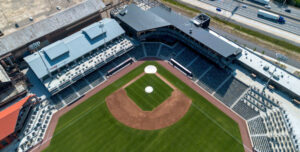
If you look at the upper right-hand corner of the drone shot, you’ll see the northern end of the massive Shed building. While the vast majority of the structure isn’t integrated into the ballpark (it will be used in future development), part is. That’s where you’ll find the team store. As if chopping off the corner of The Power House building wasn’t clever enough, the team store beats any other example of ballpark ingenuity I’ve ever seen.
This store is on the ground floor of The Shed right across the concourse from The Powerhouse. What makes you stop in your tracks is how the store was constructed there — or wasn’t constructed there. To avoid having to bring the entirety of The Shed up to code (which will basically serve as a shell for other commercial endeavors down the road), the space that is now the store arrived in four pre-built modules that were slid — or more accurately, shoved — into place. “This sounds really easy, but it was actually incredibly difficult,” noted Dryden Razook, principal at S9 Architecture.
Only these modules had to meet building code. After they were in place, interior walls were opened between the modules. Most shoppers never realize they are browsing through t-shirts and caps within something akin to pre-built storage containers.
For good measure, a large water tower with the letters FD (for Foundries District) painted on its sides remains above the store modules. It really provides an authentic look.
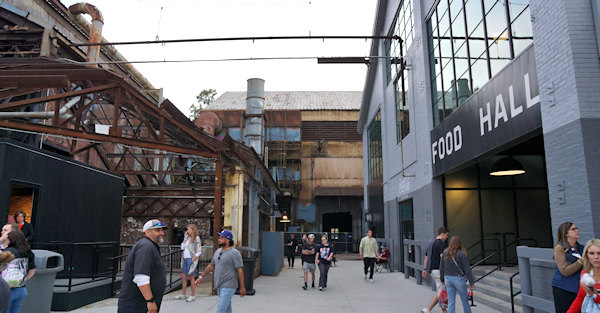
Freier feels that it makes sense that the main entrance for the park is right at this spot — where you have The Powerhouse on one side of you, The Shed with its retrofitted store and water tower on the other. Ahead of you is the first-base concourse, and to your right is the walkway around the outfield. It truly provides the fan with an overwhelming sense of Old Meets New.
The next historic structure is immense, although you don’t spot it all at once. That’s The Pattern Shop, so-called because this is where patterns for fixtures like fire hydrants were cast for well over half a century. On its concourse level is now a large food court (more on that in The Essentials below) as well as the team’s very nice offices.
It’s what is on the upper level of The Coca-Cola Pattern Shop that is stunning. It offers 17,000 square feet of air-conditioned space with (and this is mind-boggling) no columns or support beams of any kind. Just a wide-open expanse of space. This is possible because of the steel-truss roof that needs no support other than from its perimeter. Sabatini notes that it is the largest lounge space in any ballpark on which he’s worked — and that’s a lot of parks.
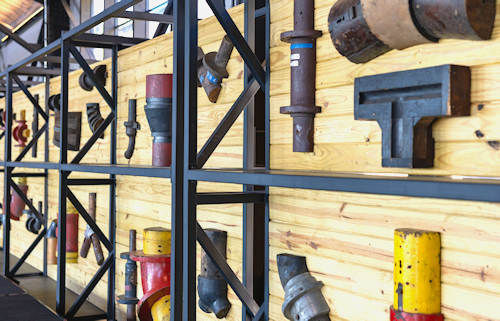 In fact, the space is so large that Freier created (“I had a crazy idea”) a system of movable walls with leftover “patterns” of the plumbing fixtures molded into them (see photo). “We wanted the flexibility (of dividing up the space), but the way those things turned into reality, it feels like artwork. I mean, people are up there taking pictures in front of our movable walls.” I suggested he start a new company creating these mesmerizing, flexible walls with wheels, and selling them, because I’ve never seen anything like them. Truly, the way the fixtures are embedded in these “walls” makes them works of art — and history.
The original thinking was that tiers of seats would be attached to the field-side of the Pattern Shop’s upper level so it could operate like the fancy lounges at modern-day stadiums. That would’ve worked if the building could have been moved closer to the first-base line — but that, of course, was impossible. Laying out the field closer wouldn’t have worked either, because of The Power House. So the team came up with an idea: create a huge outdoor patio between the structure and the field, creating another immense group space (below). The tiered seats were then placed on the field side of this patio, overhanging the field boxes below.
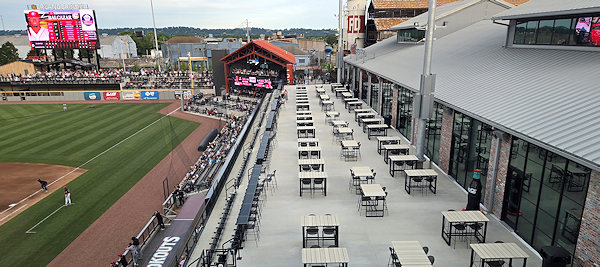
The deck serves an additional purpose, one that makes perfect sense. This provides a roof over the first-base concourse.
As you head toward home plate on this concourse, you come to a fairly narrow gap between buildings. This forms the path, by the way, from the VIP Parking Lot to the main concourse of the ballpark. On one side of this narrow corridor is The Pattern Shop building and on the other starts all of the new construction. While the construction types don’t match, the appearance of the new buildings is beautifully compatible with the old.
This building is the largest of the new structures, as it wraps around home plate and runs well beyond third base. Underneath all of this are the team spaces like clubhouses and batting tunnels. There are actually two levels above the concourse, mostly to hold the Unum luxury suites. On the very top level behind home plate are the broadcast booths and pressbox, as well the immense production space that teams need to operate cameras, video boards, social media, etc. It is all wonderfully modern and spacious. In other words, Freier didn’t try to economize by making this area small. Directly underneath these production spaces (which is still one level up from the concourse) is a club area for suite-holders.
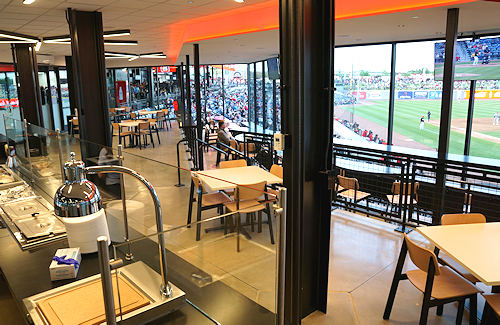 On the outfield end of the two upper levels are more group spaces. These are the HHM Party Decks, with the lower level accommodating groups up to 125 and the upper 90 — although one large group can book both levels together.
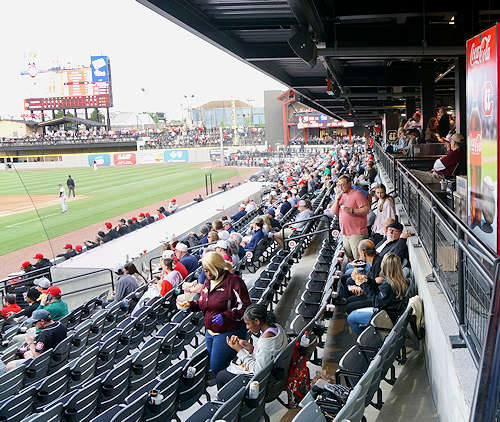
Directly behind home plate at the back of the seating bowl is a multi-level glass-enclosed lounge called The FirstBank Club (see photo), reminiscent of the lounges in this same spot in Charlotte and Richmond. Fans with seats right behind the backstop — called the Home Plate Club — can access this upscale space.
Along the third-base concourse are, of course, concessions and restrooms. In the left-field corner of the main seating bowl are the Eldridge Field Boxes and Half Rounds. These sections are angled back toward the infield. A nice touch.
The Kids Zone with inflatables is in the corner of the park’s perimeter, behind the left-field foul pole.
The Little Debbie Berm in left field is huge. It also provides a spectacular view of Lookout Mountain beyond the roofline of the ballpark.
 In dead center field is more new construction. There is a two-level lounge called the Kubota of Chattanooga Club. The first floor (shown at the top of this page) is enclosed, and can accommodate up to 175 fans, and the open-air rooftop can handle 125. The view from the upper level is spectacular.
There is a fascinating variety of new construction in right field. Between the Kubota Club and The EPB Power House are seating sections just above the outfield wall and, closer to the foul pole, a really cool section of ticketed chairs and countertops called the Right Field Porch.
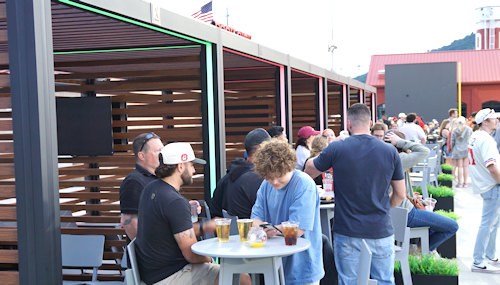
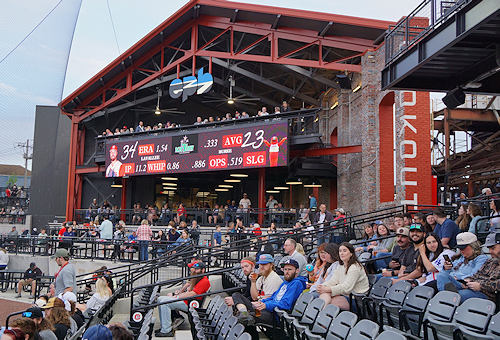
Behind these sections along the concourse are the Hunter Oil Cabanas (photo), that groups of 10 can book. The view of the field from these is wonderful. Behind the cabanas is the Rock City Bar. On top of its roof is the iconic SEE ROCK CITY that used to be painted on countless barns in the South to attract tourists to visit the Rock City attraction on top of Lookout Mountain. This is a really cute local touch with regional appeal.
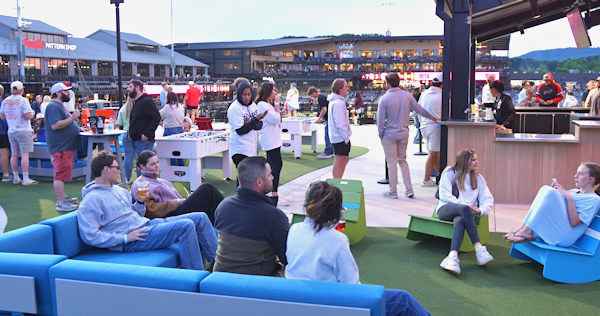
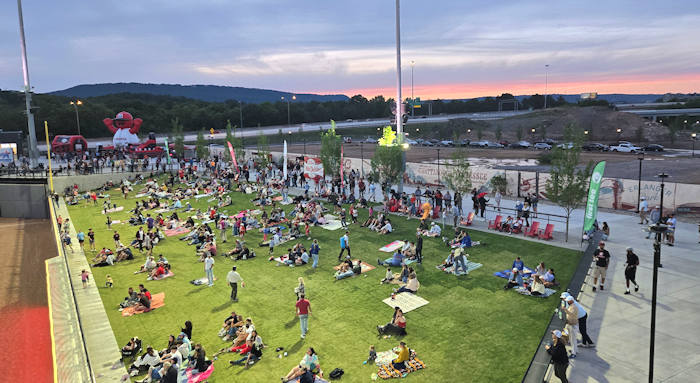
Along the edge of this bar is a “social” area with lawn furniture and outdoor games (below), very reminiscent of the extremely popular Band Box bar and lounging area in the right-field corner of Nashville’s First Horizon Park.
Those who make the trek all the way around the 360-degree concourse at Erlanger Park are bound to be impressed with all of the thoughtful features and awe-inspiring views. But what is it like to attend a Lookouts game in their new digs? Read on to find out!
The Essentials
“Affordability” is a buzzword you hear mentioned constantly on the news. The word is typically used to express dissatisfaction with the high cost of living. But at Erlanger Park, the word means the opposite. It really is affordable to attend a Lookouts game!
 Let’s dig into it. At both the 1,300-space lot near the main entrance and the 800-space lot beyond center field, parking costs $8. I asked Freier if there was a higher price on the weekends. “We do not, no.” Aren’t you missing opportunities to generate additional revenue? “Exactly.”
This philosophy permeates the entire Lookouts operation. I mean, you can buy a “concourse pass” (that is, a general admission ticket) for just $9, which is the base price of $7 plus a $2 fee. At Wilson’s new ballpark, the cheapest ticket is $18.
In Erlanger Park’s Right Field Porch with chairs and countertops, and the Bullpen Terrace next to it, tickets are only $14 (all prices I’m listing include the fees when you’re buying online. Add $1 if you are buying on the day of the game except the concourse pass. It’s still $9!). If you book a cabana, it costs $199 for ten of you. Again, the $19.90 per person is very reasonable.
Over in the left-field corner, the Field Boxes (the rows nearest the field) are $18.50, and the rows behind them are $16.
In the infield, the Homeplate Club seats (that give you access to The FirstBank Club) are sold out as season tickets. Radiating out from the backstop, the price of the seat depends on how close to the field it is. Behind the dugout, the rows closest to the action are $22.50, the middle rows are $20.50 and the last rows $18.50. Beyond the dugouts, the prices for similar rows are $20.00, $18.50 and $16.00. Interestingly, all of the seats in Section 101 down the first base line are $16. That’s a good buy.
As far as groups go, for the Coca-Cola Pattern Shop, groups of at least 50 are charged $34 per fan. This includes a buffet and access to the outdoor patio and seats. The HHM Party Decks cost $43 per person with a buffet. The Kubota of Chattanooga Club costs $49 per group member in the lower-level air-conditioned lounge, and $45 on the rooftop. Here the buffet is more upscale. The EPB Power House (which is where I’d love to watch a game) costs $32 per fan, and includes a buffet.
Note that two of the 16 luxury suites are held back for nightly rentals (versus being sold for an entire season).
Erlanger Park has a strong assortment of group spaces, and the prices are less than I’d expect.
Freier believes strongly in fan satisfaction. That seems easy to say, and you may think every ballpark operator espouses this, but the Lookouts take two approaches that build long-term fan commitment rather than short-term revenue maximization. One is charging less than the market will bear — on parking, seats, merchandise, concessions, etc. Included in this is the fact that ticket prices are the same during the week as on the weekend (something a lot of teams don’t do). The other is in refusing to stuff the ballpark full to overflowing. On Opening Night, for instance, the team cut off tickets sales way before a true capacity was reached. “We probably could have sold over 10,000 tickets, but we didn’t want to … We want people to have an enjoyable experience, and that worked well,” Freier explained.
And they’ll keep coming back. And tell their neighbors, And bring their church group. You see how that works.
Now about the food and beverage. Just like in Wilson, the team operates the concessions, not an outside firm.
The concession stands along the third-base concourse are where you’ll find the ballpark staples: hot dogs (only $4!), chili-cheese dogs ($5), cheeseburger ($7), chicken tenders and fries ($10) and the best slice of pizza I’ve ever eaten at a sports facility ($4.50). Pig Iron BBQ is also on the third-base side. They feature a brisket sandwich ($11) and BBQ nachos ($11). 16-ounce craft beer is $9.
Local firm Clumpies Ice Cream Company serves real ice cream in a cone or cup for $5.
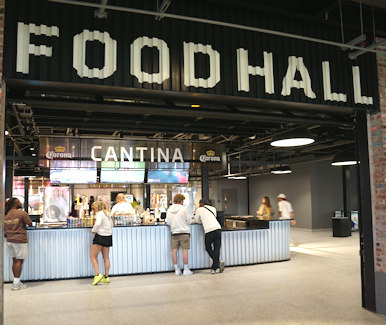  |
On the first-base side on the bottom level of The Shed is a food court. Freier explained that this is the Lookouts’ take on having food trucks that can be rotated … but without the trucks. “If sales at one aren’t the best, we can easily move a different kind of food into that space.”
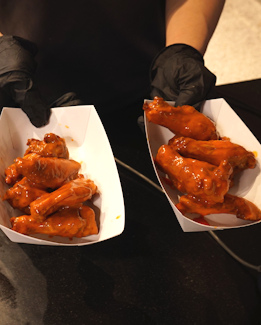
 Here you’ll find tacos ($4 with your choice of four meats), po’ boys ($10) and my favorite, chicken wings ($12 for five wing pieces — the two most-popular flavors are buffalo and parmesan garlic, by the way). And there’s a gelato stand with eight flavors for $6 per cup.
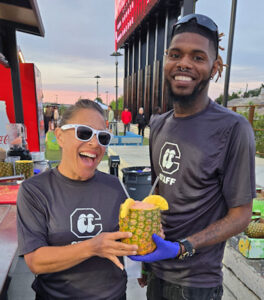
While there are a number of free-standing stands around the concourse, one that was particularly busy is in right field. Pineapple Looie’s makes delicious drinks in real pineapples ($17 if the drink includes alcohol, $12 if it doesn’t). Don’t wait, though! Some nights they run out of the tropical containers! Thanks to our models Ramona and Qudarius.
In the neighboring building to the Food Hall is the aforementioned Team Store. Again, the story of how this shop came to be (by sliding in pre-built modules) is fascinating.
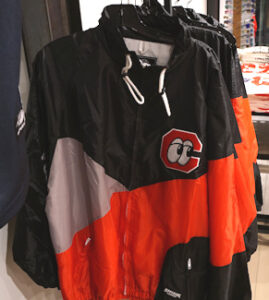
Merch that jumped out at me in the men’s area: various Columbia golf shirts, ranging from $58 to $88; Peter Millar’s polos at $150 and $155, and a quarter-zip jacket for $185; and a really cool “chute” jacket by Official League that’s $100 (see photo below).
There is an amazing selection of caps, with adjustable versions ranging from $31 to $42. Fitted caps by ’47 meanwhile are $39.
Ladies’ Go Teez t-shirts are $28 and $46, while a ’47 adjustable cap is $30.
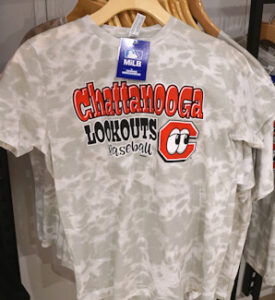
Youth t-shirts range from $19 to $30, including the one pictured by Live and Tell is $24. Kids caps are $26.
  |
For kids, there’s always the mascot Looie, while a large playground is in the left-field corner.
Truly, Erlanger Park is the home of affordable family fun.
Summary
In a recent article in Sports Business Journal, S9’s Razook was quoted as saying the following: “We should design something that could only be at this location at this time, and couldn’t be transported to another city.”
I asked him to expand on that as it relates to Erlanger Park. “For instance, we’re working around a ball field in Louisville, Kentucky, and it has some adaptive reuse to it, but that adaptive reuse was a train shed. These were industrial buildings at Chattanooga. So it’s really just saying that what’s designed for Chattanooga could only make sense if it’s in that location. It couldn’t be transported to Louisville and be a good design. It’s site-specific based on the history, the city, the location of the ball field within the city, all sorts of other factors.”
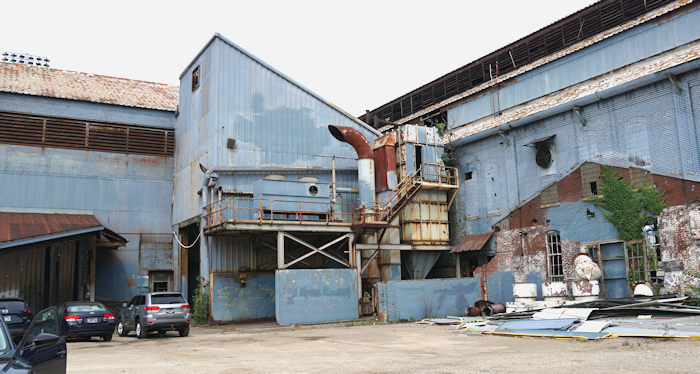
And to give you an idea of the TLC put into honoring the old buildings on the U.S. Pipe and Wheland Foundry site, no new bricks were made for the masonry on the new construction. Only bricks reclaimed from the old buildings being demolished were utilized. This is as authentic as it gets.
New City’s Irwin really enjoyed having the chance to work in and around the old buildings in the Foundries District. “It’s just fun to think about and dream about how to show off (the structures), how to find their story, find that kind of beating heart of what makes a unique building special, and show that off and really highlight that use. Every single building is unique by definition, which is the whole point of saving buildings.”
Freier was duly impressed by the collaborative effort between New City and S9. “They could see things with historic buildings that I couldn’t see.”
Here’s what I see: rising from the ruins of the abandoned buildings in a long-forgotten industrial site is arguably the best of the 30 ballparks at the Double-A level. Mayor Kelly was correct: this is indeed extraordinary.
THE FOLLOWING PHOTOS ABOVE WERE PROVIDED BY THE LOOKOUTS: the drone shot and the movable wall in The Design section; the drone shot in the Summary section.
Provide a comment below with your thoughts about Erlanger Park or this review.
I haven’t been there yet, but I absolutely love this ballpark and can’t wait to visit! For me, a new park is not just about the the shiny newness and impressive modern amenities — it’s about the atmosphere and “feel” when you walk into it. Melding the old structures with the new in an intimate and unique way truly makes me think I would strongly feel something welcoming, powerful, and good walking through the main gate and around the park. As an operator, you are selling an “experience” that will create lasting memories and keep fans coming back for more. This ballpark looks like a home run to me!
I have been to numerous major and minor league ballparks in my lifetime. This is the best park by far. Loved everything about the experience!