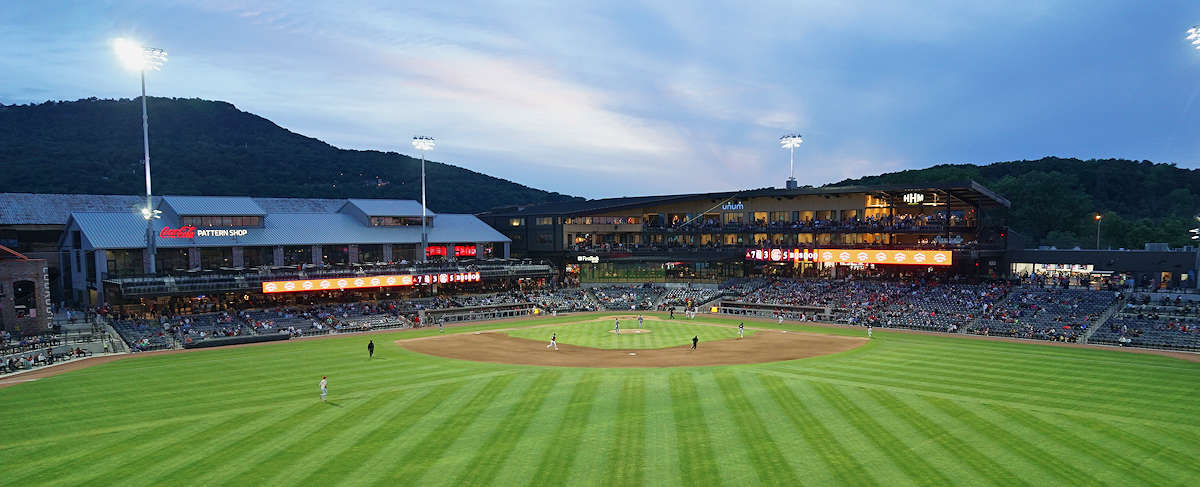
Article and photos (except as noted) by Joe Mock, BaseballParks.com
All rights reserved
Chattanooga, Tennessee On Opening Night at Erlanger Park in Chattanooga, the city’s mayor Tim Kelly addressed the assembled crowd: “What was once a shuttered industrial wasteland along the interstate is now the best minor league — if not major league — ballpark in the country, and that’s because of the people right here in Chattanooga who came together to get it done. I know this ballpark will serve as a catalyst for economic growth and vitality in the Southside because we’re all determined to make that happen. It is another reminder that we can do extraordinary things to make our city better when we all pitch in and work together as Chattanoogans.”
| Ballpark Stats |
 |
| Team: Chattanooga Lookouts of the Double-A Southern League |
| First game: April 14, 2026, a 2-1 loss to the Montgomery Biscuits |
| Capacity: 8,032, with 5,000 fixed seats |
| Dimensions: LF – 325′; CF – 400′; RF – 325′ |
| Architect: Mike Sabatini, design consultant; S9 Architecture; DH&W |
| Construction: EMJ |
| Price: $115 million |
| Home dugout: 3B side |
| Field points: East |
| Playing surface: Northbridge Bermuda overseeded with Rye |
| Naming rights: Erlanger Health System |
| Ticket info: Lookouts website |
| Betcha didn’t know: Not a single new brick was made for this park. All masonry was done using bricks from the original buildings |
Is it true that the park was constructed in the midst of an industrial wasteland? Is it really an extraordinary thing? Will it truly bring commercial development to a parcel of land that was for decades an eyesore as the first glimpse of the city that drivers see as they roll into town on I-24?
Make no mistake about it. This is a phenomenal, transformational stadium, the likes of which we’ve never seen. And the way it is integrated into an abandoned industrial site is nothing short of a miracle.
There are precedents for integrating a ballpark into existing, historic buildings. On the Major League level, San Diego’s Western Metal Supply Co. building comes to mind, as does the B&O Warehouse beyond Camden Yard’s right field. On the Minor League level, the best precedent is — come to think of it — by the same owner as the Chattanooga Lookouts: Jason Freier of Hardball Capital. This happened in Columbia, SC in 2016. (To be fair, Louisville and Montgomery also incorporated abandoned train sheds into their ballparks.)
So we can examine the project in Columbia (as well as Hardball’s project in downtown Fort Wayne) to see what is likely to be in store for the area surrounding Erlanger Park.
But first, let’s look at Chattanooga’s baseball past.
Erlanger Park is only the third new Minor League ballpark to open in Chattanooga in the past 96 years. That’s an amazing fact when you stop to consider it.
In 1929, Joe Engel bought the Lookouts franchise. He immediately set out to improve the playing conditions by doing a complete overhaul of their existing home, Andrews Field. During the offseason, he changed the orientation of the playing field to point northeast rather than Andrews’ southeast. He also rebuilt the grandstands. For good measure, Engel named the new stadium after himself. His outlay? The princely sum of $150,000.
So the 1920 Lookouts of the Southern Association played in basically the same location as before, but with completely modernized facilities and a new field orientation. Plus they were then playing in a “stadium” rather than a “field,” as was the naming custom of the time (e.g., Yankee Stadium, Cleveland Municipal Stadium). This remained the Minor League team’s home through 1999, although there was a gap of time from 1966 through 1975 when Chattanooga didn’t have a pro team.
The reason the market lost the franchise was awful attendance. In 1952, 252,703 fans passed through the turnstiles. By 1965, it had plummeted to one-tenth that number. After Chattanooga regained a team in 1976 when the Southern League Asheville Orioles relocated to Engel, it saw its best attendance ever in 1994 at 292,920. However, there’s only so much a franchise can do to promote the fact that “we have a historic ballpark.” By late in the 1990s, it was clear a new park was needed.
A decade after the Lookouts moved out of Engel Stadium, the facility was added to the National Register of Historic Places.
| From Engel to AT&T |
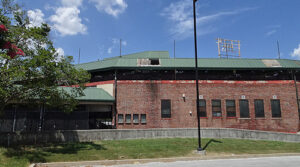 |
| Engel Stadium (above) is due to be demolished soon — note the gaping hole in its roof — but it was the home of Chattanooga baseball for seven decades. In the year 2000, it was replaced by AT&T Field (below), which has now been abandoned since Erlanger Park is open |
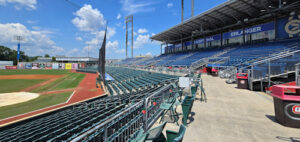 |
That move occurred in 2000, when AT&T Field (originally called BellSouth Park) opened on a tight parcel of land between downtown Chattanooga and US Highway 27. In fact, an entrance ramp for the highway is so close that there are no stands on the third-base and left-field side of the ballpark, giving the seating bowl an odd “J” shape.
Fans initially flocked to the new facility, and its first year in 2000 set its high-water mark in attendance: 290,165. It never reached that total again for the remainder of its 26 seasons, and by its lame-duck season in 2025, attendance was 191,309. It didn’t help that there were 12 rainouts that year.
It was during the run at AT&T Field that the Lookouts’ ownership changed. Freier’s Hardball Capital acquired the franchise in 2015. At that point, Freier had seen phenomenal success with the new park (Parkview Field) for his Fort Wayne TinCaps that opened in 2009, and a new stadium for his team moving to Columbia, SC was under construction.
He’s justifiably proud of the economic development that occurred in Fort Wayne because of the new stadium. “During the decade before we built the ballpark, there wasn’t $5 million invested in downtown Fort Wayne,” he explained during an interview with me for this review. “Now there’s about $1.8 billion of development around our ballpark.”
As he was considering the purchase of the Lookouts, he saw a lot of similarities between the ballpark situation in Chattanooga and what he had faced in Fort Wayne. In both situations, the ballpark wasn’t all that old, “but we knew they weren’t going to stand the test of time.” He added that he’s learned that if “you build the right kind of ballpark with the right kind of plan and the right kind of partners, you get a tremendous amount of development around it, and it really changes an area … We saw that (the new park) transformed that town and completely changed the trajectory of downtown Fort Wayne.
“So we knew that worked. And then we did it in Columbia as well. There is right about a billion dollars of development there, either done or underway.
“For us, it’s very much about finding markets where we can look and say, ‘Hey, we think that if there is someplace in this market where we feel if we do a ballpark, it can really change the area.'”
He added that not only is that tremendous for a city like Chattanooga, “it is also fulfilling our needs.”
Freier also divulged that as he was contemplating buying the Lookouts, he had his eye on the 140-acre U.S. Pipe and Wheland Foundry site as a potential home. So much so that he even discussed the possibilities of a ballpark and development at the site with the Chazen family that owned the abandoned property. “So this dates back almost 12 years in terms of the thought process” of planning a ballpark at the foundry. So he entered into the purchase agreement on the team “knowing that there was a place where we thought we could make a real difference.
“And, you know, that’s what gets a ballpark built, not our needing one.”
We’ll talk about how the Foundry site became the Lookouts’ home in our Settings section (below), but first let’s talk about financing. Knowing that the arrangement in Fort Wayne was stunning, soon after taking ownership of the team in 2015, Freier convinced Chattanooga’s mayor at the time, Andy Berke, the head of Hamilton County’s government Jim Coppinger and two local business leaders to visit Indiana. There they met with Fort Wayne’s mayor, city council members and the heads of the three biggest employers in town.
| The President and the Owner |
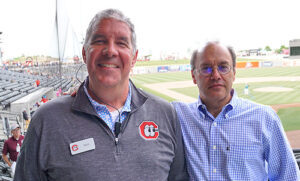 |
| When Jason Freier (right) acquired the Lookouts in 2015, Rich Mozingo (left) was already the team President and General Manager. Freier left Mozingo in his position, and the two of them expended countless hours making Erlanger Park a reality. |
Berke and Coppinger were impressed with the development spurred by Parkview Field. Freier recalled, “they said they were intrigued and wanted to see if there’s some way we can make something like that work. Obviously, who wouldn’t want that for their city, right?”
He explained that the initial funding to start construction came from $80 million in bonds by the city and the county, and a $3 million contribution from the team. Those public bonds are being repaid by sales taxes generated by the ballpark, taxes levied on the development around the park, and roughly a million dollars a year the Lookouts are paying to rent the ballpark. Another $6 million was backed by the city, but since Coppinger was no longer head of the county government, no additional funds came from Hamilton County.
Since the cost to build the ballpark was going to be $115 million, another $26 million was needed. Freier explained that the team loaned $16 million to the project, and the property owners loaned $10 million — thereby closing that gap. These two loans will be repaid only after the public bonds are covered.
Since the Chattanooga City Council and Hamilton County Commission held several public votes on the various aspects of these financial arrangements, there was never a need for any public referendums. In addition, the city’s Industrial Development Board and the county’s version of such a board approved all of this, as did the local Sports Authority.
“So while there wasn’t a public vote, it felt like we had about a million people voting,” said Freier wryly.
Before you proclaim that this is welfare for millionaires who should pay for everything themselves, and decry the fact that there was no public vote, consider that Hardball Capital has contributed millions to the project and agreed to an arrangement where the city and county get their debts satisfied first. Plus there will be millions of dollars in local taxes paid by the development that will encircle the ballpark — none of which would’ve happened had Hardball not championed this whole scenario. Honestly, I don’t see any other entity that could’ve made this happen.
And also keep in mind that it took a full ten years from the point where Hardball paid for the franchise before the new park was a reality.
In my opinion, Mayor Kelly was correct on Opening Night: this whole project is an extraordinary thing.
So let’s now set aside all of the political wrangling and check out how Erlanger Park turned out, and what it’s like to attend a Lookouts game in their stunning, groundbreaking new home.
The Setting
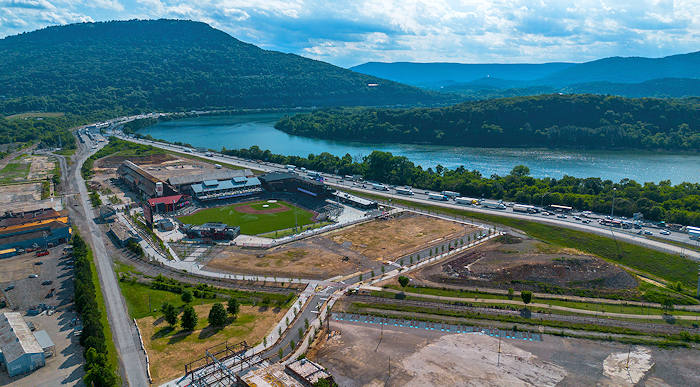
In the 1890s, Chattanooga’s entry in the Southern Association was known first as the Chats, then the Warriors. The league folded after the 1896 season, but reformed in 1901. It’s fascinating that from that season on, the team was proudly known as the Chattanooga Lookouts.
Think about that. So pervasive is the presence of Lookout Mountain on the southern edge of town that the city’s baseball team was known by the same name throughout the 20th Century and so far in the 21st.
Freier is used to rebranding his teams when they move into a new ballpark — Fort Wayne TinCaps and Columbia Fireflies being prime examples. There was no need to do that here.
An irony is that fans watching the Lookouts play during that century and a quarter couldn’t see the mountain the team was named after as they were inside the ballpark.
They sure can now. Just take a look at the photo at the top of this review and the one at the top of this section. That is none other than Lookout Mountain towering beyond the ballpark’s structures.
While not exactly at the base of the mountain, the U.S. Pipe and Wheland Foundry site is quite close, as is the Tennessee River and constantly congested Interstate 24. Could this be a more prime spot for a new baseball stadium and a sprawling mixed-use development — despite what it looked like when I visited the site in 2024 (below)?
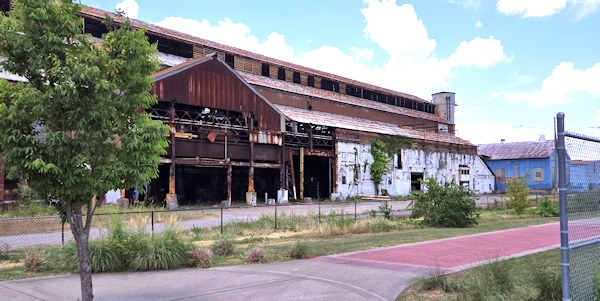
Freier likes to tell the story of how this exact location for the park and the surrounding development was approved by the city and county.
Once he had wowed the local officials with the magic his new ballparks had created in Indiana and South Carolina, Freier asked the city and county where they thought such a development should be constructed. They suggested that Hardball Capital and its development partners look around town and come back with some recommended sites, “then we’ll all think about it together,” Freier recalled.
So indeed Freier and his people scoured the city, and pinpointed five locations that could conceivably accommodate such development. They plotted the five on a big map to show to the government leaders. They couldn’t coordinate everyone’s schedules so they could have one big meeting to discuss it, so first was a session with city mayor Andy Berke on a Tuesday. “So we rolled out the map with five places. Andy looked, pointed and said THERE. And there was no discussion of any place else. Then we went to (county mayor) Jim Coppinger two days later, rolled out the map, said we have five place to show you. He pointed his hand to THERE, the same place.”
Both of the governmental leaders had instantly selected the foundry site.
“I mean, everybody knew it was a strategic site that the city needed to do something with,” said Freier. “But they both wanted it done right.”
The Chazen family had purchased the foundry site when all of the operations shut down. “They could have sold this land and just made a quick buck and been done with it. They had numerous offers,” explained Freier. “One group wanted to put an outlet mall on this site. Somebody else wanted to put a shopping center. Instead, they held onto it for 20 years because they wanted to see the right thing for Chattanooga.”
Remember that Freier had contacted the Chazens prior to buying the team, so at that point, he circled back with them and their partners at Perimeter Properties and told them the team and the governmental entities wanted to do a new ballpark and mixed-use development on their property. “I wouldn’t say they bought in completely,” said Freier. “They were a little bit intrigued, but they wondered if a baseball stadium was the right thing to anchor the development.”
A visit is worth a thousand words, so just as he done with the city and county leaders, Freier asked them to come and see such an arrangement in action. “They came and visited our ballpark in Columbia and walked around. When that was done, they said, OK, now we get the vision. Within a few months, we shook hands and had a letter of intent. We had agreed to work together to try to get this done. This was mid-2016. And now 10 years later, we’re here.
“It’s an overnight sensation,” Freier said — again, wryly.
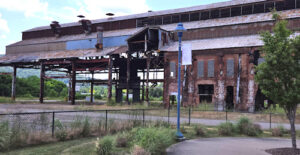 The Chazens hadn’t just been sitting idly by during the two decades. They had been going through the process of “remediation.” This is where the dirt of an industrial site — a so-called “brownfield” — is either cleaned or removed. This was an enormous help as construction on the ballpark started, because a lot of time and money was saved because most of the remediation had already been completed.
One reason the city and county looked favorably on the project was because of the developer that Freier and Perimeter Properties brought to the table. Jim Irwin, president of New City Properties, had worked with Freier on Fort Wayne. In the years since, he has earned a national reputation for his firm’s “adaptive re-use” of old, often historic, buildings that have been left abandoned.
For this review, Irwin told me, “Whenever it’s possible not to tear down old structures, I’ve learned to fight as hard as I can to keep things that have permanence. It’s not even necessarily about putting the identical use back in place. It’s really about connecting people that move through buildings with this idea that this building has been there longer than I have, and it will be here longer than I will be.
“At its most human level, it’s why people come to cities.”
When told that New City was willing to develop the foundry site, the city and county leaders replied that if building a ballpark can bring a developer of this caliber to Chattanooga, then we’ve got to do this, according to Freier.
For his part, Irwin was thrilled with the opportunity. “What a gift it is to be able to do this in the context of a ballpark, which is really our modern-day cathedral.”
So what exactly was in this site, with its unparalleled visibility along I-24? The site was actually home to two companies that relied on each other, and when one ceased operations, it wasn’t long until the the other threw in the towel as well. That left quite an odd assortment of massive industrial structures and smaller sheds. Making things more interesting is the fact that railroad tracks run through the site, as does the Tennessee Riverwalk. This is a 16-mile-long paved trail that stretches from the historic St. Elmo neighborhood just south of the foundry all the way through downtown Chattanooga around to the Chickamauga Dam. Its path roughly follows the south bank of the Tennessee River.
This site is just south of a major interchange on I-24, in which US 27 splits off to the north through downtown. This stretch of highway is hopelessly crowded, and if you find yourself at the interchange, you need to understand that you missed your chance to exit to the ballpark. My advice is to use Waze.
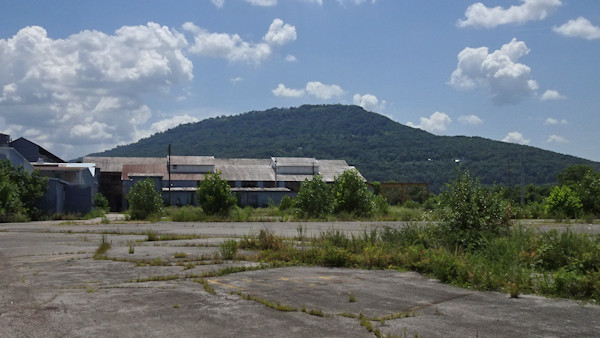
For now, the northern-most part of the foundry site is used for parking (I took the photo above from roughly that spot in 2024). That is at the very bottom of the drone shot at the top of this section. The light colored dirt lots just above that are slated to hold apartments and an office building.
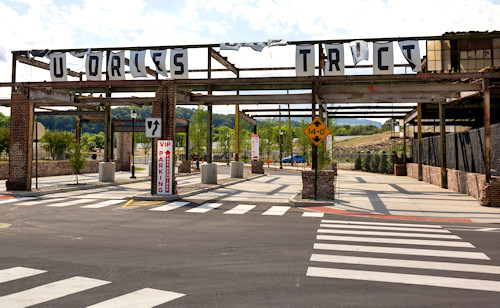 The main north-south street through this part of town is Broad Street. If you don’t park in one of the two public lots, you’ll approach the ballpark by turning off of Broad onto West 26th Street. As you cross Chestnut Street, you’ll be driving through an exposed portion of the old Valve and Hydrant Building. What a tremendous way to enter the area adjacent to the ballpark (see photo)!
Two massive buildings were retained — one completely incorporated into the ballpark (the Pattern Shop) and a tremendously long, skinny building referred to as The Shed. A small portion of the latter holds some critically important components of the ballpark (more on that later), while the vast majority is being preserved for future development. As Irwin told me, “we are in the dreaming, ideation phase for the shed building.” By my rough estimate, they have over two million cubic feet of space under the aging roof of the structure, so there is a lot they can do there. “Certainly, what we end up doing there, we will work very hard to preserve that feeling when you walk in there and just go ‘Oh my gosh, there is nothing like this left.'”
The ballpark is the first phase of this site’s development. It needed to be completed first to anchor or activate the rest of the development. I can’t wait to return year after year to see how the development is coming along. Oh, and to watch baseball at one of America’s foremost Minor League palaces.
The Exterior
One thing is universal as I’ve worked on in-depth reviews of over 100 ballparks. The architect always wants to be featured prominently in the review so they can receive credit for the park they designed. Fair enough.
Only once could I not find out the architecture firm on a new park. (I think both the owner and the architect himself/herself didn’t want the firm’s name attached to the finished project. Whatever!)
As my visit to Erlanger Park was approaching, I kept pestering Freier to put me in touch with the architecture firm behind the design. It struck me as a little odd that he seemed reluctant to do so.
Then I visited the park and I understood why. In a nutshell, Freier didn’t want to hire one of the big international firms to tell him how his ballpark should be designed. After doing a spectacular job with Fort Wayne and Columbia (both of which were designed expertly by Populous), he knew what he wanted. “We didn’t want competing visions. We wanted our vision.”
So Freier created what he calls “a three-headed monster.” He asked Mike Sabatini, who had been the lead designer of Columbia’s park when he was with Populous, to come out of retirement and provide his “ballpark expertise.”
| The Designers |
 |
| Mike Sabatini was kind enough to provide this shot of himself on the left, with two gentlemen from DH&W — Tripp Mullins and Ray Boaz. This was taken on Opening Day at Erlanger Park. |
S9 Architecture had worked closely with New City on “adaptive re-use” in projects in Atlanta and Nashville, so they were brought into the design team. Said Freier, “They really figured out how to maximize these historic buildings.”
Third was a firm in Chattanooga called DH&W Architecture. “They’re the ones who took the vision and turned it into reality. They not only drew the things up, but showed up at every weekly meeting and checked everything to make sure it was being done correctly.”
So there was no Populous. No HKS. No HOK. No Pendulum. Freier and New City had created a team of specialists who worked together to carry out the team’s vision.
“And we were also lucky enough to have a local contractor that had some experience building ballparks. They are a very sophisticated company called EMJ.” They’d built AT&T Field in downtown Chattanooga, the 2006 BaseballParks.com Ballpark of the Year, Fluor Field in Greenville, SC, and massive AutoZone Park in Memphis.
Freier says that he learned in Fort Wayne that “there’s nothing like having local people involved. If you know this is where you’re going to bring your kids and your grandkids, there’s a different level of pride in that. So we really wanted to keep as much of this local as possible.”
As we examine the ballpark’s exterior, you have to keep in mind that there is a fascinating mixture of very old structures and brand-new construction. And it all works extremely well together. You also have to employ your imagination to see how the deteriorating industrial structures will be “re-used” in the future.
So let’s look around the perimeter of Erlanger Park.
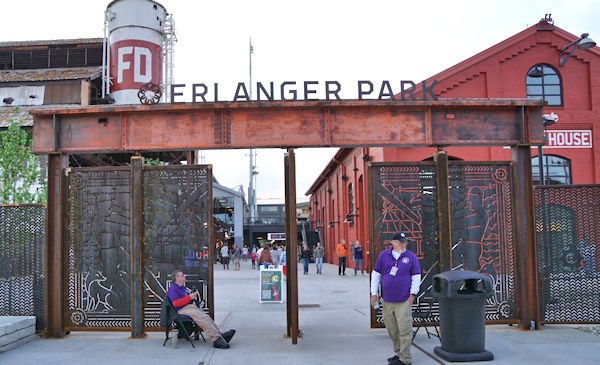
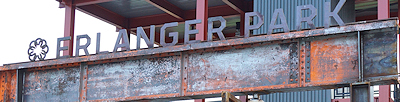
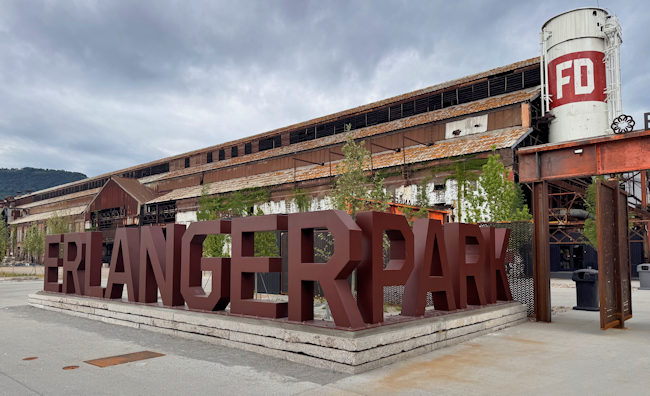
The main entry gate (above) is the one closest to the right-field corner of the playing field. This is quite intentional, and you’ll see why as we venture inside the park’s design in the next section. This is where you’ll find ticket windows and the mammoth name of the park in the photo at the top of this section.
As we move counterclockwise around the outfield, you’ll notice that there aren’t actual structures acting as the exterior. There is a perimeter fence that separates the 360-degree concourse inside the ballpark from the walkway — which is actually part of the Tennessee Riverwalk — on the outside. You’ll walk in the shadow of the backside of the huge video board. Unlike in Wilson, the back shows the name of the park in huge letters.
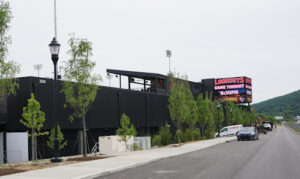 This walkway brings you to the other public entryway beyond center field. Near this point, the Tennessee Riverwalk branches off to the right to head north toward downtown. To the left, there continues to be a sidewalk that runs behind where apartments will soon be constructed. Once the apartment complex is finished, I’m told its balconies will literally hang over the outfield concourse.
As you reach a point near the left-field foul pole, you’ll note that you are just a few feet from from the northbound lanes of I-24, and beyond that, the river. There is a street (see photo) that runs between the exterior of the park — here there are structures, not just a perimeter fence — and the interstate. This street, by the way, is called Pipe Street as an homage to the industrial history of the site. This is the only way you can reach the “VIP parking lot.” While it currently dead-ends here, eventually it will continue all the way around the perimeter of the property.
This part of Erlanger Park behind third base is what thousands of cars see clearly every single day, and the Lookouts use this fact to great effect by having a huge video board that drivers can’t miss.
When you reach the part of the exterior directly behind home plate, you may be surprised that there is no entryway for fans to enter the park. While unusual (although the new parks in Wilson and Richmond have a similar arrangement), it only makes sense, since there are no fans who would be approaching the park from this direction. Just beyond this point is where you enter the VIP lot. This is only temporary, because this partly paved lot will one day be the home of more of the mixed-use development slated for the foundry site.
If you’re lucky enough to park here, you’ll see that there is a tiny entryway to enter the ballpark. You’ll also notice that you are staring at the west-facing wall of the deteriorating shed building, all 570 feet of it.
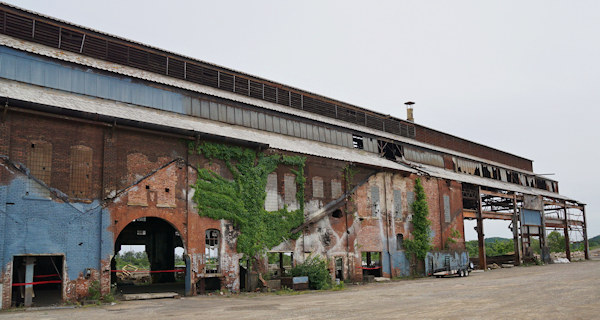
There is also a fascinating story about this VIP parking lot. This was the original site designated for the ballpark.
Sabatini recalled that a lot of effort was put into figuring out how to fit the playing field in this spot, with the long foundry building being in right field, much like the B&O Warehouse at Camden Yards. “It was a really, really tight site, especially since the site narrows down the further south you go, because of the highway and railroad and all that.”
“We tried eight ways ’til Sunday to squeeze it in, but it just wouldn’t fit,” Freier lamented.
So all the planning of the park’s design shifted to the north side of this jumble of abandoned structures. And do those structures ever make for a fascinating stadium!
Join us as we venture inside Erlanger Park.